Germany
Rosenbusch
Three friends from Munich, a hexagon they will not let go of, and two collections made in Germany with Swiss Sellita movements for €1,250.
- Founded
- 2020First watch 2023
- Range
- €1,250–1.5k
- Movement
- SellitaSW200-1 / SW210 Elaboré
- Case size
- 39.5–42 mm
- Reviews
- 1Updated automatically
On the wrist
Rosenbusch Watches reviews and guides
The brand
A hexagon, made in Munich
Rosenbusch started in Munich’s beer gardens, where three German friends, Eli, Jonas and Nick, met to talk about mechanical watches. Each had his own reason for caring: a grandfather’s old watch, a watch bought to mark the birth of a child. They began working on their first collection around 2020 with one stated aim, to make good mechanical watches accessible to as many people as possible. Eli brings a background in architecture and engineering, and you can see it in how much thought goes into the case. Jonas comes from finance and Nick from law, so this is a small team of enthusiasts rather than industry veterans.
The first watch arrived in 2023 through an Indiegogo campaign. The Quest RB200 is an integrated-bracelet sports watch in the 1970s mould, with a hexagonal bezel and caseback, a 42mm steel case about 11.7mm thick and 100m of water resistance. At launch it came with either a Seiko NH35 or a Sellita SW200-1 Elaboré. Today the Sellita version is the one Rosenbusch sells, in Deep Black, Midnight Blue, Emerald Green and Sterling Silver, behind a display caseback that shows the decorated rotor. The brass dials have a matte or sunburst finish, and the hexagon carries through from bezel to caseback so the watch reads as one idea.
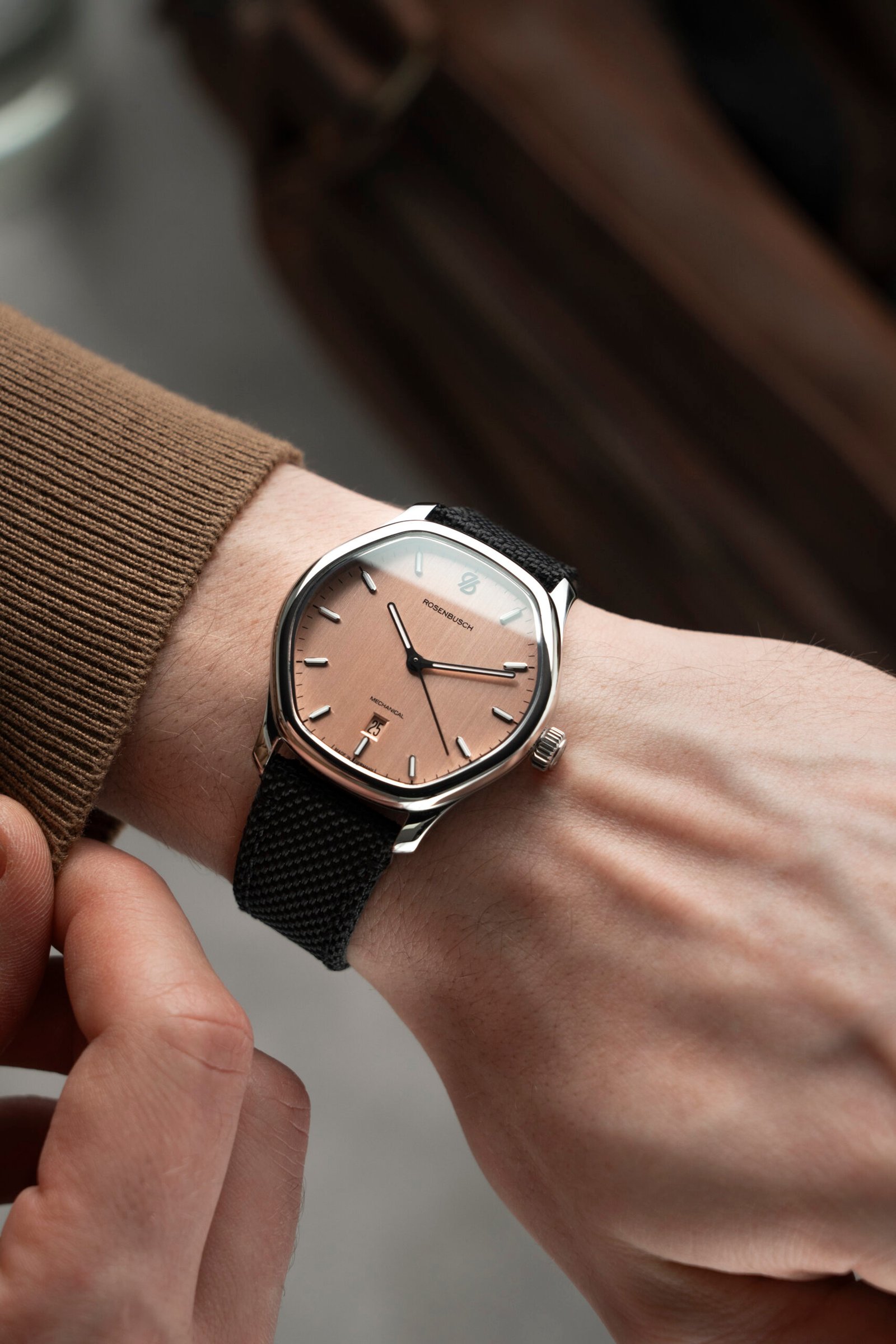
The second collection, the Horizon, is the one we reviewed after meeting the brand at Micro Praha. It takes the hexagon into dress territory. The 39.5mm case is fully polished, with a 46mm lug-to-lug and a curved sapphire crystal that makes it 8.1mm at the edge and 9.8mm at the centre. Inside is a hand-wound Sellita SW210 Elaboré with around 45 hours of power reserve, and it is still rated to 100m, which is unusual for a watch this slim. In person it was better than the photos suggested, and that does not happen often. The hexagonal hour markers are lumed, and a custom 16mm deployant clasp finishes it off.
The Horizon comes in four editions that are genuinely different rather than four colours of one idea. Black Pearl uses a Musou Black coating that absorbs almost all light. Canvas White has a linen texture, Urban Blue a graded brushed dial on a denim strap, and Copper Sun a brushed copper dial with dark grey hands. Rosenbusch says its production happens in Germany, which it presents as the way it keeps control of quality. The movements are Swiss. It is an honest split, clearly explained, and it is more than many brands at this price will tell you about where their watches come from.
Pricing is refreshingly simple. Every Horizon and every Quest RB200 costs €1,250 including VAT on the brand’s own shop, and the limited Quest RBX with a skeletonised Sellita and a numbered sapphire caseback is €1,500. That is not cheap for a young microbrand, but you get a German-made case, an Elaboré grade Sellita and a design that does not look like anyone else’s. Earlier reviewers noted small bracelet niggles on the Quest, such as no tool-free micro-adjustment, so try one if you can. The brand shows at fairs like Micro Praha, which is where we first handled both watches.
Who it’s for
You want a mechanical watch with its own shape rather than another homage, and you like the idea of a small German team that builds in Germany and fits Swiss movements. The Horizon is the one if you want a slim hand-wound dress watch that can still go swimming, and the Quest if you want an integrated sports watch.
If you like Rosenbusch
Five brands worth a look
People also ask
Rosenbusch, answered
Where are Rosenbusch watches made?
Rosenbusch is based in Munich and says its production takes place in Germany, which lets the founders keep control of quality. The movements are Swiss, from Sellita. The company trades as Rosenbusch Watches GmbH.
How much do Rosenbusch watches cost?
Every Horizon and Quest RB200 is €1,250 including VAT on the official shop. The limited Quest RBX, with a skeletonised Sellita movement and a numbered caseback, is €1,500. A mesh bracelet for the Horizon costs €80.
What movements do Rosenbusch watches use?
The Quest RB200 uses an automatic Sellita SW200-1 in Elaboré grade, running at 28,800 vph. The Horizon uses the hand-wound Sellita SW210 Elaboré with around 45 hours of power reserve. Early Quest pieces from the 2023 campaign were also offered with a Seiko NH35.
What is the difference between the Rosenbusch Quest and the Horizon?
The Quest RB200 is a 42mm integrated-bracelet sports watch with an automatic movement. The Horizon is a slimmer 39.5mm dress watch on a strap, with a curved sapphire and a hand-wound movement. Both share the hexagonal design language and 100m water resistance, and both cost €1,250.
Is Rosenbusch worth it?
For an original design with a German-made case and a Swiss Elaboré movement at €1,250, we think so. The Horizon impressed us more in person than in photos. It is a young brand, so resale and long-term service history are still unknowns.