ELKA R Series Review: Neuchâtel Written on a Dial
- Dan H.
- November 9, 2026
A Tower on the Brand’s Own Street
Every now and then a brand releases a tribute watch and you can almost hear the marketing meeting behind it. Pick a landmark, print its name on the dial, write three paragraphs about heritage, done. The ELKA R Series is not that. It is a watch about one specific tower, on one specific street in Neuchâtel, built from historical plans, a historical clock dial, and the actual stone of the building, and it manages to make every one of those references visible on the wrist rather than just in the press release.
The context matters here. ELKA traces its roots to Amsterdam in 1877, picked up its Swiss connections in the early twentieth century, and was revived in 2022 by Hakim El Kadiri, who spent years at Rado and Hamilton before taking the name back out of the drawer. Today the brand lives in Neuchâtel, and last December it opened its permanent boutique at 16 Rue des Chavannes. So when ELKA decided to name a collection after the Tour des Chavannes, it was quite literally paying tribute to the neighbourhood it works in. We last met the brand through the ELKA Arinis, a dive watch built around Lake Neuchâtel, and the R Series feels like the natural next chapter: same city, different story, much drier wrist.
There are two models in the R Series, the R02 Pierre d'Hauterive with a beige dial and the R01 1736 Edition in black and gold. Both share the same case, crystal, and movement, and both are priced at $2,059 / €1,801 (CHF 1,716, taxes not included). Before the watches, though, the tower deserves a proper introduction.
The Tower That Kept Neuchâtel’s Time
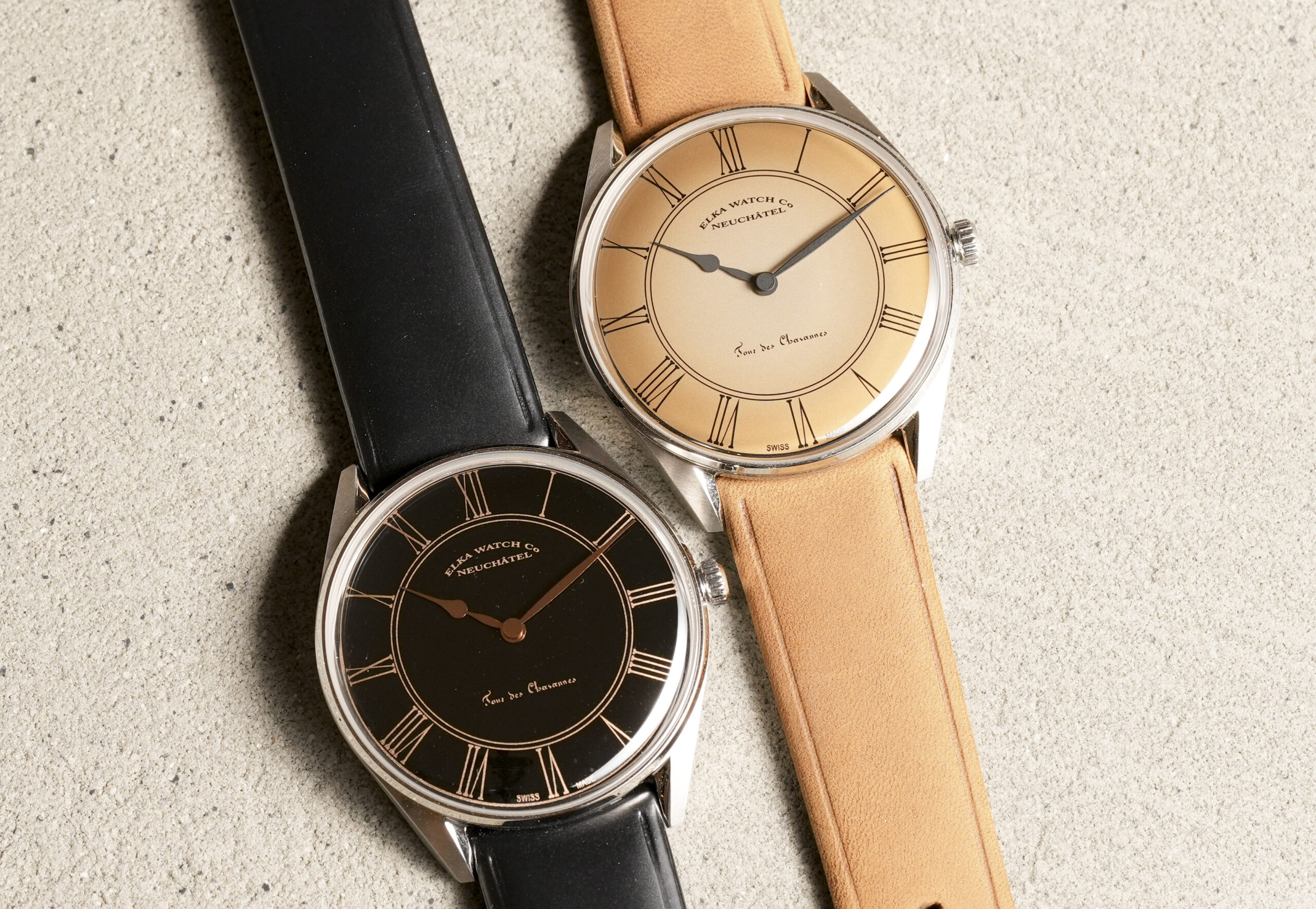
The Tour des Chavannes went up in 1285 to close off the upper end of the street that shares its name and guard the northwestern flank of Neuchâtel's medieval ramparts. From 1531 it housed the javiole, a disciplinary prison for non-criminal offences (the medieval version of being sent to your room, more or less). Over time it became something far more useful: the town's clock. A first mechanism was installed in 1679, and in 1736 the heraldist Samuel Müller painted a new dial with gold numerals on a black background.
The tower's most interesting chapter came in 1805, when the City of Neuchâtel began distributing "mean time" from it, an early and genuinely pioneering attempt to synchronise civil life around one shared time. Deemed unsanitary and out of step with a modernising city, the tower was demolished in 1867. For a watch brand based a few steps away, that is about as rich a story as you could ask for, and ELKA has turned two fragments of it into two very different dials.
Dials Drawn From Stone and Ink
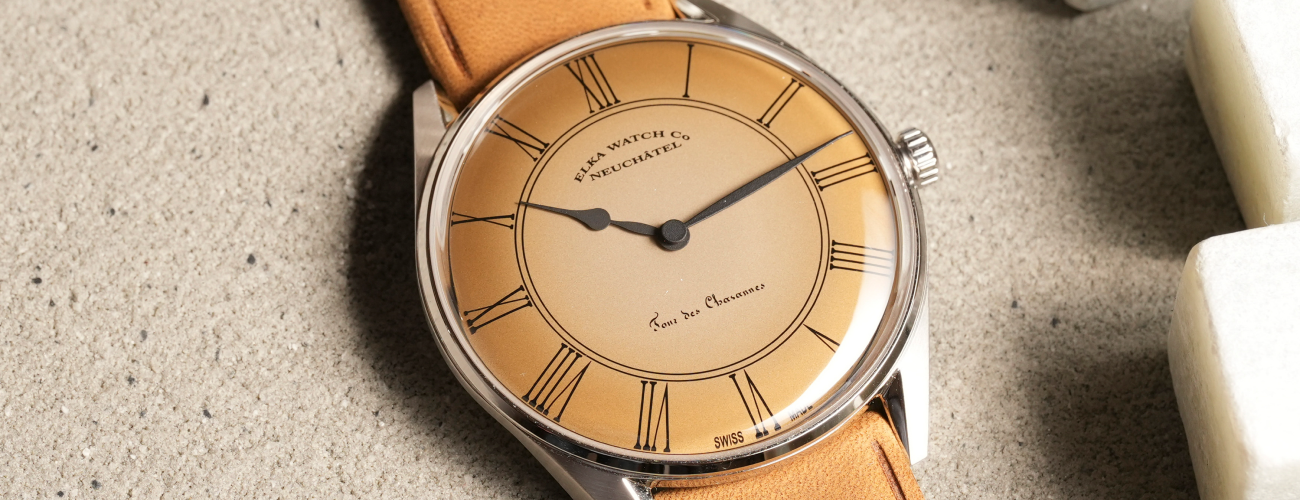
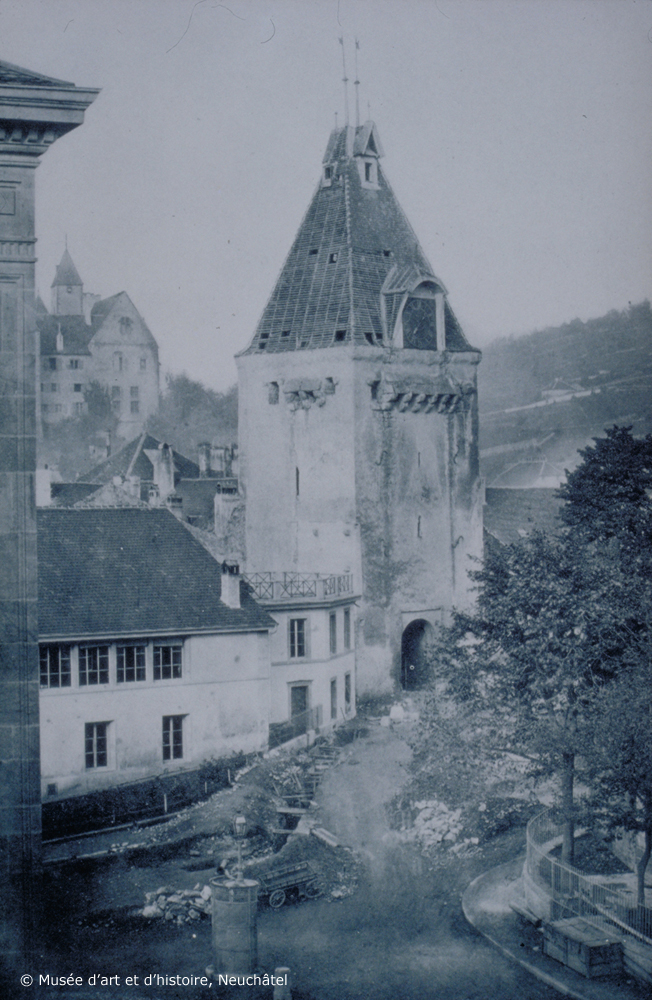
The R02 Pierre d'Hauterive takes its colour from the yellow limestone of the Hauterive quarry, a stone the Romans used to build Aventicum and that was used again in 1899 for the building next to the tower. ELKA translates it into a sand-coloured beige dial with black Roman numerals and brushed black hands. The black inscriptions recall the Chinese ink strokes used by nineteenth-century engineers on their drawings, and they give the whole dial the feel of a carefully drafted plan rather than a printed watch face.
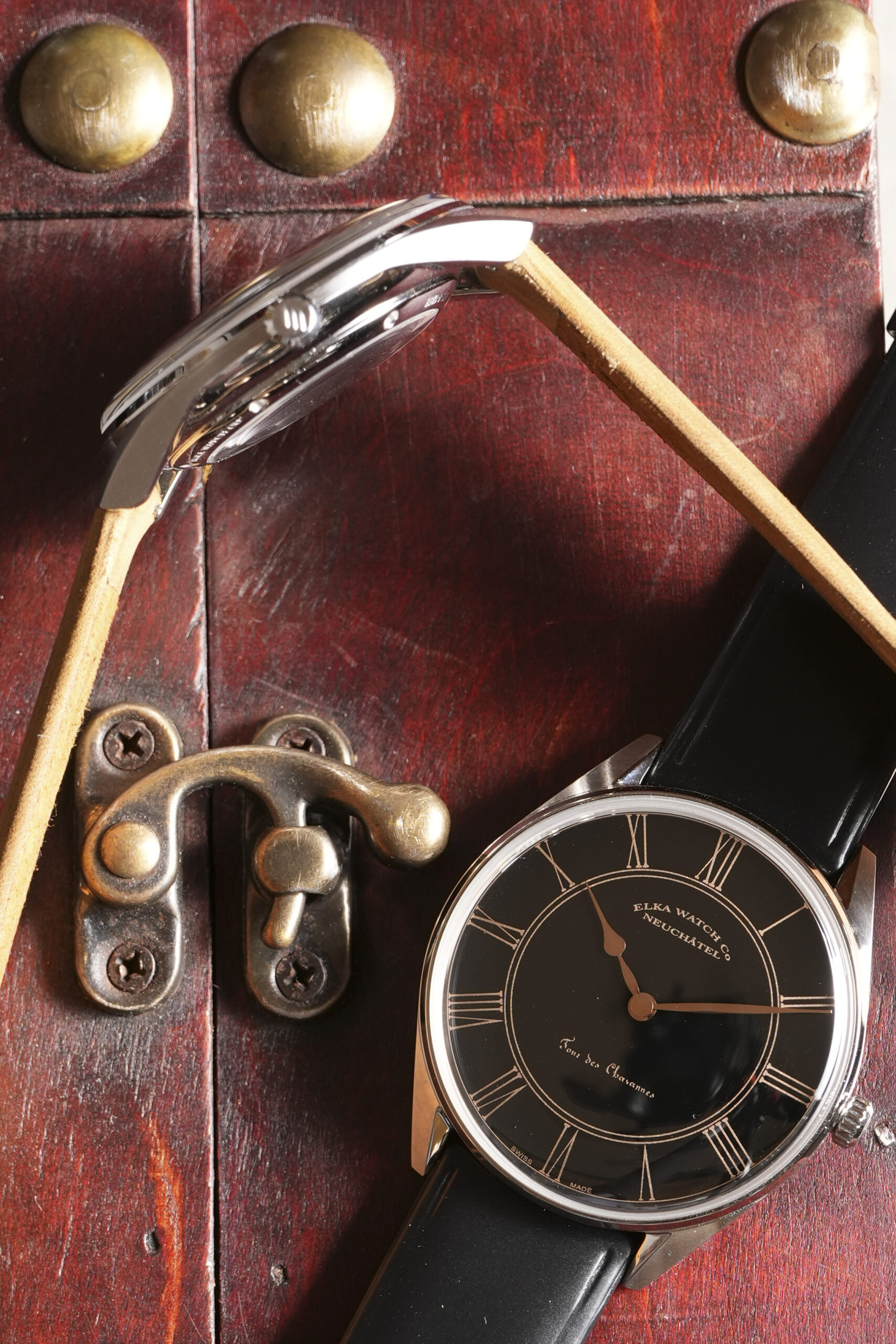
The R01 1736 Edition goes in the opposite direction. Its black dial with rose gold-coloured Roman numerals and polished rose gold-coloured hands is based directly on Müller's 1736 dial for the tower, with the same black and gold contrast. Where the beige dial reads like an architect's sheet, the black one reads like the clock that once kept time for the whole town (and yes, it is the more theatrical of the two).
The detail that ties both together sits at six o'clock: the "TOUR DES CHAVANNES" signature. It reproduces the hand-drawn lettering from engineer Henri Ladame's original plans, dated July 29 1867, the same year the tower came down. This is the part that convinced me the tribute is real. It is a small, almost hidden line of text, and it is lifted straight from a historical document rather than set in a generic vintage font. You would only do that if you actually cared about the building.
I love both, but if it were my money I would go for the beige. ELKA has form with beige dials across its other collections, and the shade always seems to land in that warm, slightly matte place that photographs well and wears even better. Under a domed crystal it gets better still, which brings us to the glass.
A Box Sapphire With Vintage Manners
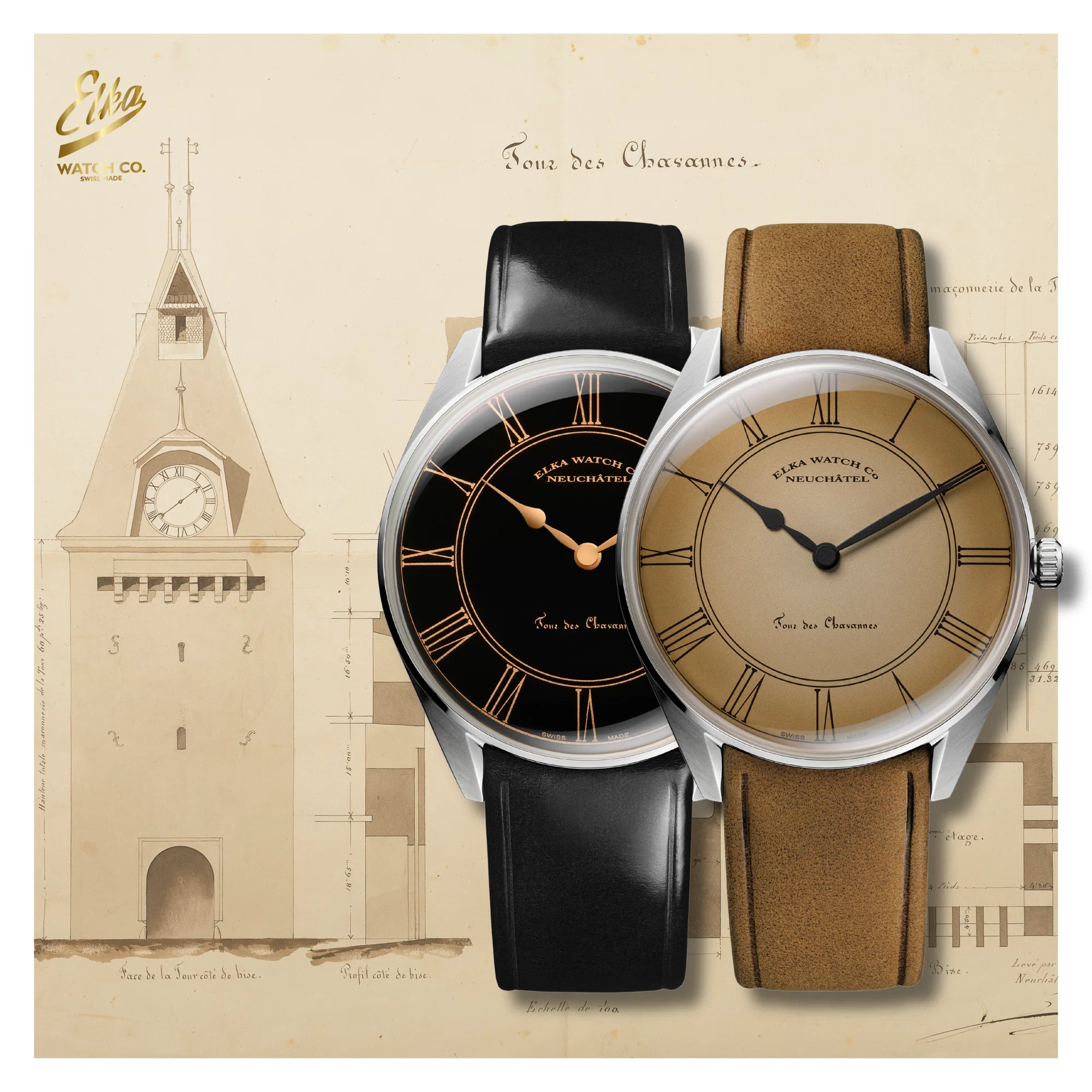
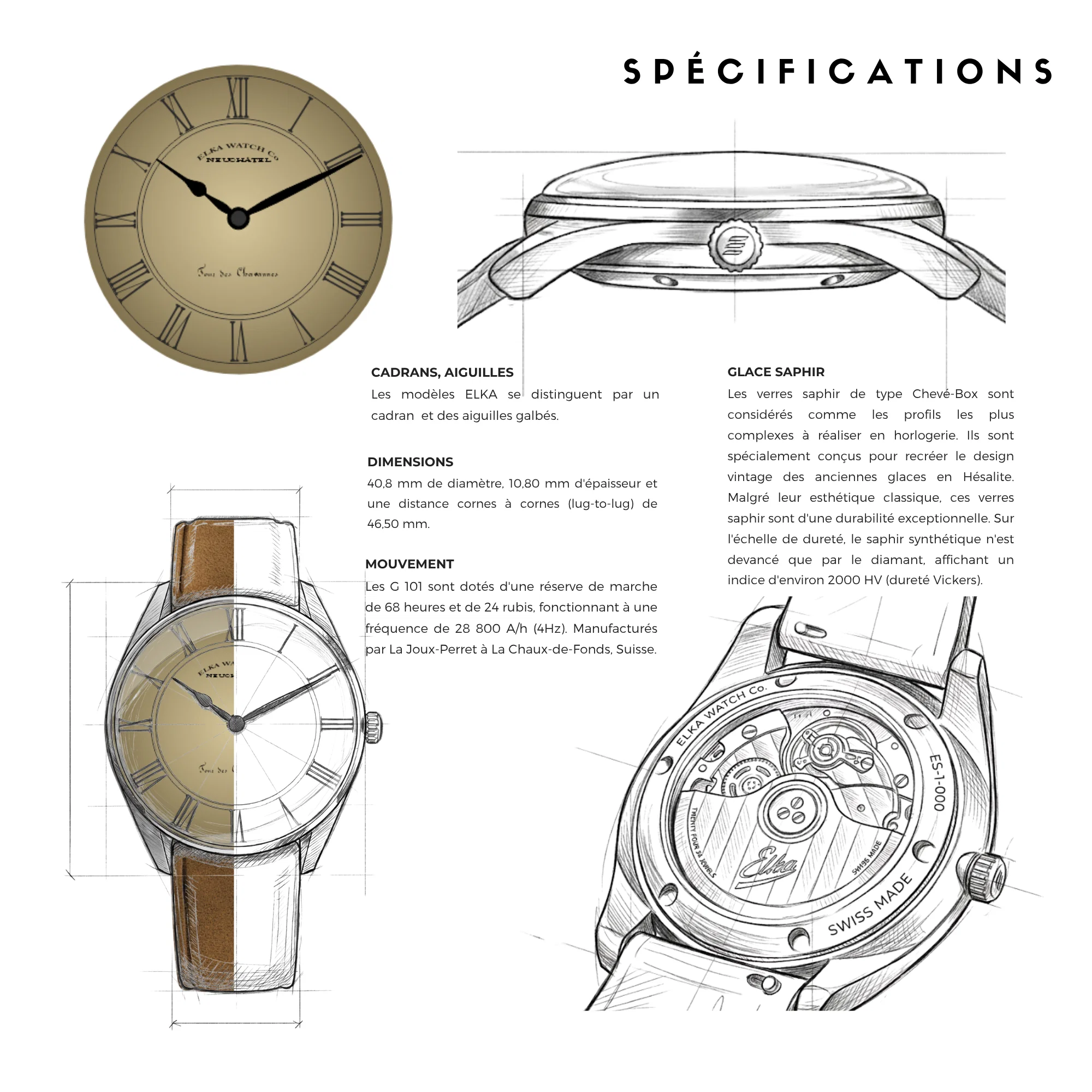
ELKA's round, domed crystals have become something of a signature, and on the R Series they use a Chevé type box sapphire with an anti-reflective treatment on one side. The shape is designed to recreate the look of the old Hésalite (acrylic) crystals found on mid-century watches, which bulged up from the case and caught the light at the edges. Here you get that same soft distortion around the dial perimeter, but with the scratch resistance of sapphire.
It sounds like a minor spec line. In the metal it is half the charm. It also pairs nicely with the curved dial and curved hands underneath, so the whole front of the watch follows one soft arc. The box shape lifts the dial visually, softens the Roman numerals at the edges, and gives the whole watch that slightly warm, slightly nostalgic look that a flat crystal simply cannot produce (one of those details that makes you tilt your wrist far more often than you need to).
The crystal sits on a case that is just as considered as the dial, so let's look at the steel.
A Slim Case of Curved Proportions
The case measures 40.8 millimetres in diameter, 10.8 millimetres thick, and 46.5 millimetres lug-to-lug, all in 1.4404 steel with elegant curved lines. That 1.4404 designation is the European grade name for what most of the industry calls 316L, the corrosion-resistant steel used by most quality watchmakers. The numbers translate into a watch that sits flat and close to the wrist, with a lug span short enough for smaller wrists despite the 40.8 millimetre diameter.
Water resistance is 50 metres, which is what you would expect from a dress-leaning piece like this. Rain, hand-washing, and the odd splash are fine. This is not the ELKA you take into the lake, and it is not pretending to be.
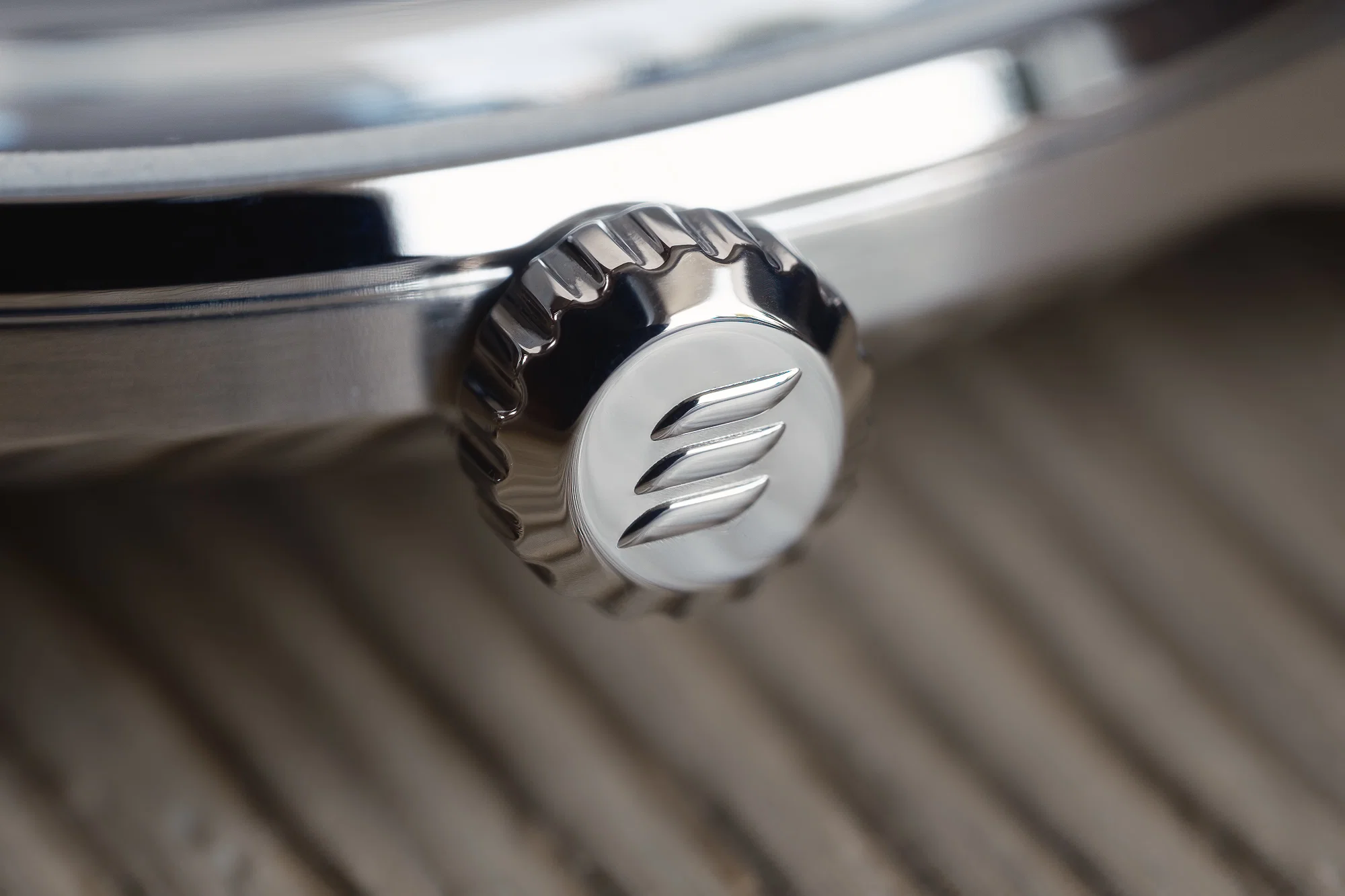
The small parts get the same attention. The crown is nicely decorated, and the pin buckle, also in 1.4404 steel, carries ELKA branding so the details hold up even when you take the watch off. The two models also wear different straps: the beige R02 comes on cognac suede with a rembordé construction, tapering from 20 to 18 millimetres, while the black R01 sits on black Veau Glacé calfskin with a semi rembordé edge and the same taper. Both pairings are spot on, the cognac warming up the sand dial and the glossy black calf matching the formality of the 1736 Edition. Turn the watch over, though, and there is more to see.
La Joux-Perret G101 Under the Hood
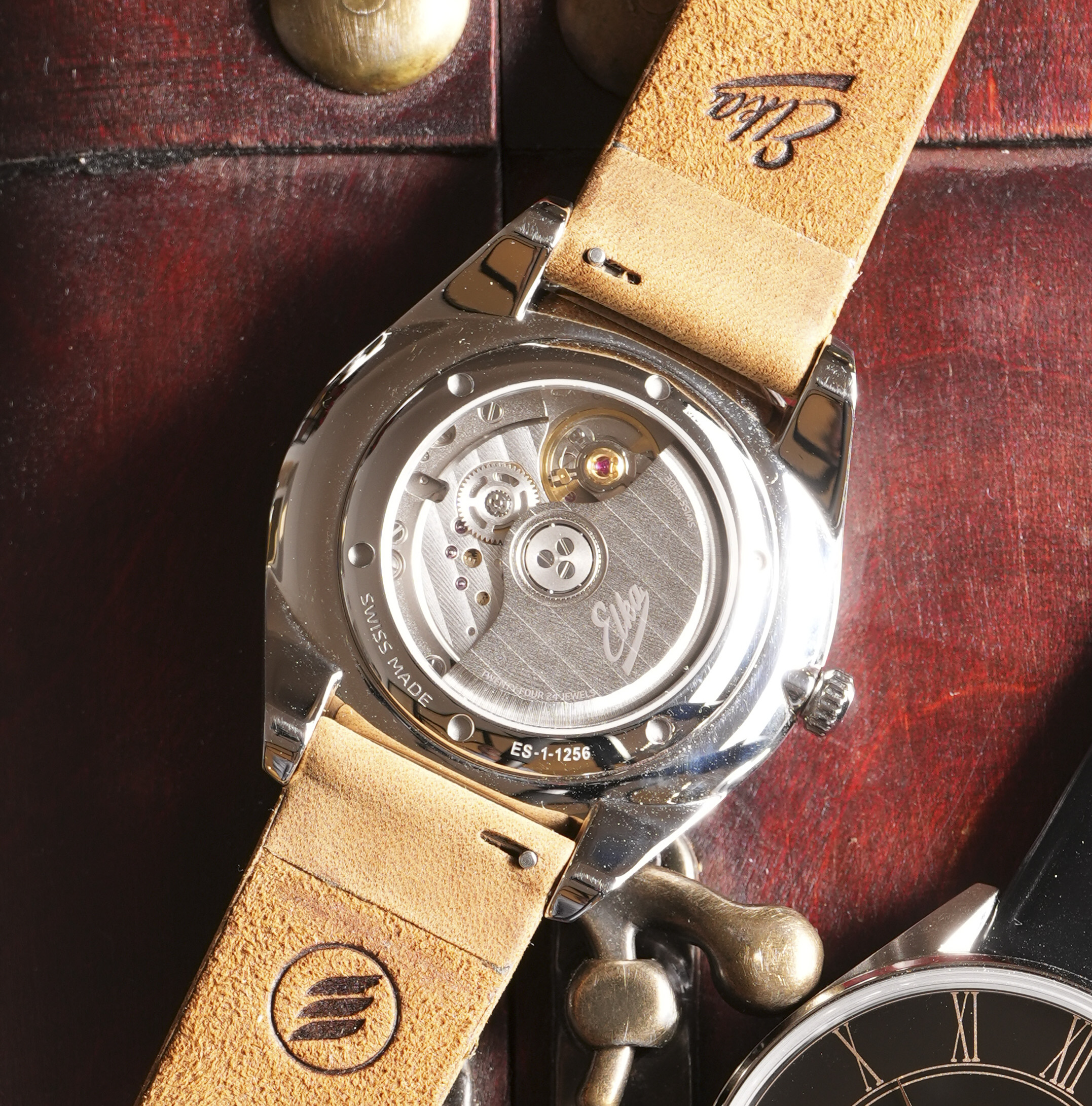
Inside both models is the La Joux-Perret G101 automatic, made just up the road in La Chaux-de-Fonds. ELKA fans will already know this calibre well, as it has become the brand's movement of choice, and for good reason. It beats at 28,800 vph (4 Hz), has a hacking seconds function for precise setting, and offers a 68-hour power reserve. Take it off on Friday evening, pick it up on Monday morning, and it is still running.
The movement is on show through a screwed caseback in 1.4404 steel with a sapphire crystal window, where the decorated rotor with ELKA branding takes centre stage. It is a satisfying view on a watch at this price and a fitting way to finish a design that is so focused on what you see. Calibre, dial, and history all point in the same direction, which is exactly what makes this release stand out.
Why It’s Special
Plenty of watches claim a connection to a city. The R Series earns it through specific, traceable references, all executed with restraint.
- A Tribute With Receipts: The dial signature reproduces Henri Ladame's lettering from 1867, the black dial follows Samuel Müller's 1736 clock, and the beige dial follows the Hauterive limestone. Each reference can be traced to a real document, artwork, or material.
- Local in the Literal Sense: ELKA's boutique is on the Rue des Chavannes, and the movement is made in La Chaux-de-Fonds. Few brands can say their tribute watch honours the street they work on.
- Box Sapphire Character: The Chevé type box sapphire recreates the vintage Hésalite look without the scratches, the kind of crystal you more often see on watches costing considerably more.
- A Serious Movement at the Price: At $2,059 / €1,801, a Swiss G101 with 68 hours of reserve, an exhibition caseback, and a 10.8 millimetre case is a strong package next to the many Sellita SW200 based vintage reissues sitting in the same bracket, most of which offer around 38 to 41 hours.
A Neuchâtel Postcard You Can Wear
The ELKA R Series is a vintage-inspired dress watch with a properly researched story, a slim 40.8 millimetre case, a domed box sapphire, and the La Joux-Perret G101 inside. It suits the collector who wants something with a sense of place, a watch that tells you exactly where it came from rather than vaguely gesturing at "Swiss heritage."
At $2,059 / €1,801 (CHF 1,716, taxes not included) for either version, the value is easy to justify. The beige Pierre d'Hauterive is the quieter, warmer daily wearer and my personal pick; the black 1736 Edition is the one for evenings and anyone who wants a bit more drama.
The only real question left is which side of the tower you are on: the stone or the clock?
Specifications
- Brand: ELKA
- Model: R Series "Tour des Chavannes", R02 Pierre d'Hauterive (beige dial) and R01 1736 Edition (black dial)
- Case Material: 1.4404 steel (316L equivalent)
- Case Dimensions: 40.8mm diameter, 10.8mm thickness, 46.5mm lug-to-lug
- Water Resistance: 50m / 5 bar
- Dial: R02 beige dial with black Roman numerals and brushed black hands; R01 black dial with rose gold-coloured Roman numerals and polished rose gold-coloured hands; no date
- Strap: R02 cognac suede, rembordé, 20/18mm; R01 black Veau Glacé calfskin, semi rembordé, 20/18mm; pin buckle in 1.4404 steel
- Crystal: Chevé type box sapphire, anti-reflective treatment on one side
- Movement: La Joux-Perret G101, Swiss automatic, 28,800 vph (4 Hz), hacking seconds
- Power Reserve: 68 hours
- Caseback: Screwed caseback in 1.4404 steel with sapphire crystal exhibition window
- Limited Edition: No, part of the regular R Series collection
- Price: $2,059 / €1,801 (CHF 1,716, taxes not included)
More information about this exact watch model on ELKA.
Image Gallery
About ELKA R Series: Key Questions Answered
What is the difference between the two ELKA R Series models?
They share the same 40.8mm case, box sapphire, and La Joux-Perret G101 automatic, so the choice comes down to the dial and strap. The R02 Pierre d’Hauterive has a beige dial with black Roman numerals and brushed black hands on a cognac suede strap, inspired by the yellow limestone of the Hauterive quarry. The R01 1736 Edition has a black dial with rose gold-coloured Roman numerals and polished rose gold-coloured hands on a black Veau Glacé leather strap, inspired by the tower’s 1736 clock dial.
What movement is inside the ELKA R Series?
Both models use the La Joux-Perret G101, a Swiss automatic calibre made in La Chaux-de-Fonds. It beats at 28,800 vph (4 Hz), has a hacking seconds function, and offers a 68-hour power reserve, which means you can leave it off the wrist over a weekend and still find it running on Monday.
How much does the ELKA R Series cost?
Each R Series model is priced at $2,059 / €1,801, or CHF 1,716, with taxes not included. Both dials sit at the same price, so you are choosing on taste rather than budget.
Top Lists
- anOrdain, Baltic, Elka, Furlan Marri, Havaan Tuvali, HEINRICH Watches, Laco, Ophion, Vario
- By Dan H.
- Astor & Banks, Baltic, Havaan Tuvali, Laco, MD Watches, STERNGLAS, Vario
- By Dan H.
- Baltic, Berneron, Dug Glashütte, Elka, Kurono Tokyo, Laco, Maen, Maurice Lacroix, Nomos Glashütte, STERNGLAS, Straum, Unimatic
- By Dan H.