United States
Nodus
A Los Angeles workshop where every movement is assembled, regulated and tested by hand. Purpose-built tool watches, sold direct, with the engineering budget spent where you actually feel it.
- Founded
- 2017Los Angeles
- Range
- $500–1,000
- Movement
- Seiko & MiyotaNH34 / NH36 / 9075
- Case size
- 39.5–40 mm
- Reviews
- 1Updated automatically
On the wrist
Nodus reviews and guides
The brand
Assembled, regulated and tested in Los Angeles
Nodus was established in 2017 in Los Angeles by Wes Kwok and Cullen Chen, two enthusiasts who wanted to build the watches they could not find. The brand describes itself as a watch research and design company rather than simply a watchmaker, and that framing turns out to be accurate once you look at what it actually spends its time on.
The part that matters is the end of the supply chain. Components are sourced globally, but every watch is assembled, regulated and tested in the Nodus workshop before it ships. Regulation is done in house to around eight to ten seconds a day depending on the model, which is tighter than the factory specification of the Japanese movements they use and considerably tighter than anything else at this price.
Then there is Nodus Extension, the research division, which is where the brand gets genuinely unusual. Its output is not new dial colours but new mechanisms: crown tube designs, bezel click systems, crystal shapes and clasp extension mechanisms. These are the parts of a watch most brands buy off the shelf and nobody writes about, and they are exactly the parts you touch every day.
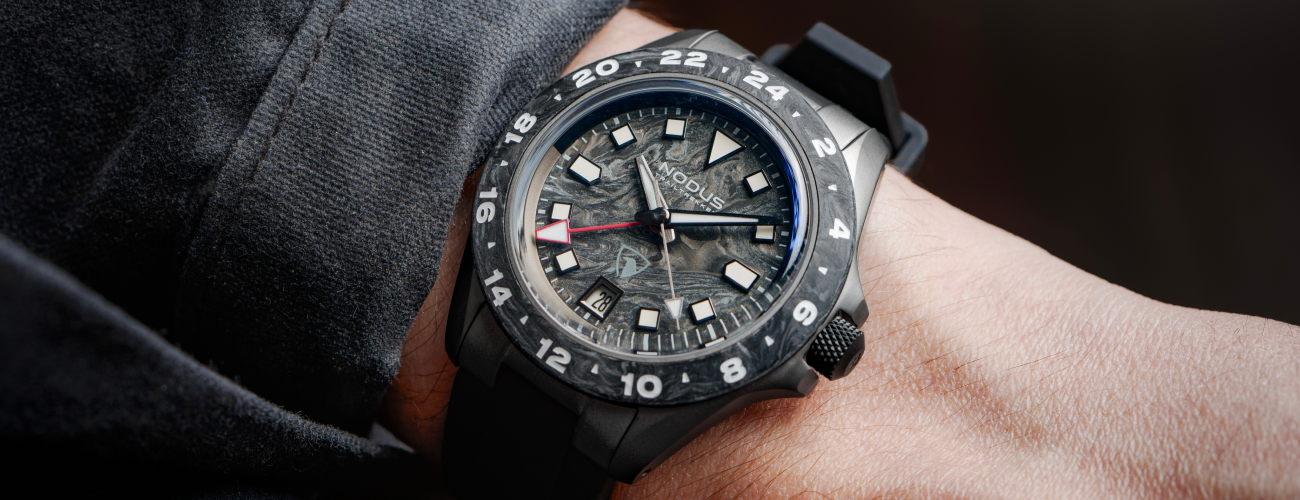
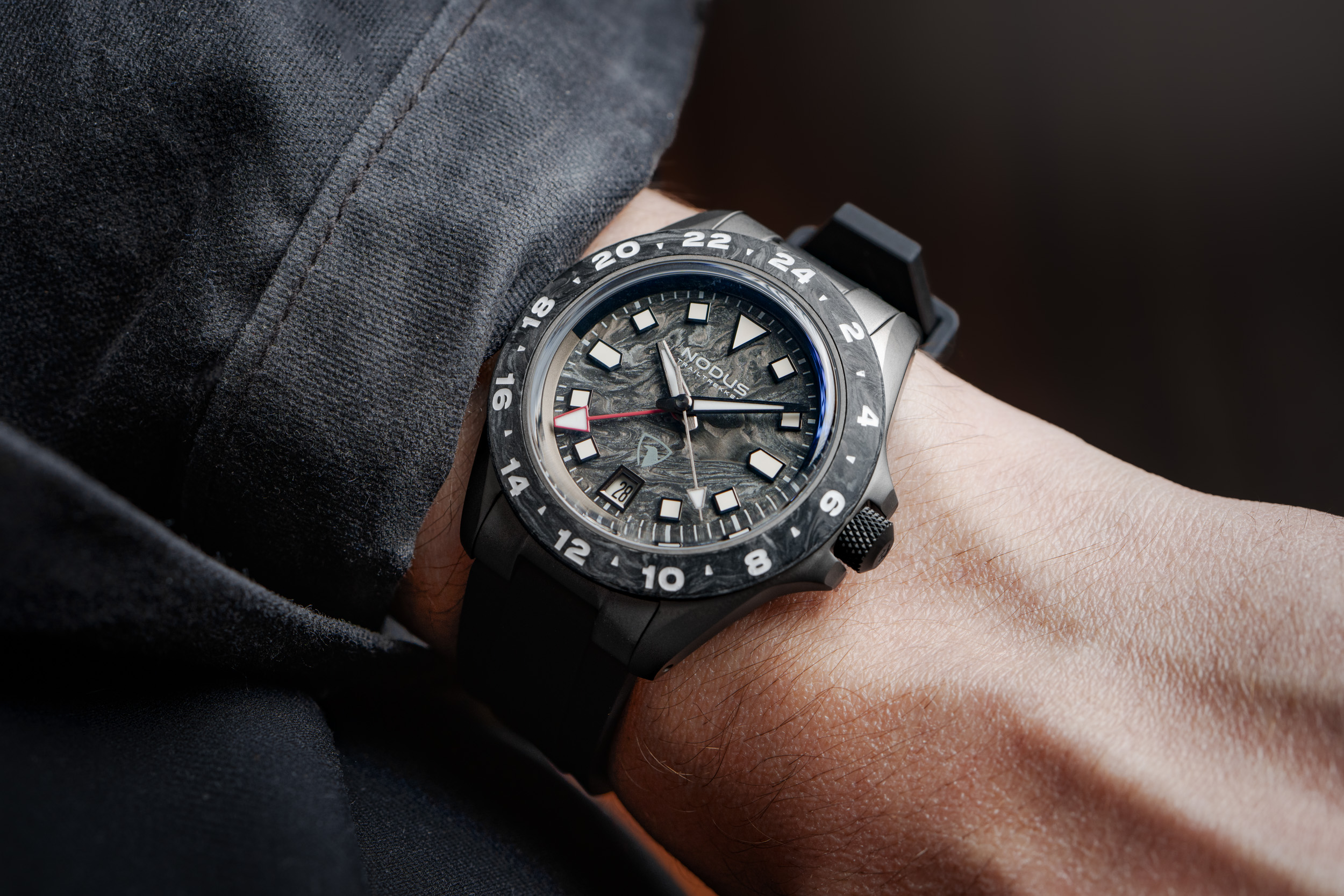
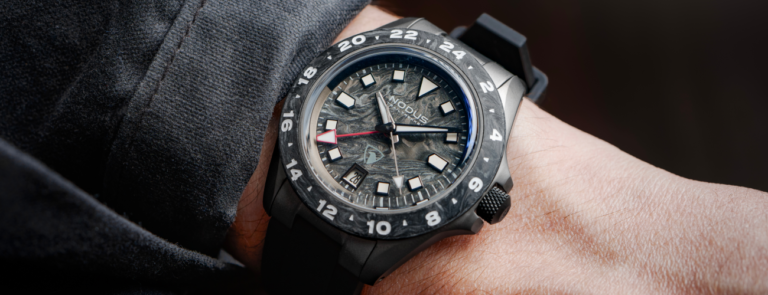
The current catalogue is built around the Sector II platform, one case architecture that spawns Pilot, GMT, Sport and Field Titanium variants, mostly around 40mm on Seiko NH34 and NH36 calibres from roughly $500. Above it sits the Deep, a 500 metre tool watch at $650. The TrailTrekker, a collaboration with Raven, is 39.5mm and 11.8mm thick with 200m water resistance, a Cerakote bezel and a Miyota 9075 flyer GMT, at $875.
Nodus also runs two things that sit outside the product line. Design Lab is a collaborative platform that lets designers, watchmakers and the community contribute to custom designs. Intersect, created in 2021, is a community watch show now run jointly with Formex and Jack Mason, with several events a year. Neither sells a watch directly, which tells you something about how the brand sees its role.
Who it’s for
You care more about how a watch feels in the hand than whose name is on the dial. Nodus spends its money on crown action, bezel clicks, clasp mechanisms and movement regulation, the things you notice on the hundredth day rather than the first. If you want a sub-$1,000 tool watch that has been through a human’s hands before it reaches yours, and you like the idea of buying from a brand that publishes its engineering rather than its heritage, this is one of the strongest arguments in the category.
If you like Nodus
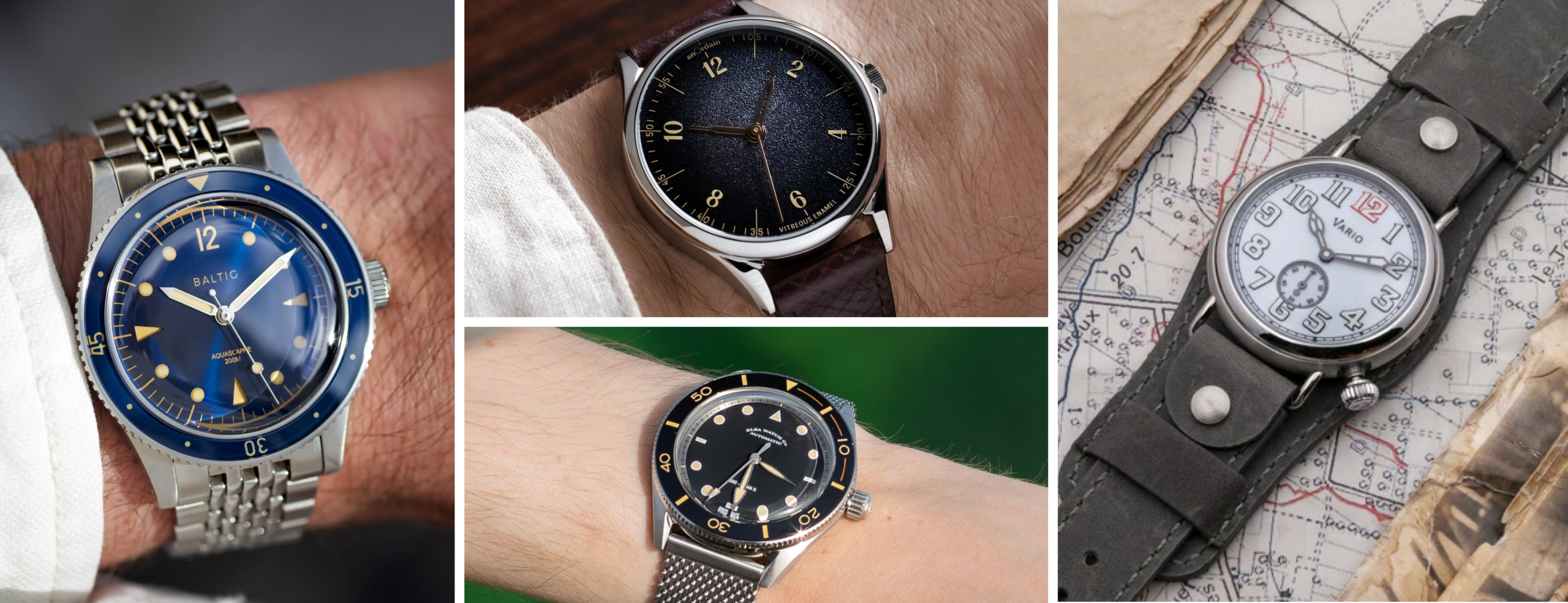
Five brands worth a look
People also ask
Nodus, answered
Where are Nodus watches made?
Components are sourced through a global supply chain, but every watch is assembled, regulated and tested by hand in the Nodus workshop in Los Angeles before it ships. The brand was founded there in 2017.
How much do Nodus watches cost?
Roughly $500 to $1,000. The Sector II Pilot starts around $500 and the Sector II Dive GMT around $575. The Deep, a 500 metre diver, is $650. The TrailTrekker collaboration with Raven is $875, and limited or collaboration pieces sit at the top of the range.
What movements do Nodus watches use?
Japanese automatics. The Sector II line uses Seiko calibres, including the NH34 GMT and the NH36. The TrailTrekker uses the Miyota 9075, a flyer-style GMT running at 28,800vph with 24 jewels and 42 hours of power reserve. Nodus regulates each movement in house rather than fitting it as supplied.
How accurate are Nodus watches?
Nodus regulates every movement in its own workshop, quoting roughly eight to ten seconds a day depending on the model. That is noticeably better than the standard factory tolerance for these Japanese calibres, and it is one of the main things you are paying for.
What is the Nodus Sector II?
It is the brand’s modular core. One case architecture underpins several variants, including the Pilot, GMT, Sport and Field Titanium, so the shared engineering can be refined over time rather than redesigned for every new release.