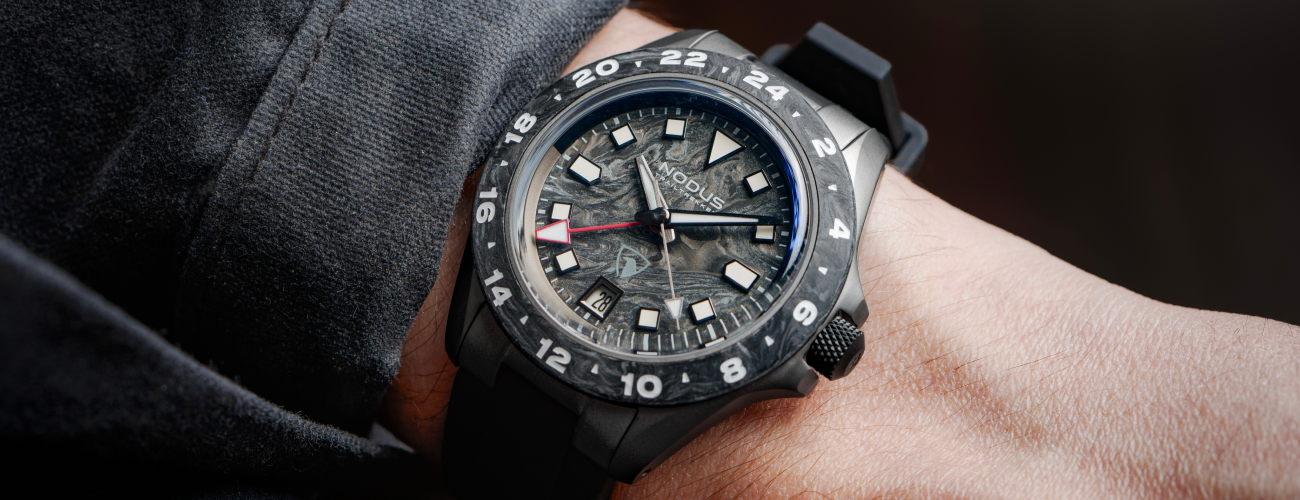
Nodus TrailTrekker Review: A GMT Collection Built for the Long Way Round
- Dan H.
- November 2, 2026
Love at First Wrist
I rarely fall for a GMT. Most of them blur together for me, a 24-hour bezel here, a fourth hand there, and a spec sheet that reads like every other spec sheet. The Nodus TrailTrekker collection is the exception, and it has been since the first time I tried one on. I got hands-on with these at Micro Praha back in 2025, and out of everything on the tables that weekend, the TrailTrekker comfortably landed in my top three watches of the show. By far, if I am being honest.
Nodus was founded in 2017 by Wes Kwok and Cullen Chen in Los Angeles, and it has spent the years since quietly becoming one of the most dependable names in the American microbrand scene. The formula is simple: sensible sizing, tough cases, sharp pricing, and everything designed and assembled in their own Los Angeles workshop. Nodus Design Lab is the brand's more experimental arm, and it is where collaborations like this one live.
The TrailTrekker is the fourth project between Nodus Design Lab and Raven Watches, the Kansas-based maker of rugged adventure watches, and it lands as a family of four GMT models: the A.C.T., the Basecamp, the Clay, and the Carbon. Pricing runs from $925 to $1,075. I will spend most of my time with the Clay and the Carbon, because those are the two that genuinely stopped me in my tracks, but the platform underneath is shared, and that is where the story starts.
Four Routes, One Platform
Every TrailTrekker uses the same new Nodus platform: a 316L stainless steel case measuring 39.5 millimetres across, 11.8 millimetres thick, and 46.6 millimetres from lug to lug, with 20 millimetre lugs, a screw-down crown, and 200 metres of water resistance. A box sapphire crystal sits on top with a blue anti-reflective coating on the underside, and a fixed 24-hour bezel frames the dial on every version. Those are proper everyday GMT proportions, and the short lug-to-lug means this will sit comfortably on far more wrists than the average 41 or 42 millimetre travel watch.
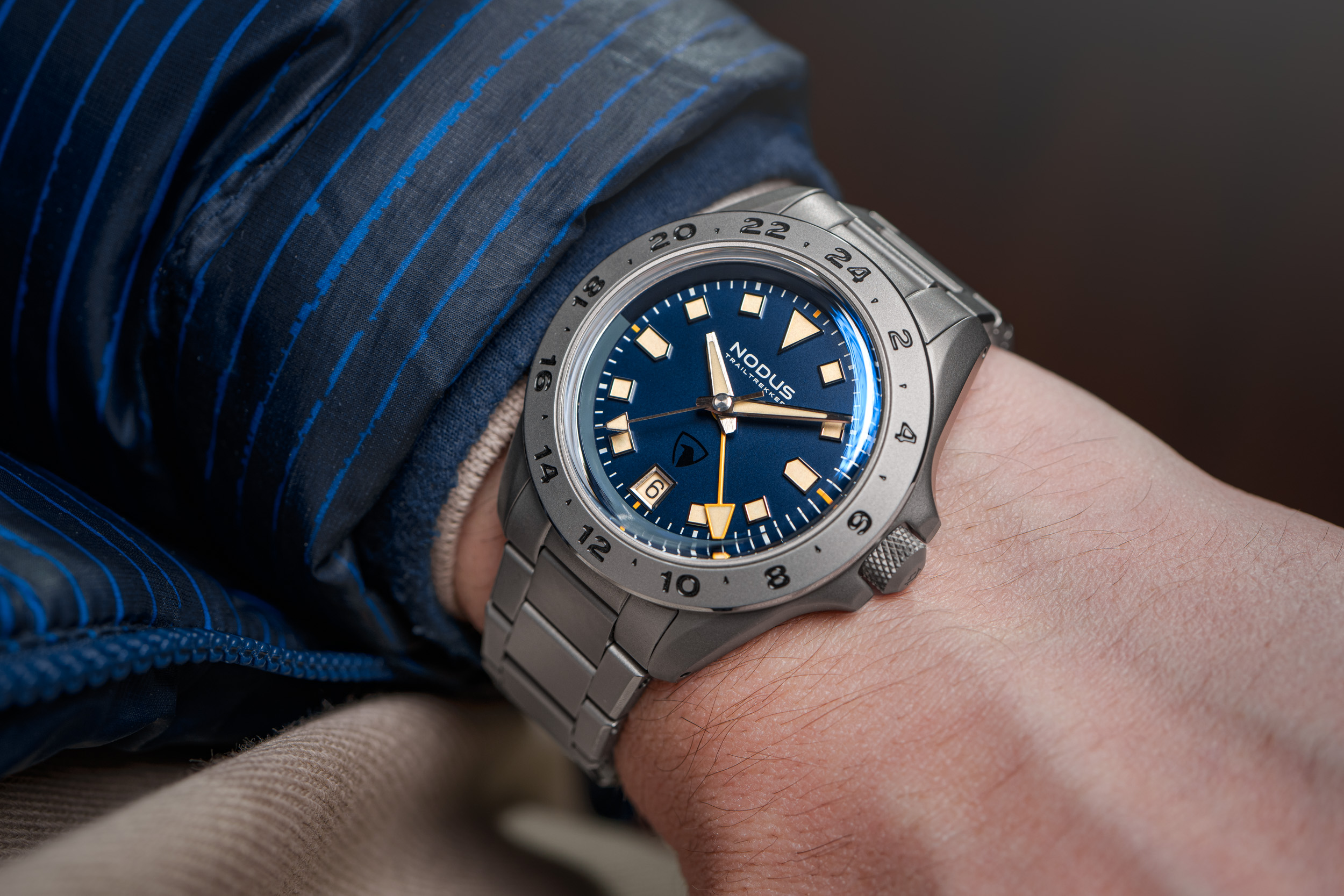
The differences are all in the dressing. The A.C.T. takes its name from the Arctic Circle Trail in Greenland and pairs a raw steel case and a matte white dial with 3D-chamfered gunmetal hands and indices and a high-polish black DLC bezel. It is the crisp, high-contrast one of the family. The Basecamp, named for the starting point of any expedition, is the back-to-basics option: a media blasted steel case, a hardened steel bezel, and Swiss Super-LumiNova Old Radium X1 lume for a warmer, vintage glow. Both come in at $925 and weigh 68 grams for the watch head alone.
Those two would already make a convincing collection. Then Nodus decided to paint the whole thing gunmetal.
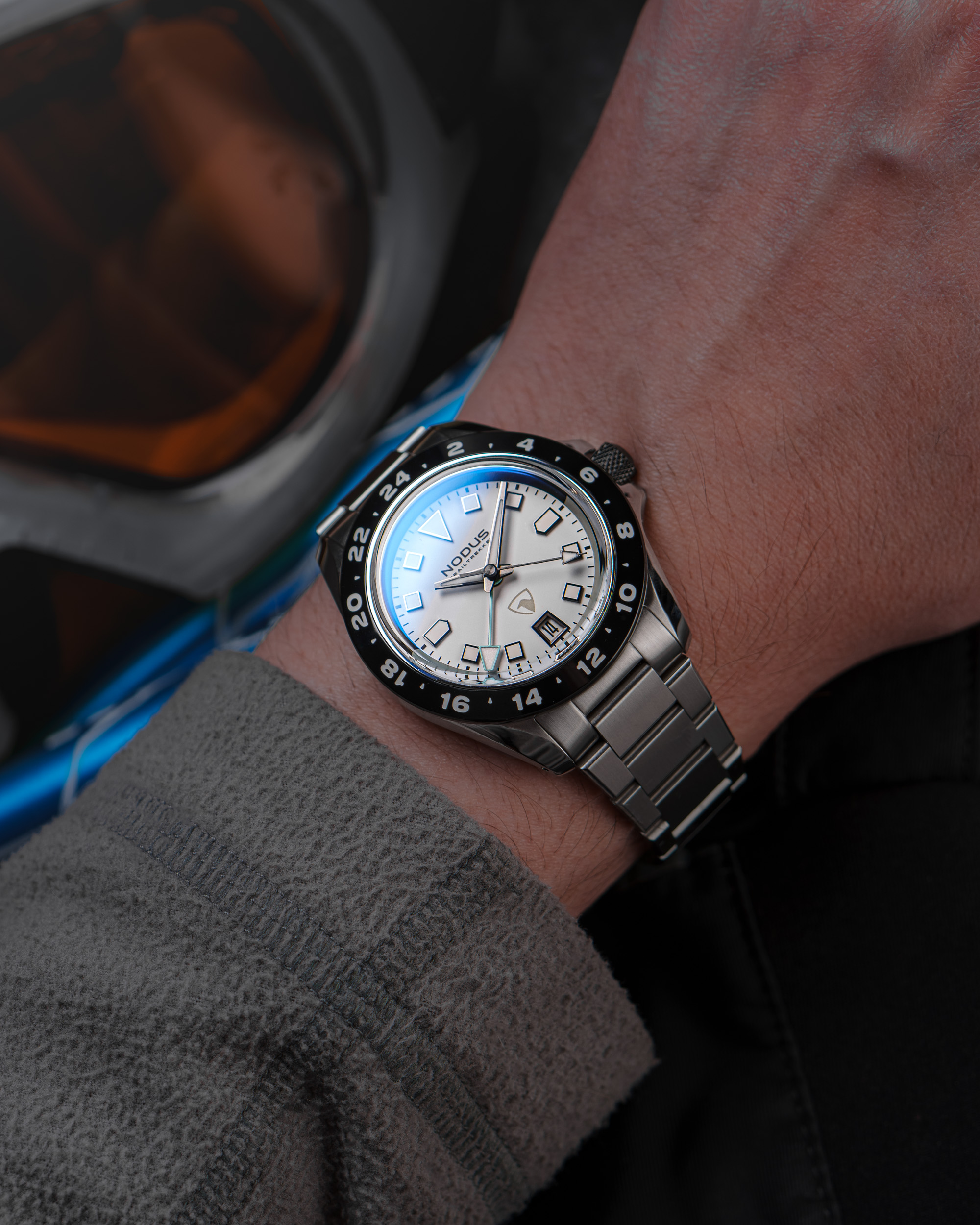
Clay and Carbon: A DLC Finish Few Brands Get Right
DLC (diamond-like carbon) coating is one of those things that looks easy on a product photo and is notoriously hard to get right in production. Plenty of brands have tried it and failed, and that includes some much bigger names than Nodus, more often than you would expect. Uneven tone between case and bracelet, a finish that looks painted rather than bonded, edges that wear through within months; I have seen all of it on watches costing several times more than this.
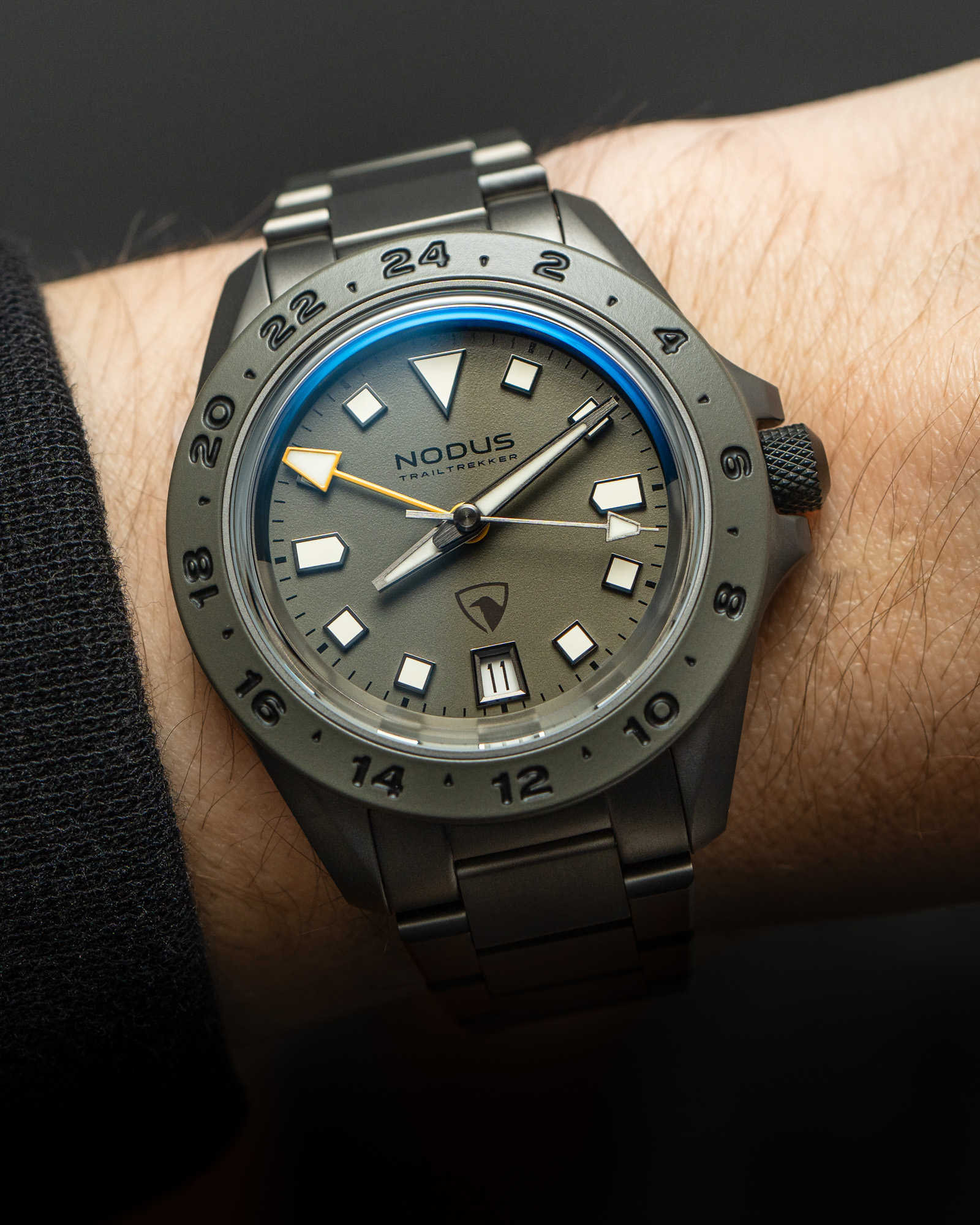
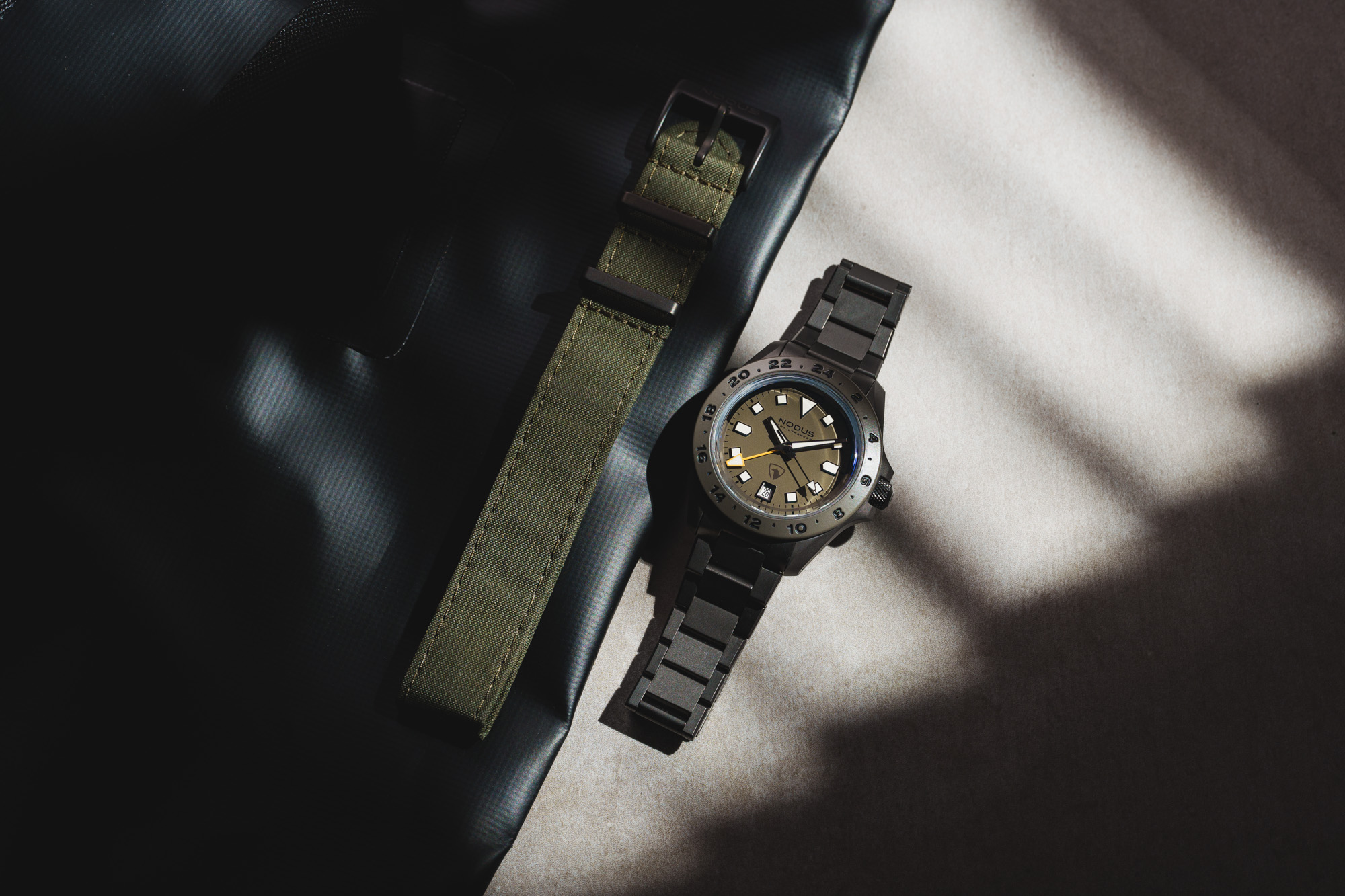
The Clay is covered entirely in gunmetal gray DLC, case, bracelet, and all, and in the metal the quality is honestly out of this world for a brand of this size. The tone is consistent across every surface, the matte texture is even, and it feels genuinely bonded to the steel rather than sitting on top of it. The bezel and dial are protected with Cerakote, a ceramic-based coating better known from firearms and outdoor gear, which gives them a dense, slightly earthy surface that suits the expedition theme perfectly. Gunmetal 3D-chamfered hands and indices keep the whole thing tonal without going flat, and Swiss Super-LumiNova BGW9, which Nodus extends even to the date wheel, takes over after dark. At $975 it is, for me, the most wearable of the four.
The Carbon shares the gray DLC case and bracelet, but swaps the dial and bezel for something far more dramatic.
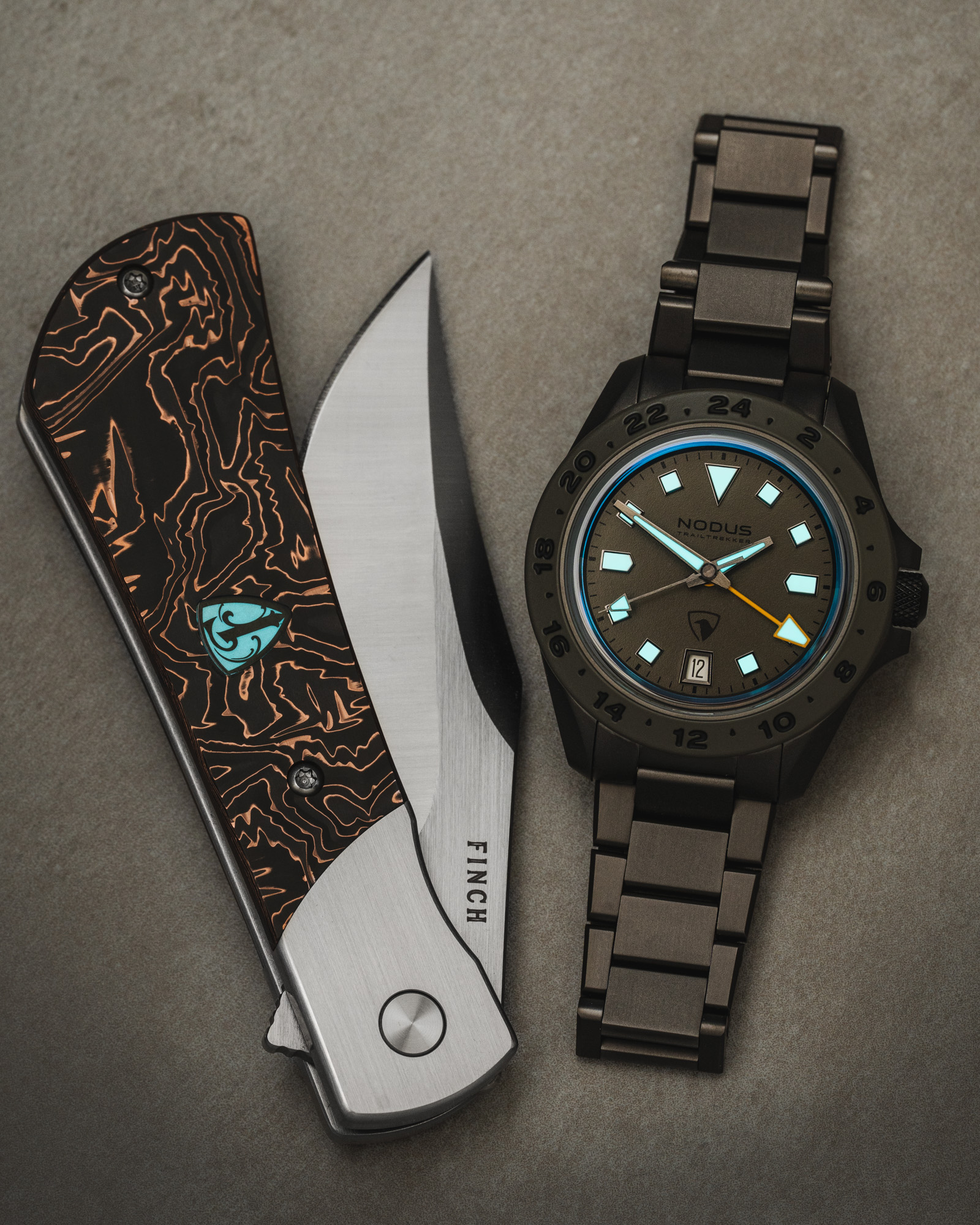
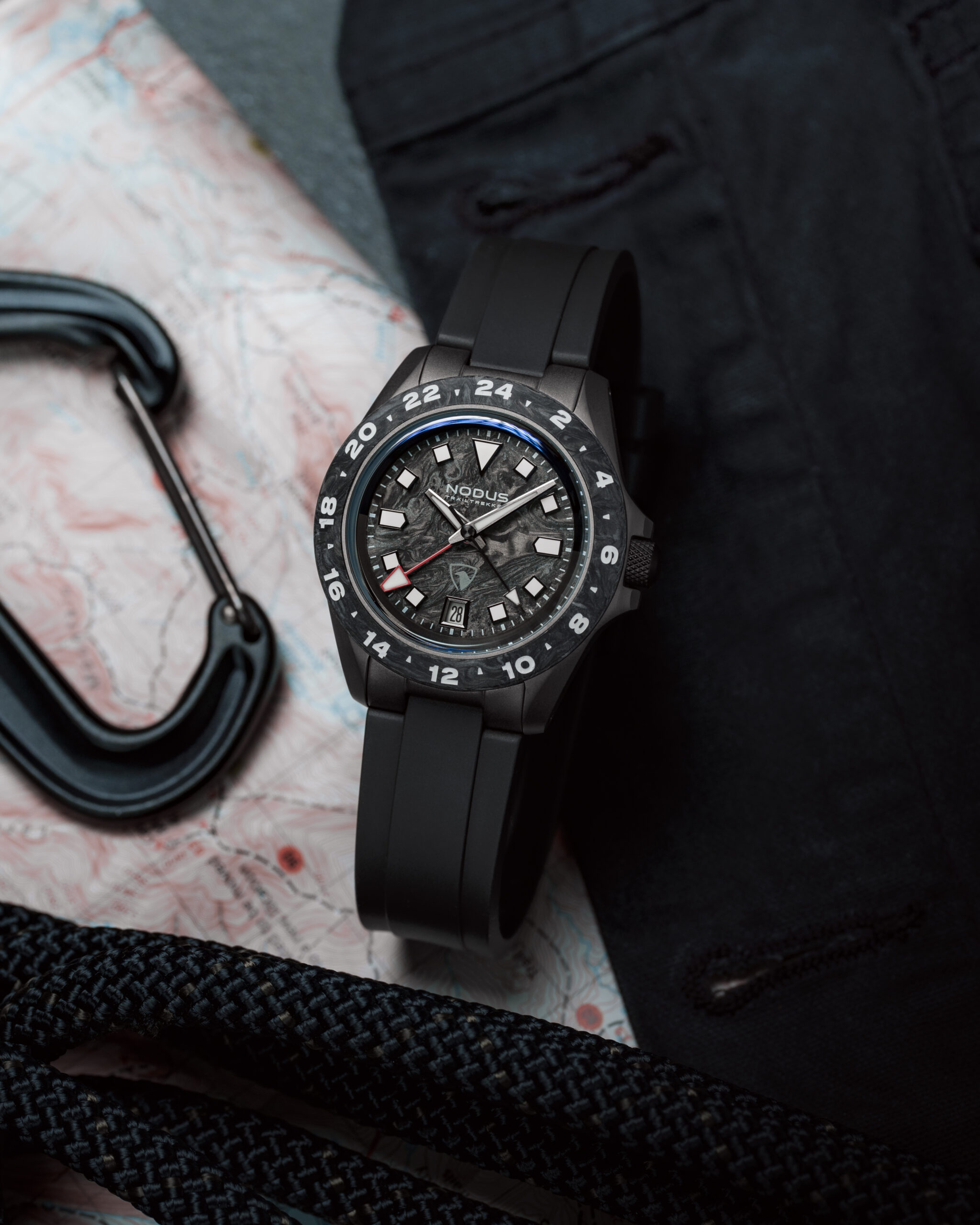
Forged Carbon and a Lume Show to Match
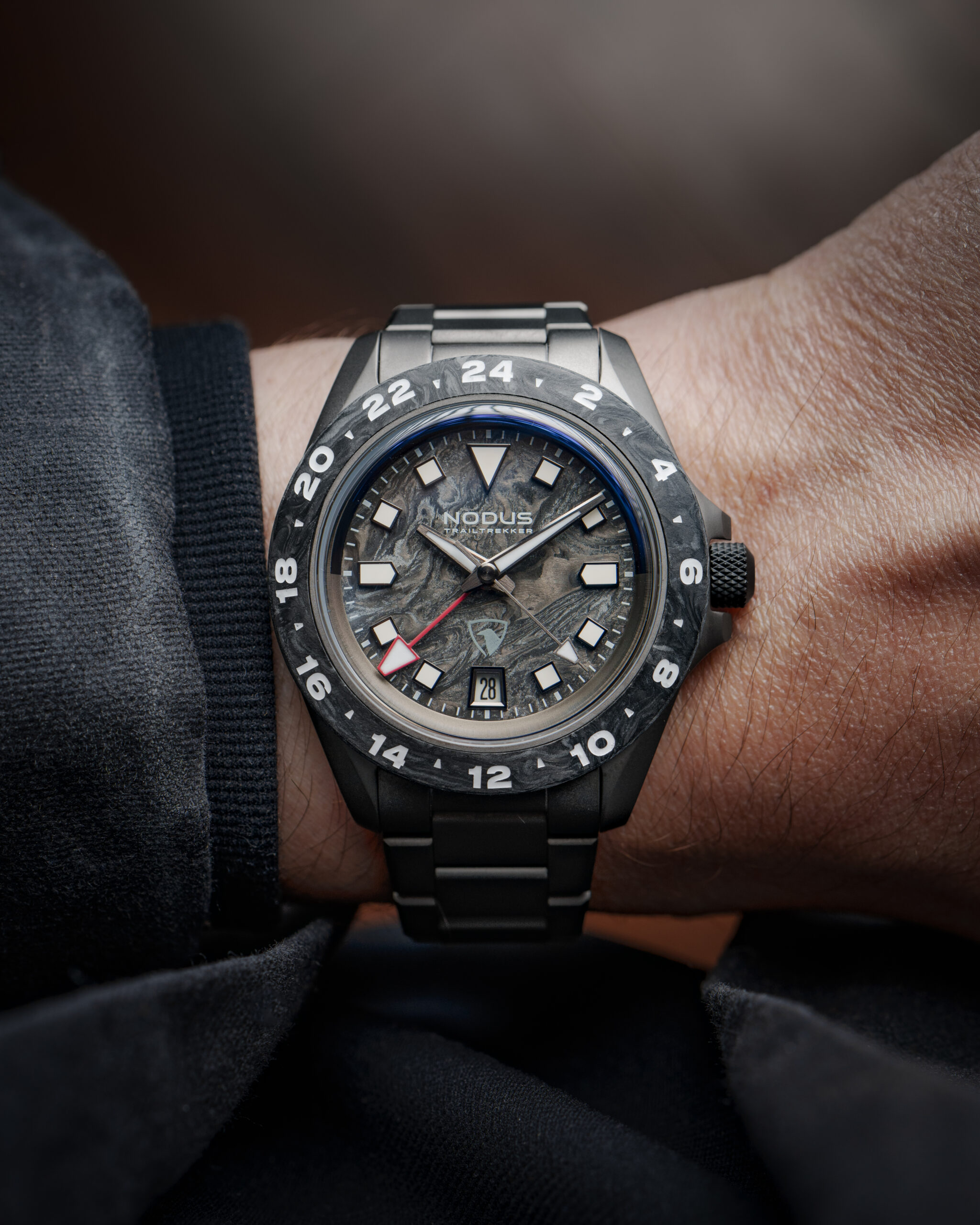
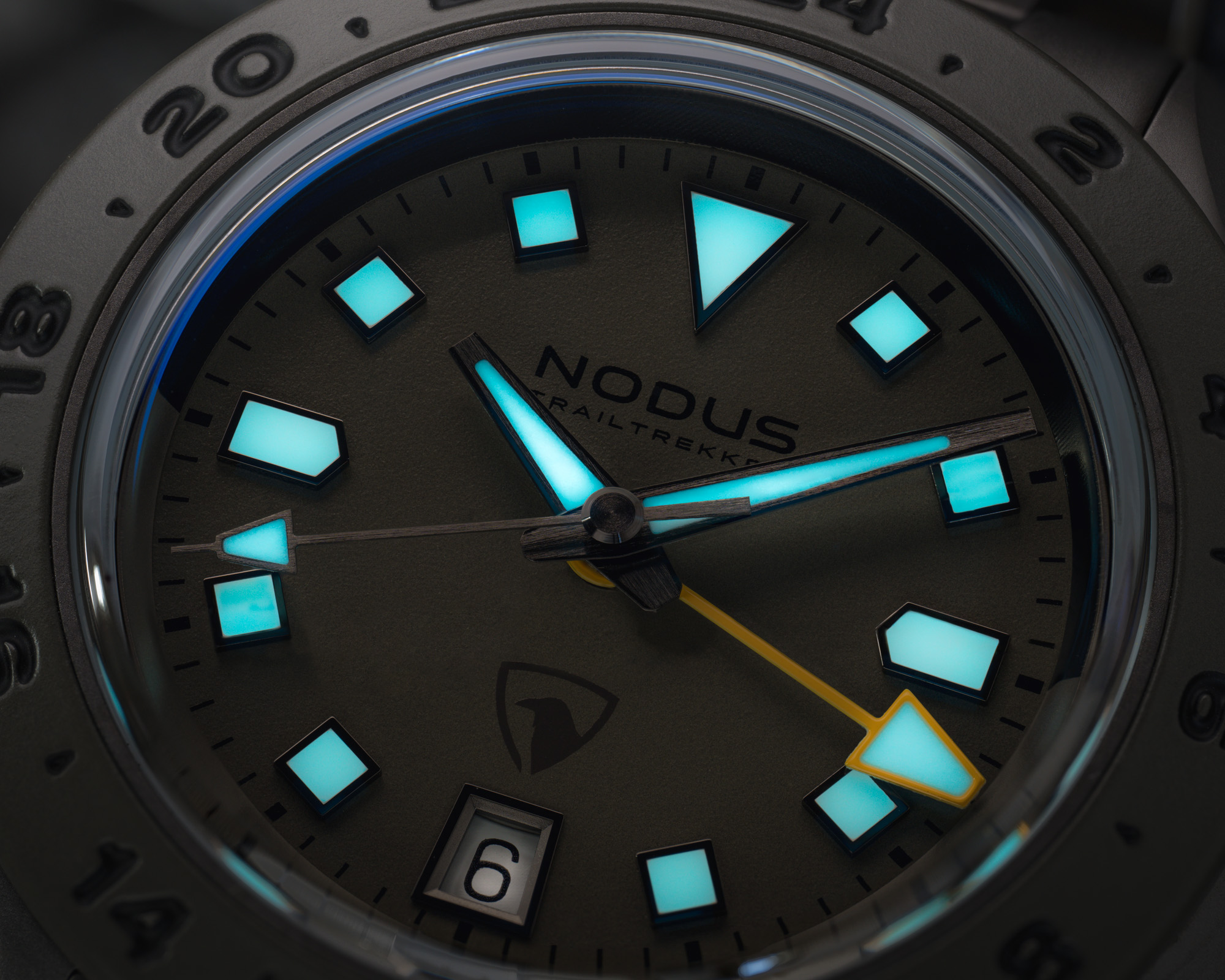
The TrailTrekker Carbon uses a dial of marbled forged carbon with Super-LumiNova infused directly into the material, surrounded by a fixed 24-hour bezel machined from solid forged carbon fibre that is fully lumed. Because of how forged carbon is made, no two dials and bezels are alike, so every Carbon carries its own pattern (good luck finding a twin at your next meetup).
In daylight it is a gorgeous, smoky texture that plays beautifully against the gunmetal case. Turn the lights off and the whole watch lights up: the fully lumed bezel, the lume infused through the forged carbon dial, and the lumed date wheel all glow at once. That lume combination is absolutely insane, and it is the single detail I kept coming back to when I tried it in person. It is easily one of the most beautiful GMT watches of the year for me, and the collaboration as a whole feels like two brands who know exactly what the other is good at.
The Carbon also ships with a Nodus Fusion FKM rubber strap with metal endlinks alongside the bracelet, which is a nice touch at $1,075. All of that wrist presence would mean little without something reliable ticking underneath.
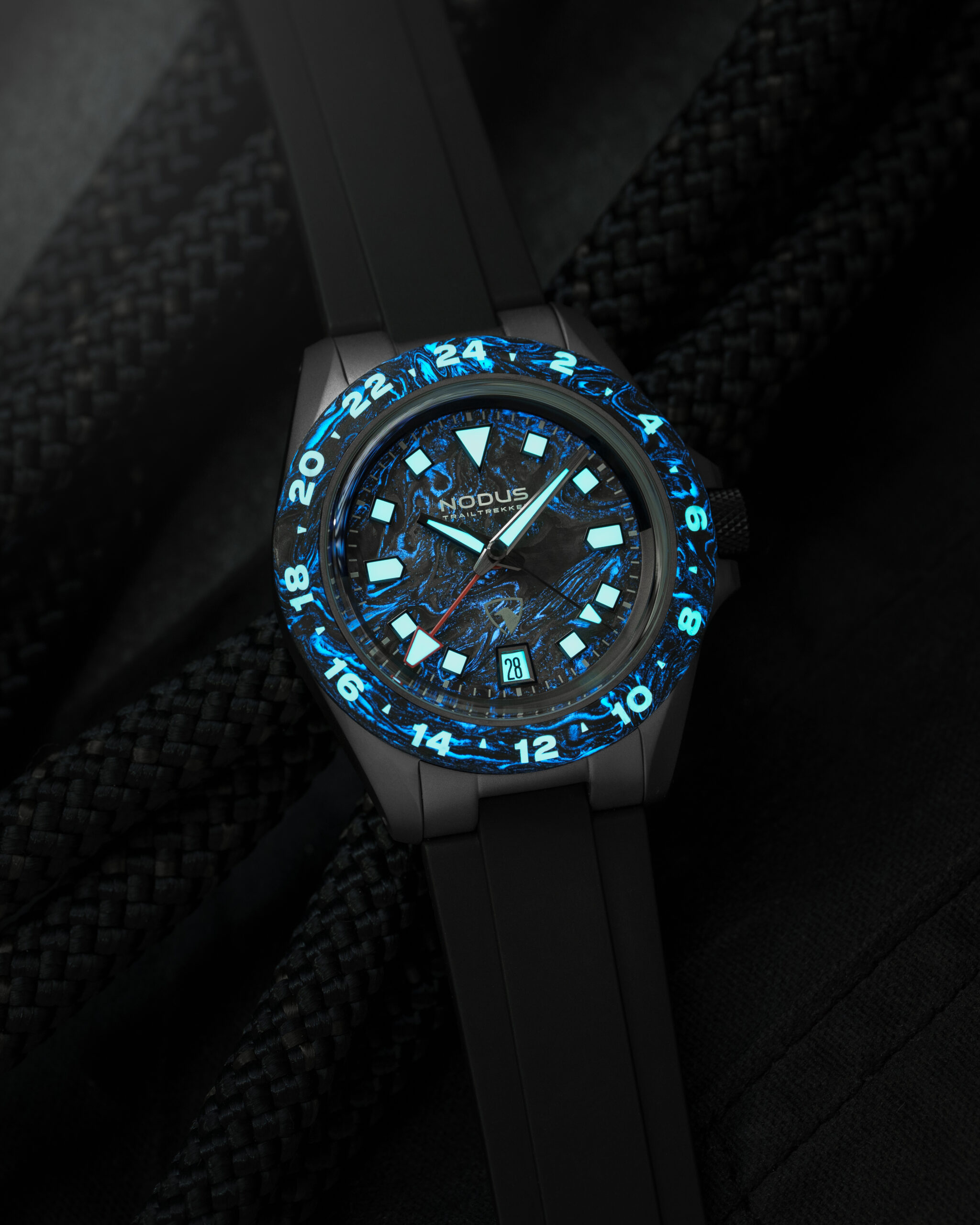
Miyota 9075 under the Hood
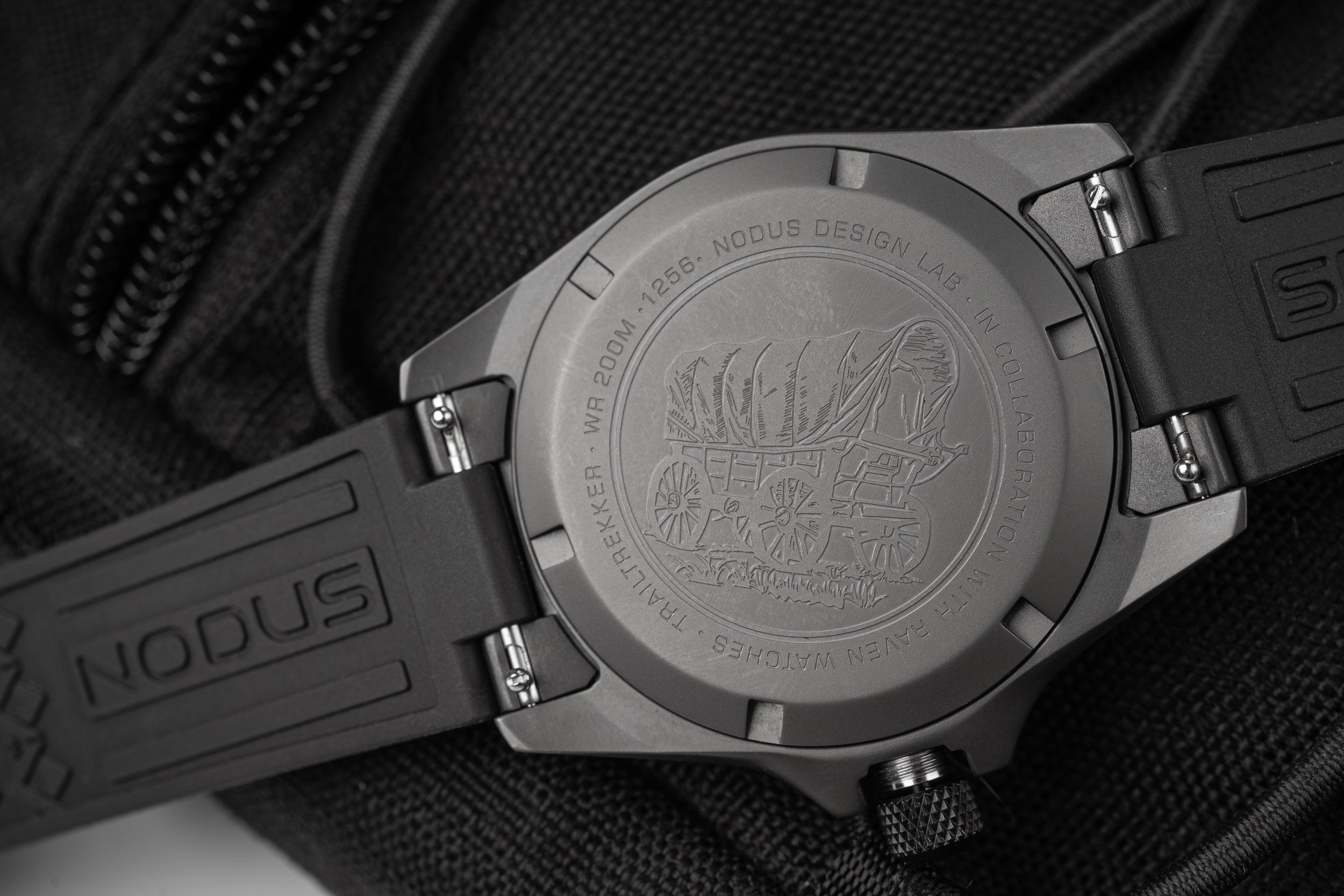
Here Nodus makes a deliberate choice. Instead of the Sellita SW200 that so many microbrands reach for, the TrailTrekker runs the Miyota 9075 GMT, made in Japan, with 24 jewels and a 42 hour power reserve. Crucially, the 9075 lets you set the local hour hand independently, so you can jump between time zones without stopping the watch or disturbing your home time on the 24-hour hand. That is the configuration actual travellers want, and it has historically been hard to find at this price.
Nodus regulates every movement in house to plus or minus 8 seconds per day, and the whole watch is assembled and inspected in Los Angeles. On paper, Miyota versus Sellita might look like a step sideways. In reality, a true travel GMT at under $1,100 is a stronger proposition for a watch called TrailTrekker than a Swiss badge with a caller GMT ever would be.
Bracelet, Proportions and Everyday Wear
Every model comes on a bracelet that tapers from 20 to 16 millimetres, closing on Nodus's NEM extension clasp, with quick-release springbars for easy strap swaps. On the DLC versions the bracelet carries the same gray finish as the case, so there is no mismatch at the lugs. The Basecamp bracelet is matte blasted with polished accents for a bit of sparkle.
The build quality is the thing that sticks with you. It feels sturdy and dense in the hand, the materials are excellent, and the tolerances are tight everywhere I looked at Micro Praha. Built for real use, not babied.
Why It’s Special
The TrailTrekker is not interesting because it is a GMT. It is interesting because of how much it gets right at once, and how few watches at this price manage the same.
- Microbrand DLC Done Properly: The gunmetal finish on the Clay and Carbon is consistent, even, and convincingly bonded, a level of execution that bigger brands regularly miss.
- Forged Carbon With Real Lume: Super-LumiNova infused into a forged carbon dial, plus a fully lumed solid carbon bezel, makes the Carbon one of the most memorable night shows in the category, and every piece is unique.
- A True Travel GMT: The Miyota 9075 with an independently adjustable local hour hand beats the caller GMT setups common in Swiss-powered microbrand GMTs around the $1,000 mark.
- Everyday Proportions: At 39.5 millimetres wide, 11.8 millimetres thick, and 46.6 millimetres lug to lug with 200 metres of water resistance, it is a GMT that genuinely works as a daily wearer.
- Four Personalities, One Platform: From the white A.C.T. to the classic steel Basecamp, there is a TrailTrekker for very different collectors without any of them feeling like an afterthought.
The Trail worth taking
The Nodus TrailTrekker collection is the GMT I did not know I was waiting for. It is compact, tough, finished to a standard that punches well above its price, and built around a movement that actually suits travel. It is a watch for the collector who wants one rugged GMT that can do the hike, the flight, and the office without asking for special treatment.
Pricing is $925 for the A.C.T. and Basecamp, $975 for the Clay, and $1,075 for the Carbon. Availability is the only catch: at the time of writing the Clay begins shipping in late October, the A.C.T. and Carbon are sold out with estimated restocks in November and December 2026 respectively, and the Basecamp is sold out with no restock date yet. My picks are the Clay and the Carbon, without hesitation.
The only real question is which trail you are on. Just do not expect a Carbon to wait around for you.
Specifications
- Brand: Nodus
- Model: TrailTrekker (A.C.T., Basecamp, Clay, Carbon), a Nodus Design Lab x Raven Watches collaboration
- Case Material: 316L surgical-grade stainless steel; raw steel (A.C.T.), media blasted (Basecamp), full gunmetal gray DLC (Clay, Carbon)
- Case Dimensions: 39.5mm diameter, 11.8mm thickness, 46.6mm lug-to-lug, 20mm lug width
- Bezel: Fixed 24-hour; high-polish black DLC (A.C.T.), hardened steel (Basecamp), Cerakote coated (Clay), solid forged carbon, fully lumed (Carbon)
- Dial: Matte white (A.C.T.), Cerakote coated (Clay), marbled forged carbon with infused Super-LumiNova (Carbon)
- Water Resistance: 200m
- Strap: Bracelet with 20mm to 16mm taper, NEM clasp, quick-release springbars; Carbon also includes a Nodus Fusion FKM rubber strap with metal endlinks
- Crystal: Box sapphire with blue anti-reflective coating on the underside
- Movement: Miyota 9075 GMT (Japan), 24 jewels, independently adjustable hour hand, regulated by Nodus to ±8 seconds per day
- Power Reserve: 42 hours
- Lume: Swiss Super-LumiNova BGW9 Grade A (A.C.T., Clay, Carbon), Old Radium X1 (Basecamp); lumed date wheel (Clay, Carbon)
- Limited Edition: Not stated by Nodus (regular production with restocks)
- Price: $925 (A.C.T., Basecamp) / $975 (Clay) / $1,075 (Carbon)
More information about this exact watch model on Nodus.
Image Gallery
About Nodus TrailTrekker: Key Questions Answered
What are the differences between the four Nodus TrailTrekker models?
All four share the same 39.5 millimetre case, Miyota 9075 GMT movement, box sapphire crystal, and 200 metres of water resistance. The A.C.T. ($925) has a matte white dial and a high-polish black DLC bezel, the Basecamp ($925) is the classic media blasted steel version with Old Radium X1 lume, the Clay ($975) is fully coated in gunmetal gray DLC with a Cerakote protected bezel and dial, and the Carbon ($1,075) adds a forged carbon dial and fully lumed forged carbon bezel to a gray DLC case and bracelet.
Is the Nodus TrailTrekker a true GMT?
Yes. The Miyota 9075 inside lets you jump the local hour hand independently, which is the setup frequent travellers want because you can change time zones without stopping the watch or touching the 24-hour hand. Nodus quotes 24 jewels, a 42 hour power reserve, and regulates each movement to plus or minus 8 seconds per day.
Is the TrailTrekker a Nodus and Raven Watches collaboration?
It is. The TrailTrekker is the fourth collaboration between Nodus Design Lab in Los Angeles and Raven Watches, the Kansas-based brand that builds rugged adventure watches. Raven brings the adventure ethos and Nodus handles the manufacturing, with every watch designed and assembled in Los Angeles.
Top Lists
- anOrdain, Baltic, Elka, Furlan Marri, Havaan Tuvali, HEINRICH Watches, Laco, Ophion, Vario
- By Dan H.
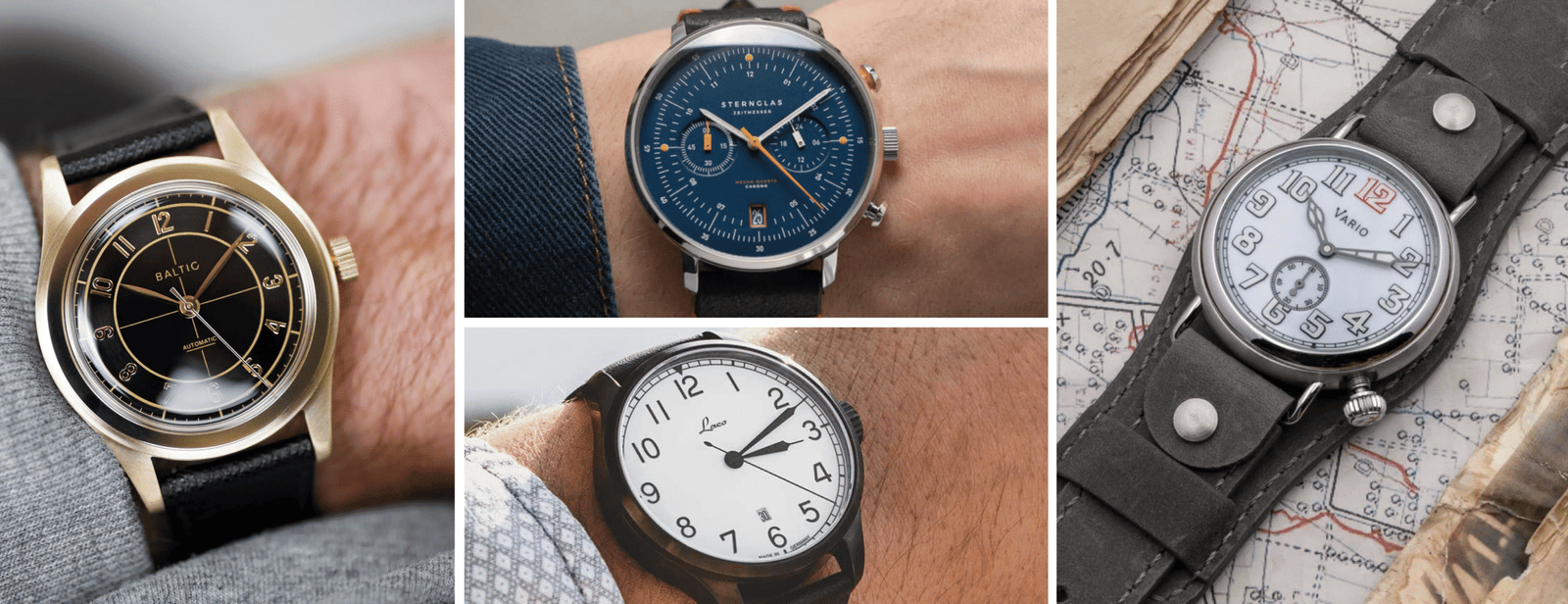
- Astor & Banks, Baltic, Havaan Tuvali, Laco, MD Watches, STERNGLAS, Vario
- By Dan H.
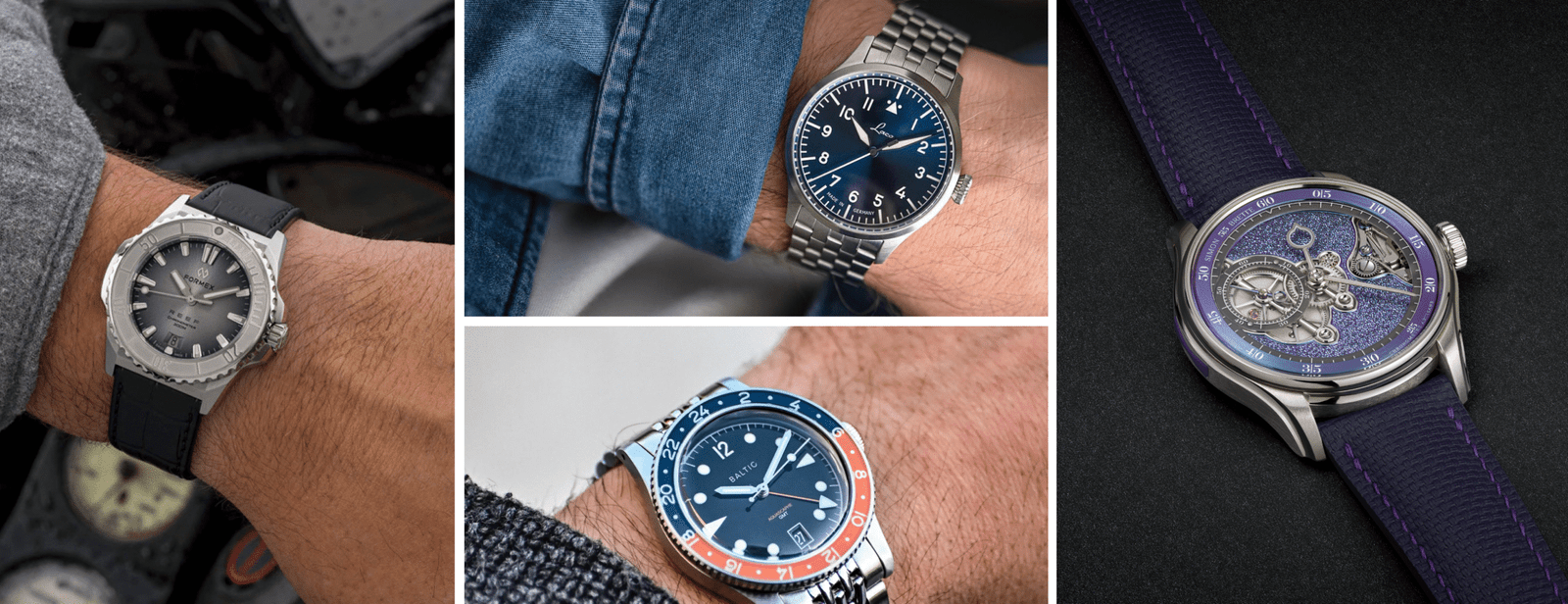
- Baltic, Berneron, Dug Glashütte, Elka, Kurono Tokyo, Laco, Maen, Maurice Lacroix, Nomos Glashütte, STERNGLAS, Straum, Unimatic
- By Dan H.