
RESERVOIR Mark II Review: GT Tour, Kanister, and Airfight Jet
- Dan H.
- November 16, 2026
Three Dials, One New Case
RESERVOIR has always been a dial brand. You spot one across the room because of the rev counter or fuel gauge printed on it, and until now the case and strap were mostly there to hold that dial up. The Mark II changes that. It's a new case and integrated bracelet, and RESERVOIR is launching it with three of its existing dials: the GT Tour, the Kanister, and the Airfight Jet.
I'll say it up front. I think this is one of the best vintage-inspired racing watches out there, and the build quality is a big part of why.
Some background if the name is new to you. RESERVOIR started in 2017 and has made essentially one kind of watch ever since: a jumping hour with a retrograde minute hand and a power reserve indicator, styled after a car, aircraft, or industrial gauge. Most brands would have added a diver or a chronograph by now. RESERVOIR kept working on the same idea, and the Mark II is the first time it has given the case and bracelet the same attention as the dial.
The price is $6,800 excluding VAT, or €6,800 including VAT in Europe, the same for all three. I'll come back to that at the end.
How to Read It
Most people's first reaction to a RESERVOIR is mild confusion, so let's start here.
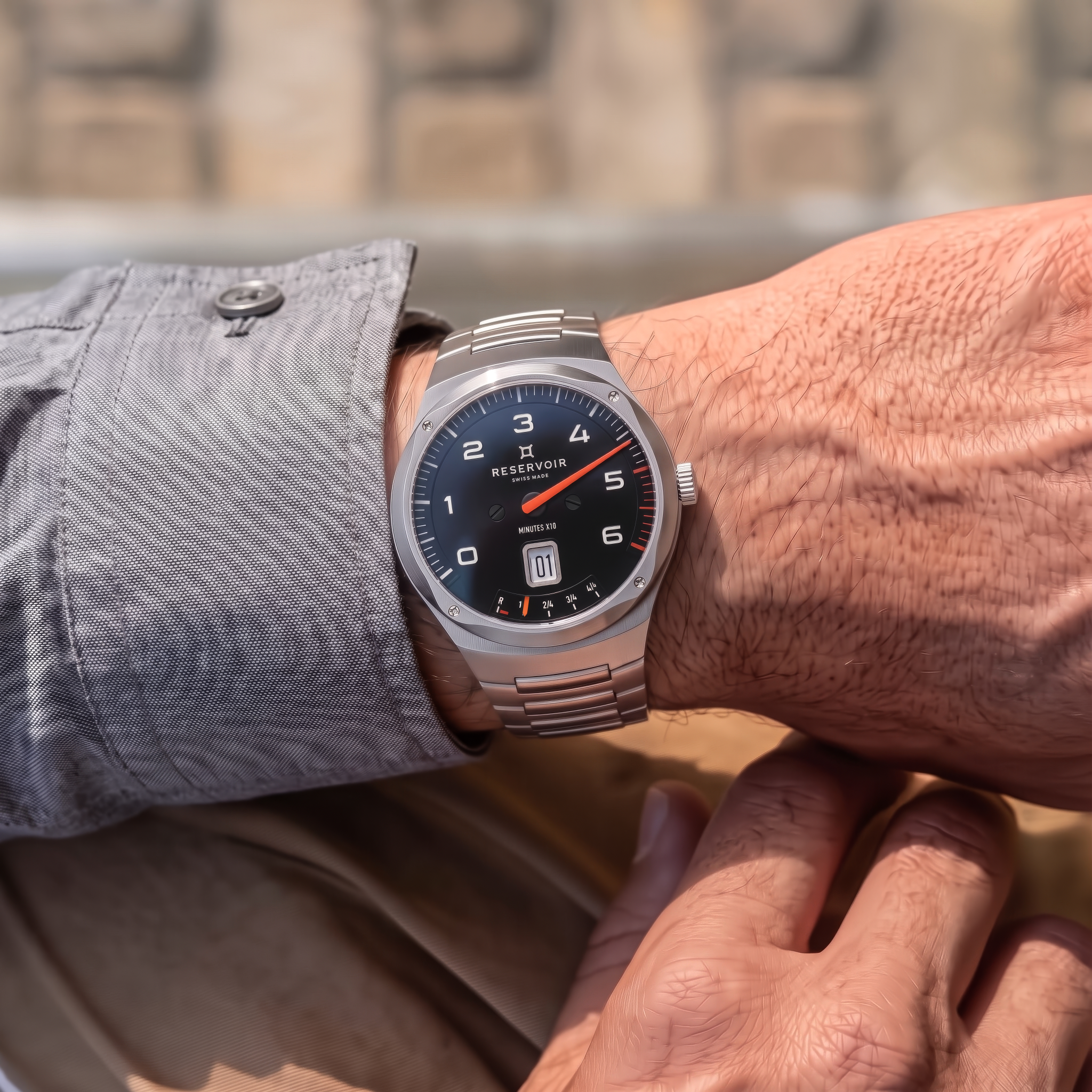
There's no hour hand. The hour is a number in the window near six o'clock. The one hand in the middle is for minutes only, and instead of going around the dial it moves along an arc.
Over 60 minutes the hand travels from one end of the arc to the other. When it gets to the end, it jumps back to zero and the number in the window clicks over to the next hour. That's the retrograde minute and the jumping hour working together.
So if the window says 03 and the hand is a little past the middle of the arc, it's just after half past three.
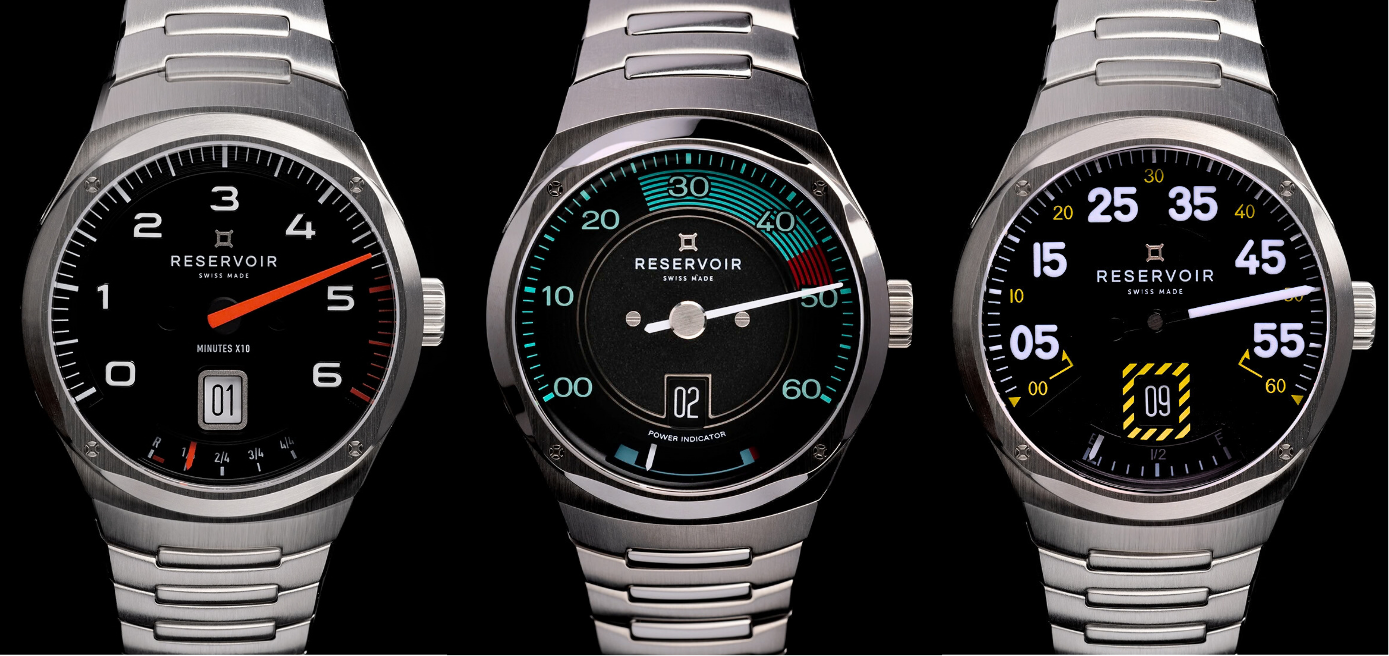
Each dial labels the arc its own way. The GT Tour runs from 0 to 6 with "MINUTES X10" printed underneath, so when the hand points at 4 it's 40 minutes past. Same logic as a rev counter where 4 means 4,000 rpm. The Kanister counts from 00 to 60 in tens. The Airfight Jet has big numerals at 05, 15, 25, 35, 45, and 55, with smaller yellow tens near the rim between them.
The small gauge at the bottom of the dial is the power reserve, covering the movement's 56 hours.
It takes a few glances to stop looking for an hour hand. After that it's honestly quicker than a normal dial, because the hour is just written down for you. Fair warning, though. You will end up staring at it at 59 minutes past to watch the hand snap back.
The Three Dials
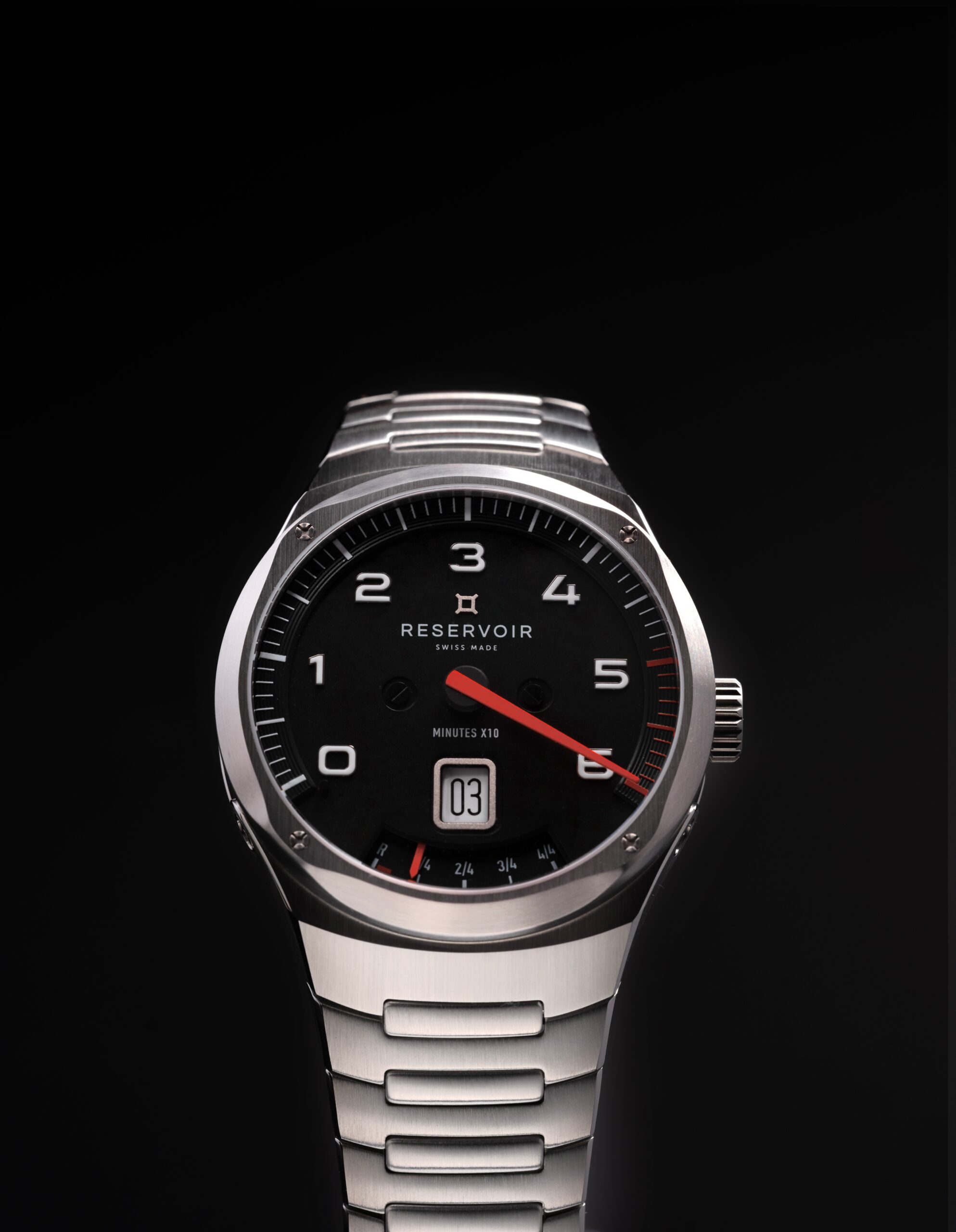
The GT Tour is the most classic of the three. Black dial, white numerals from 0 to 6, a long red minute hand. Between 5 and 6 there's a run of red markers that work exactly like the redline on an old tachometer. The hour window has its own steel frame, and the power reserve at the bottom goes from R up to 4/4 with a small red pointer. If you grew up staring at old sports car dashboards, this is the one.
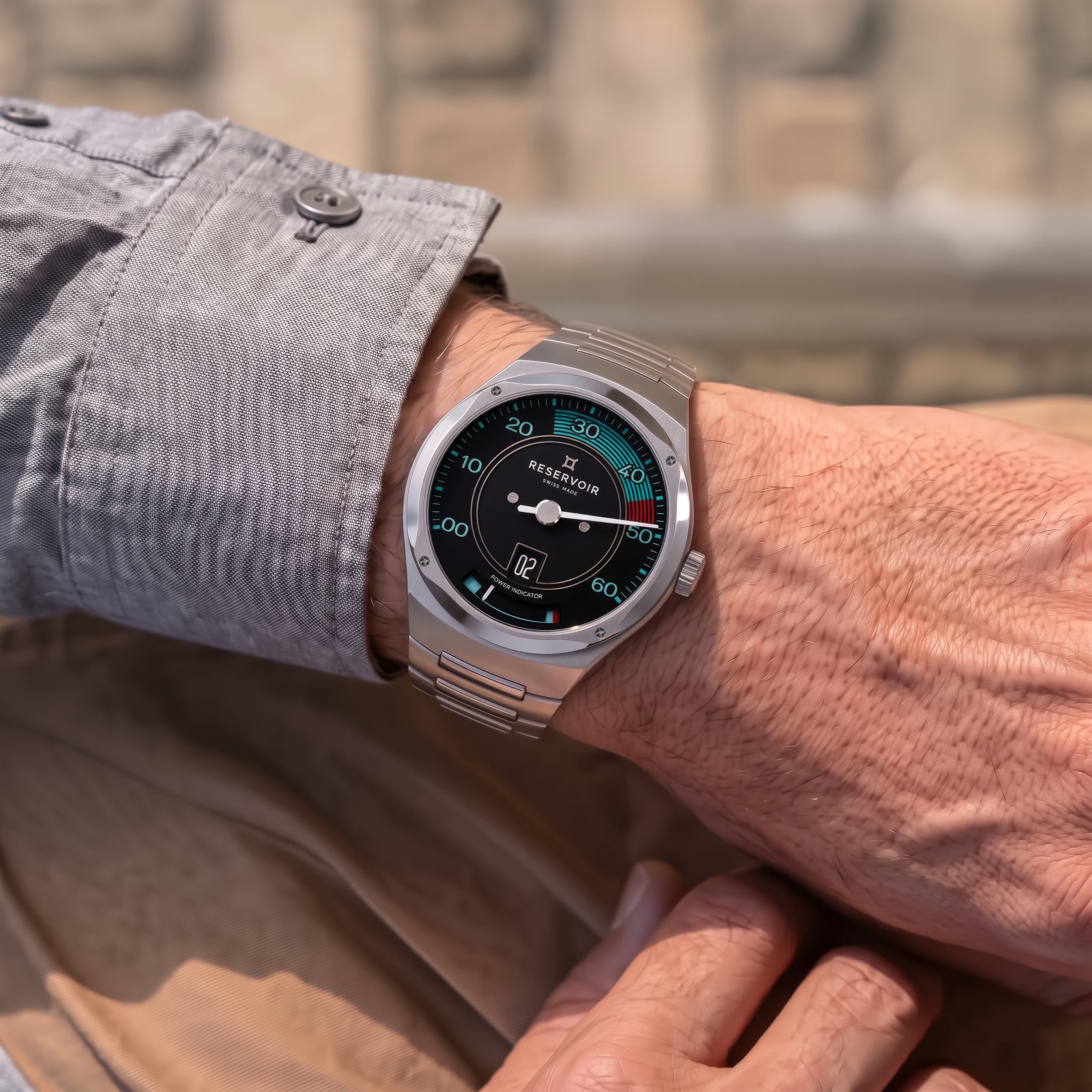
The Kanister is a fuel gauge. A teal arc runs across the top of the dial with a red section between 40 and 50, and the hand is white. The power reserve sits under the words "POWER INDICATOR," teal at one end and red at the other. It's the most graphic of the three.
The Airfight Jet is the aviation one. Big white numerals, small yellow tens, and yellow and black hazard stripes around the hour window. There's a lot on that dial and it still reads clearly, which is harder to pull off than it looks.
I like all three. Which one you pick mostly depends on whether you're a car person or a plane person.
The Case, and Where It Comes From
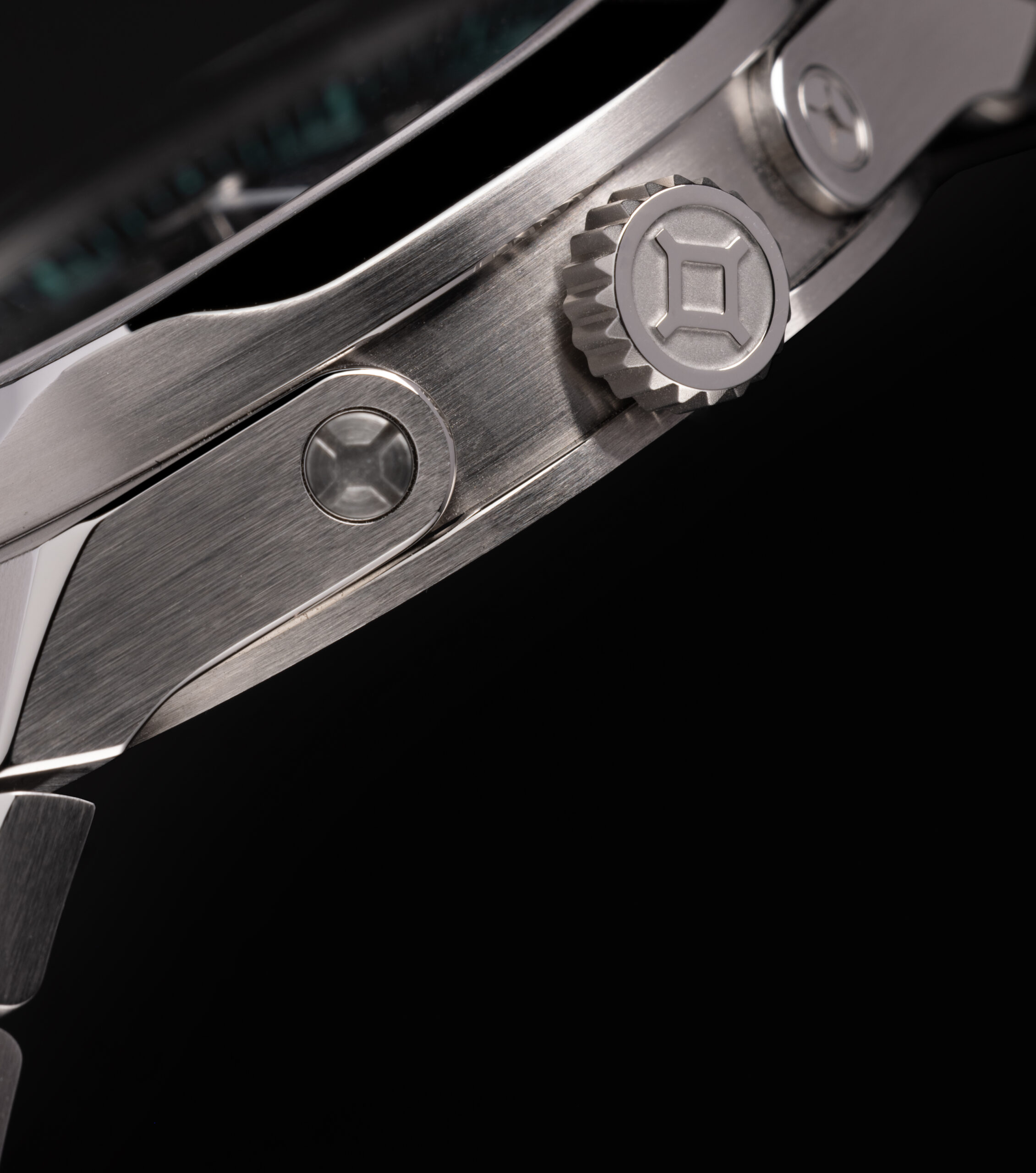
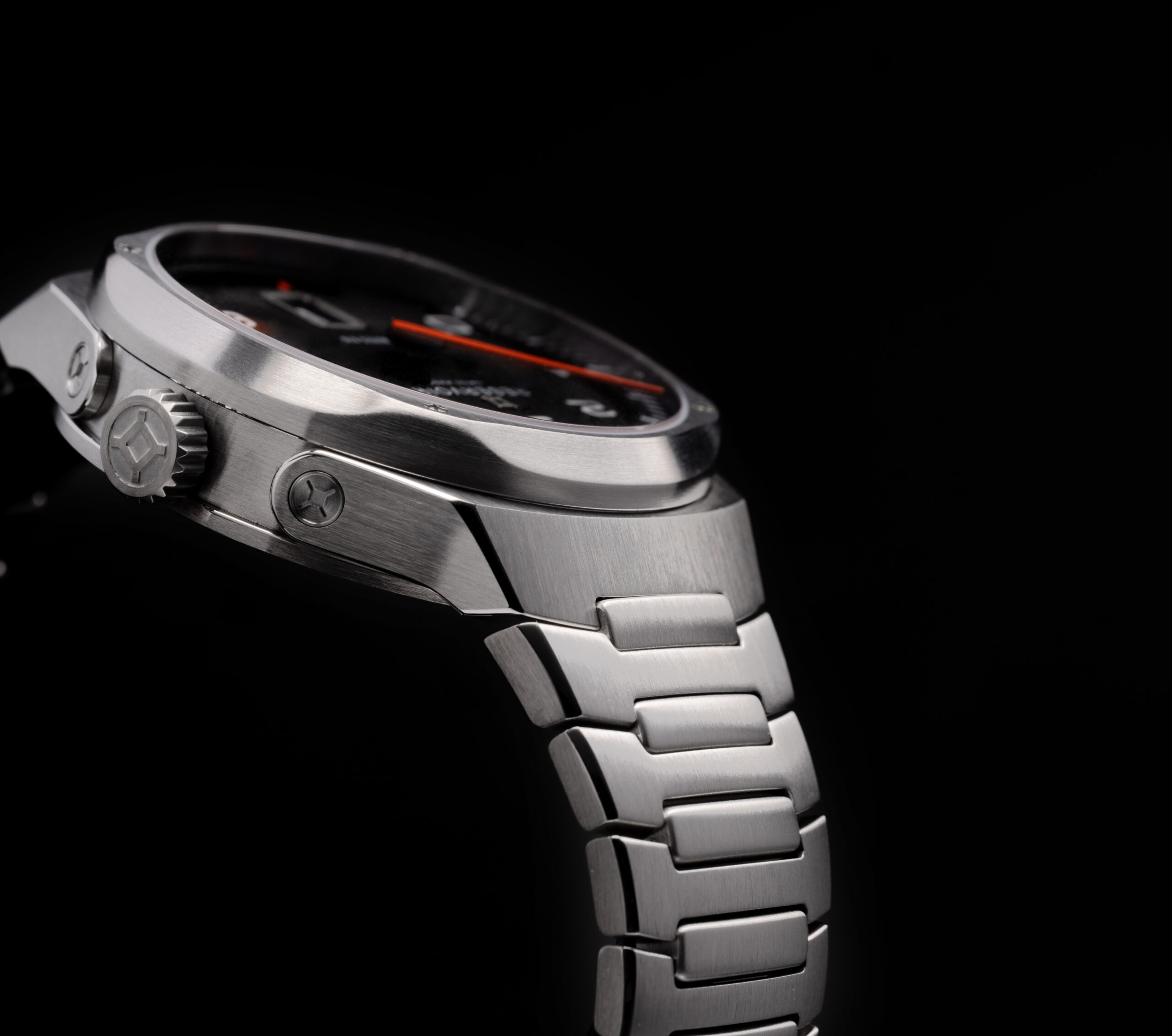
The press material talks a lot about silhouette, and you can see what they were going for. It's a faceted steel case with visible screws and a bracelet that comes straight out of it, no lugs. RESERVOIR took "inspiration" pretty far here. If you know the integrated-bracelet sports watches of the 1970s, you'll recognise the references immediately.
I don't mind it. The screws look like hardware off an engine cover rather than decoration, which suits a brand that has been drawing gauges for years.
On paper: 41mm, 316L stainless steel. The GT Tour and Airfight Jet are brushed, while the Kanister mixes satin finishing with polished surfaces. There's a screw-down crown with the logo on it, 5 ATM of water resistance, and an anti-reflective sapphire crystal. The bracelet is 20mm wide, screwed to the case, and closes with a folding clasp that also carries the logo.
What I keep coming back to is how solid it is. Nothing rattles, nothing feels hollow, and the bracelet is finished to the same level as the case, which you can't take for granted at any price. This isn't a fun concept that got rushed into production. Somebody cared about the material sourcing, the movement, the hands, and the dial printing, and you can tell.
The Movement
The calibre is the RSV-240. RESERVOIR designed a 113-part complication module, which it has patented, and mounted it on a modified La Joux-Perret G100 automatic. The base movement keeps time at 28,800 vph with 56 hours of power reserve. The module handles the jumping hour, the retrograde minute, and the power reserve display. It's Swiss Made, and you can see it through the open caseback, which was redesigned for the Mark II and also carries the logo.
Jumping hours are hard to get right. The hour disc has to snap over cleanly, and here the minute hand has to fly back at the same moment, every hour, for years. On the Mark II both happen crisply.
I'd put it among the best jumping hours you can buy right now. That isn't a huge surprise from a brand that has spent its whole existence on this one complication.
Verdict
The Mark II is the most complete watch RESERVOIR has made. The dial was always the reason to buy one. Now the case, bracelet, and movement are good enough to be reasons on their own.
The one thing I'd flag is the price. At $6,800 / €6,800 it's a real commitment, and the microbrand space is crowded right now, with more good watches at lower prices than ever. For some people that will make this a hard pill to swallow. The flip side of all that competition is that margins get squeezed hardest for brands that spend serious money on R&D and their own movements, and RESERVOIR is clearly one of them.
If you like old racing and aviation instruments and want a watch that tells the time unlike anything else in your collection, this should be near the top of your list. Then comes the hard part, which is choosing between the car and the plane.
Specifications
- Brand: RESERVOIR
- Model: Mark II (GT Tour RSV01.GT/137, Kanister RSV01.KN/137, Airfight Jet RSV02.AF/137)
- Case Material: 316L stainless steel, brushed (GT Tour, Airfight Jet) or satin and polished (Kanister)
- Case Dimensions: 41mm
- Water Resistance: 5 ATM, screw-down crown
- Strap: Integrated 316L stainless steel bracelet screwed onto the case, finished to match the case, 20mm, folding clasp
- Crystal: Anti-reflective sapphire crystal; 360° open caseback
- Movement: Calibre RSV-240, patented in-house 113-part complication module on a modified La Joux-Perret G100 self-winding base, 28,800 vph, retrograde minute, jumping hour, power reserve indicator, Swiss Made
- Power Reserve: 56 hours
- Lume: Not specified
- Limited Edition: Not stated by the brand
- Price: $6,800 (excl. VAT) / €6,800 (incl. VAT)
More information about this exact watch model on RESERVOIR.

Image Gallery
About RESERVOIR Mark II: Key Questions Answered
How do you read the time on a RESERVOIR Mark II?
The hour is the number in the window near six o’clock. The single hand in the centre only shows minutes, moving along an arc from zero to 60. When it reaches the end, it flies back to zero and the window jumps to the next hour. The small gauge at the bottom is the power reserve.
What movement is inside the RESERVOIR Mark II?
It’s the RSV-240, RESERVOIR’s own patented 113-part complication module sitting on a modified La Joux-Perret G100 automatic. It runs at 28,800 vph with a 56-hour power reserve and is Swiss Made. You can see it through the open caseback.
How much does the RESERVOIR Mark II cost?
It’s $6,800 excluding VAT in the US and €6,800 including VAT in Europe. All three versions (GT Tour, Kanister, and Airfight Jet) cost the same, so you’re only choosing a dial.
Top Lists
- anOrdain, Baltic, Elka, Furlan Marri, Havaan Tuvali, HEINRICH Watches, Laco, Ophion, Vario
- By Dan H.

- Astor & Banks, Baltic, Havaan Tuvali, Laco, MD Watches, STERNGLAS, Vario
- By Dan H.
- Baltic, Berneron, Dug Glashütte, Elka, Kurono Tokyo, Laco, Maen, Maurice Lacroix, Nomos Glashütte, STERNGLAS, Straum, Unimatic
- By Dan H.