Germany
Sternglas
A Hamburg brand making Bauhaus-style watches since 2016, with sapphire crystals on almost everything and prices that start under €200.
- Founded
- 2016Hamburg, Germany
- Range
- €179–899
- Movement
- Japanese & SwissMiyota / Ronda / Seiko / Sellita
- Case size
- 33–42 mm
- Reviews
- 0Updated automatically
The brand
Bauhaus, at a fair price
Sternglas was founded in Hamburg in 2016 by Dustin Fontaine, who still runs the company. His story is a simple one. He worked in a watch factory during his school days, went looking for a watch for himself, and found only two options: an expensive luxury piece or a trendy fashion watch that would not last. He decided there should be a third. The brand started with a crowdfunding campaign and has since sold watches to more than 53,000 people, according to its own figures. That is a lot of wrists for a brand that has never spent luxury money on marketing.
The design language is Bauhaus through and through: clean dials, thin hands, simple numerals and cases that do not shout. Sternglas is open that it is not a luxury brand and does not want to be. What it does want is good design and decent materials at a fair price. That shows in the details. Most models get a domed sapphire crystal with anti-reflective coating, which is unusual at these prices, and many use a tool-free quick-change strap system. Development starts with sketches on paper and can take many months before a model is released.
The Naos is the core of the range. The quartz Naos is 38mm and only about 6mm thick, with a Ronda or Miyota quartz movement, and it featured in our list of the thinnest microbrand watches. The Naos Automatik uses a Miyota 8215 or 821A, and the newer Naos Pro steps up to a Miyota 9015, which Fratello called the best Sternglas it had handled. There is also a 33mm Naos XS, a moonphase, a solar version and a GMT using the Miyota 9075. Water resistance is 50m across most of the range, which is fine for daily life.
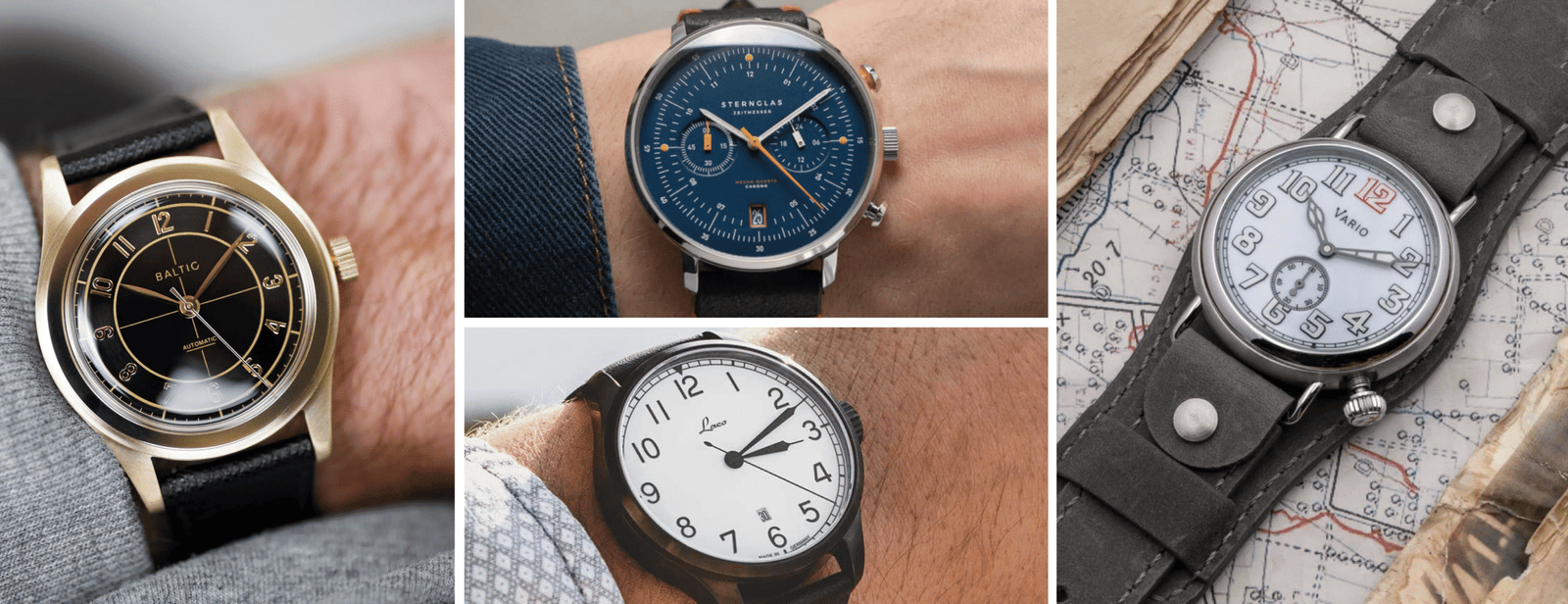
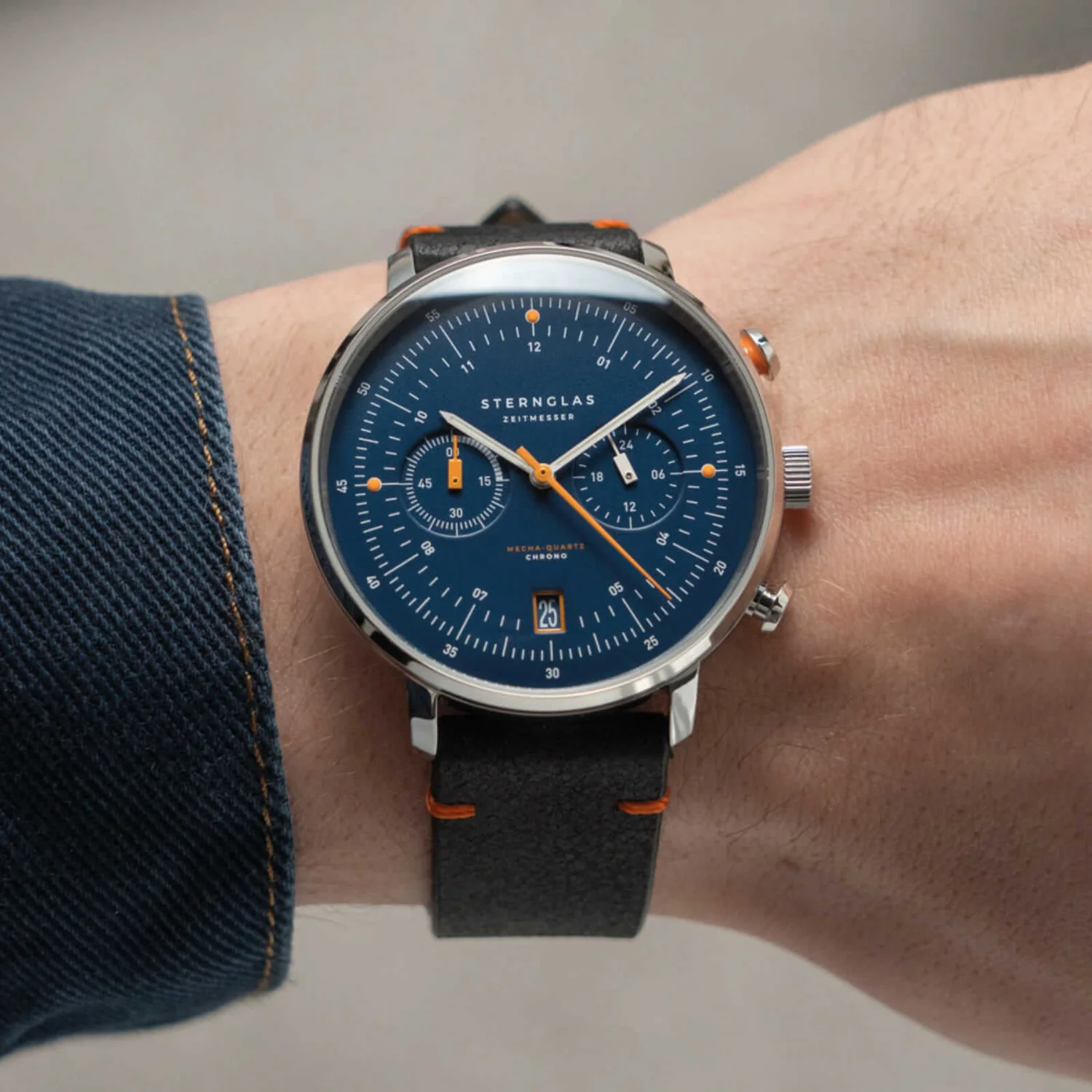
The Hamburg family is sportier, with 42mm cases. The Hamburg Automatik runs a Miyota 8215, and the Hamburg Chrono uses a Seiko VK64 meca-quartz with a 24-hour display. The Hamburg Chrono Edition Küste, with a dark blue dial and orange accents, took the top spot in our list of the best microbrand watches under 500 dollars at €349. At the top of the catalogue, the Kanton 2.0 uses a Swiss Sellita SW200 in a 39mm case for €899. There is also a Lumatik with a fully lumed dial, a Berlin line and the Egor.
Sternglas is honest about where its parts come from: depending on the model, components come from Germany, Switzerland, China or Japan, and the watches are designed in Hamburg. So this is not a made-in-Germany brand in the Glashütte sense. Prices on the official shop run from €179 to €899, with most quartz pieces between €200 and €300 and most automatics between €400 and €700. All watches carry a two-year warranty and a 30-day return period. It is the kind of brand that makes a good first watch, or a sensible second one.
Who it’s for
You want a clean, Bauhaus-style watch with a sapphire crystal for a few hundred euros, and you value straightforward design over complications or heritage. The quartz Naos is the easy everyday choice, and the Naos Pro is the one if you want a proper automatic without stepping up to Nomos money.
If you like Sternglas
Five brands worth a look
People also ask
Sternglas, answered
Where are Sternglas watches made?
Sternglas is based in Hamburg, where the watches are designed. The brand says that, depending on the model, components come from manufacturers in Germany, Switzerland, China and Japan. It is a German brand, but the watches are not made in Germany in the traditional sense.
How much do Sternglas watches cost?
Prices on the official shop run from €179 to €899. Most quartz models, like the Naos, cost between €200 and €300. Automatics such as the Naos Automatik and Hamburg Automatik sit between roughly €370 and €500, the Naos Pro is €699 and the Sellita-powered Kanton 2.0 is €899.
What movements do Sternglas watches use?
Mostly Japanese movements. Quartz models use Ronda or Miyota calibres, automatics use the Miyota 8215, 821A or 9015, the GMT uses the Miyota 9075, and the Hamburg Chrono uses a Seiko VK64 meca-quartz. The Kanton 2.0 uses a Swiss Sellita SW200, and the Hamburg Solar uses an Epson solar calibre.
What is the difference between the Naos Automatik and the Naos Pro?
Both are 38mm Bauhaus-style automatics. The Naos Pro is slimmer at 11mm against 12mm, has a redesigned dial and better finishing, and uses the higher-grade Miyota 9015 instead of the Miyota 8215. It costs €699 on leather, against around €370 to €450 for the regular Naos Automatik.
Are Sternglas watches good quality?
For the money, yes. Sapphire crystals, steel cases and reliable Japanese movements are a strong package under €500, and Fratello called the Naos Pro excellent value. Water resistance is 50m on most models, so they are everyday watches rather than tool watches.