Switzerland
Epos
A Swiss house that bet on mechanical watches in 1983, the middle of the quartz crisis, and still builds skeletons, jumping hours and big moon phases for prices most complication makers would laugh at.
- Founded
- 1983Roots in 1925, Vallée de Joux
- Range
- €800–3.7k
- Movement
- Modified SwissSellita / ETA / Unitas
- Case size
- 34–43 mm
- Reviews
- 0Updated automatically
The brand
Mechanical when nobody else was
Epos traces its lineage to James Aubert, who founded James Aubert SA in the Vallée de Joux in 1925 and concentrated on chronographs and minute repeaters. His son-in-law, Jean Fillon, inherited that knowledge and later became Epos’s leading watchmaker for many years, credited with its jumping hour and regulator designs. Wikipedia describes the Aubert link as the brand’s told ancestry, which is a fair way to put it. What is documented is that James Aubert SA went under during the quartz crisis, like thousands of other Swiss firms.
In 1983 Peter Hofer, a long-established watch industry figure, bought the remaining assets and founded Montres Epos SA with his wife Erna. The timing looked foolish. The Swiss industry was collapsing, quartz was winning, and Hofer committed to mechanical watches anyway. Jean Fillon worked alongside him for around twenty years. In 2002 Hofer handed the company to the Chonge-Forster family, with Ursula Forster as president and her husband Tamdi Chonge as chief executive. Their son Singi Chonge became chairman in 2014, and the family still runs the business.
Epos does not make its own base movements and does not pretend to. It buys calibres from ETA, Sellita and Unitas, then modifies and decorates them, adding its own modules for complications. That approach is the whole point. It lets Epos offer skeletons, jumping hours, second time zones and big moon phases at prices where other brands sell plain three-handers. The current management has said it aims to keep most models between roughly CHF 1,500 and CHF 3,500, and the catalogue largely does.
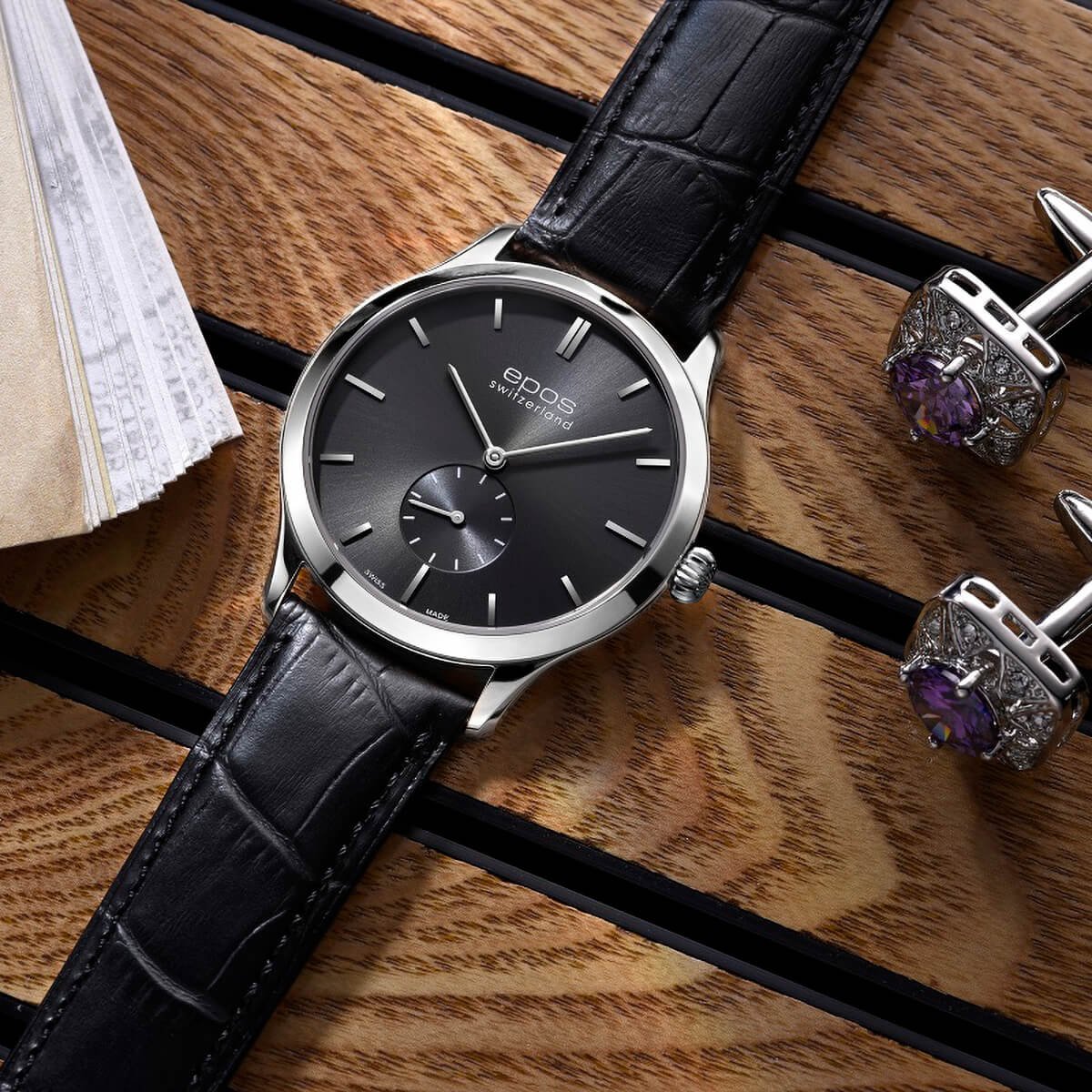
The range is enormous, with hundreds of references sorted by number rather than name. The 3408, which made our list of the thinnest microbrand watches, is a 39mm dress watch just 5.9mm thick with a hand-wound Peseux 7001, at €1,559 to €1,759. The 3435 Verso flips a Unitas 6497 so the movement shows on the dial side, from €2,739. The big moon 3439 and 3440 models run €3,099 to €3,699. The Sportive 3441 Diver DD is 43mm, rated to 500m, at €1,999. Quartz models start at €799.
Above all that sits a limited five-minute repeater at €17,699, which shows the Vallée de Joux roots are more than marketing. For most buyers, though, Epos is a brand for complications on a budget. The decoration is good for the money, with Côtes de Genève and blued screws on a €1,559 watch like the 3408. The weak points are brand recognition and a catalogue so large it can feel unfocused. Buy one because you love the complication, not because you expect it to hold its value like a better-known name.
Who it’s for
You want a mechanical complication you can actually see, like a skeleton, a jumping hour or a big moon, without paying the big-house premium. The 3408 is the pick if you want a genuinely thin hand-wound dress watch, and the Verso if you want the movement on show from the front.
If you like Epos
Five brands worth a look
People also ask
Epos, answered
Are Epos watches Swiss made?
Yes. Epos says all its watches are designed and manufactured in Switzerland, using Swiss base movements from ETA, Sellita and Unitas that it modifies and decorates. The company is Epos Uhren AG, run by the Chonge-Forster family since 2002.
How much do Epos watches cost?
Quartz models start at €799, and most mechanical watches sit between about €1,200 and €3,700. The 3408 ultra-thin is €1,559 to €1,759, the 3441 Diver DD is €1,999, and the big moon 3440 BM tops out at €3,699. A limited five-minute repeater is the exception at €17,699.
Does Epos make its own movements?
No. Epos buys Swiss base calibres from ETA, Sellita and Unitas and builds on them, adding decoration and its own modules for complications such as jumping hours, second time zones and big moon phases. That is why its complications cost far less than in-house equivalents.
What is the Epos 3408?
It is Epos’s ultra-thin dress watch, a 39mm steel case only 5.9mm thick with a hand-wound Peseux 7001 movement decorated with Côtes de Genève and blued screws. It is priced from €1,559 on a strap and featured in our list of the thinnest microbrand watches.
Is Epos a good watch brand?
For complications at a fair price, yes. The movements are proven Swiss calibres, the decoration is better than the price suggests, and the brand has been making mechanical watches since 1983. The trade-off is low name recognition and a very large catalogue, so resale values are modest.