Straum Expedition Review: Built For Norwegian Nature
- Dan H.
- August 28, 2026
Built For, Not Inspired By
There is a particular kind of marketing sentence that gets used far too often in this hobby, the one where a brand says a watch was inspired by a mountain, a glacier, or a fjord, and then hands you a polished dress case with a blue dial. Straum has just launched a watch whose entire premise is a correction of that habit. The Expedition, they say, is built for Norwegian nature rather than inspired by it, and after going through every angle of it, that distinction actually holds up.
Straum has been one of the most quietly consistent microbrands of the last few years, and the pattern by now is predictable in the best possible way. Everything they release feels considered from all angles, as though the design team argued about each chamfer until somebody won. The Jan Mayen Basalt took a volcanic texture and made it into a dial that changes character with the light, and the Frozen Metal Titanium turned a metallurgical accident into a surface nobody else could copy. The house style has always been Norwegian nature translated through precision, and Grade 5 titanium has been the material of choice throughout.
The Expedition is that same DNA with a harder edge, and it arrives alongside a genuine restructure of the catalogue. Straum has split its output into two collections, Inspired By for the models that translate a landscape into a dial, and Built For, the new technical line the Expedition opens. The brand's own summary of the design brief is the clearest thing they have written in years, that decoration has been reduced wherever function can replace it. Three dial colours launched, every one of them screaming rigidity and purpose without abandoning the elegance Straum built its name on. Pre-orders opened August 24 2026 at $2,750 / €2,100 (31,000 NOK) on rubber, with deliveries scheduled for March 2027. That is a long wait, and it is worth understanding exactly what you would be waiting for.
A Case Engineered Around Impact
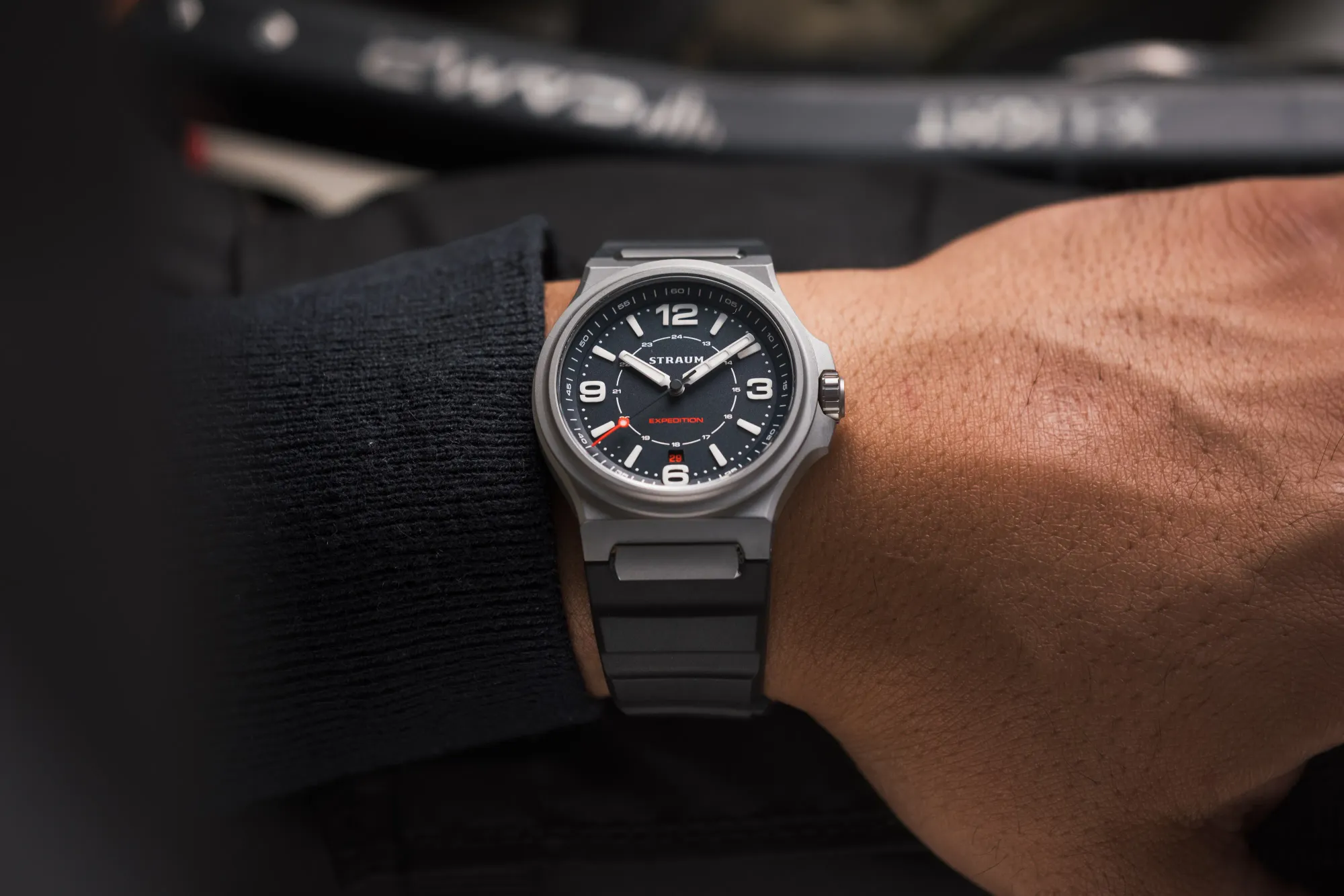
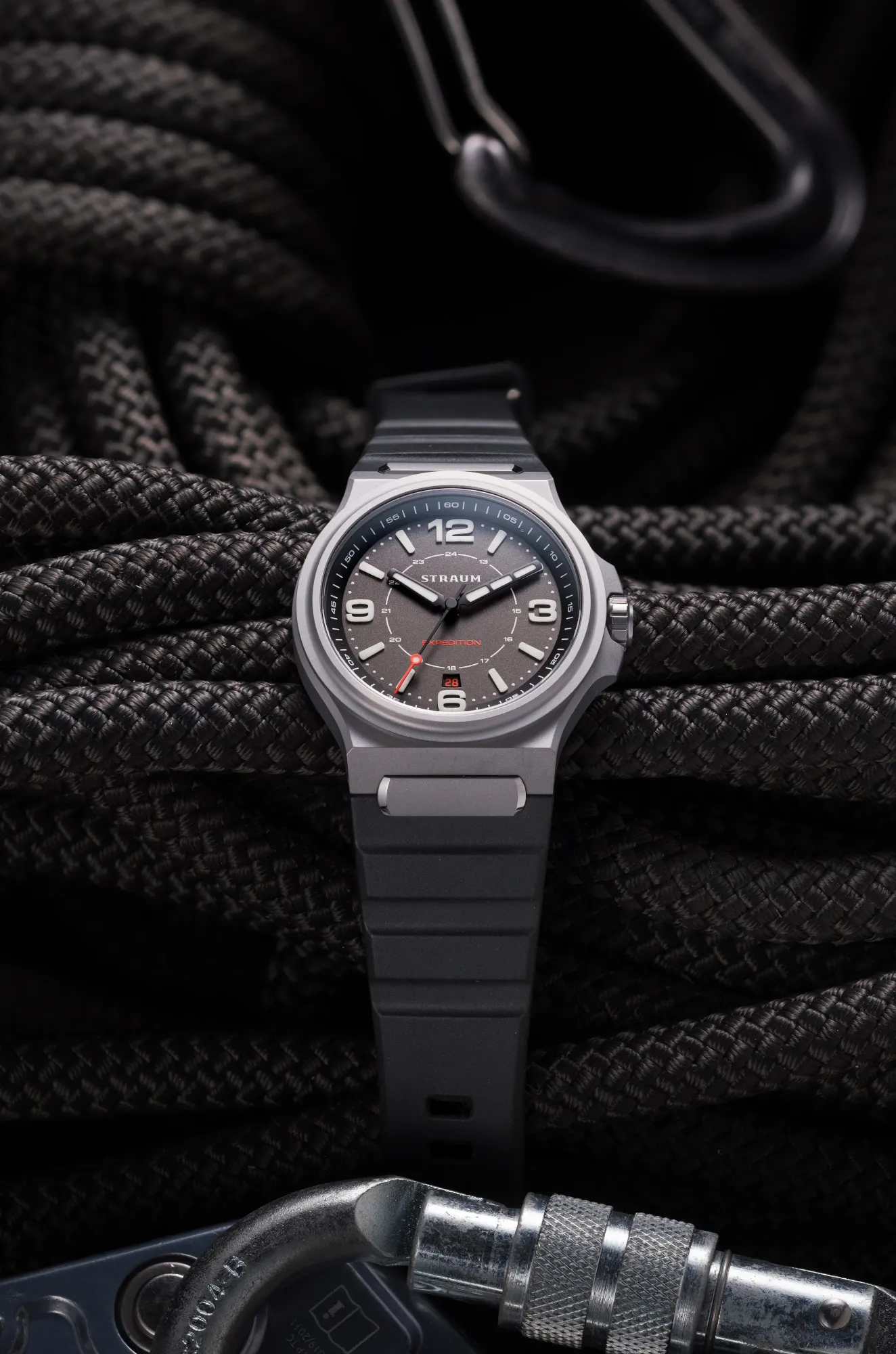
The specification that matters most here is not a number, it is a decision. The case is hardened Grade 5 titanium with a broadened flank, and the reason for that flank is that it deflects impacts away from the crystal. Instead of a slab of metal with a sapphire perched on top, the geometry has been shaped so that the most fragile part of the watch sits below the parts that will meet a rock face first. The stepped bezel does the same job from a different direction by lowering the case's highest plane.
The numbers back the intent up. The bezel measures 38.2mm across, thickness is 11mm with the crystal and 10.3mm without it, and the lug to lug is a very manageable 45.7mm. Water resistance is 10 ATM, which is the honest number for a watch that will meet rain, rivers, and snow rather than saturation diving. The whole thing is bead-blasted, which is exactly the right finish for a case designed to be scuffed, because bead-blasted hardened titanium ages into character rather than damage.
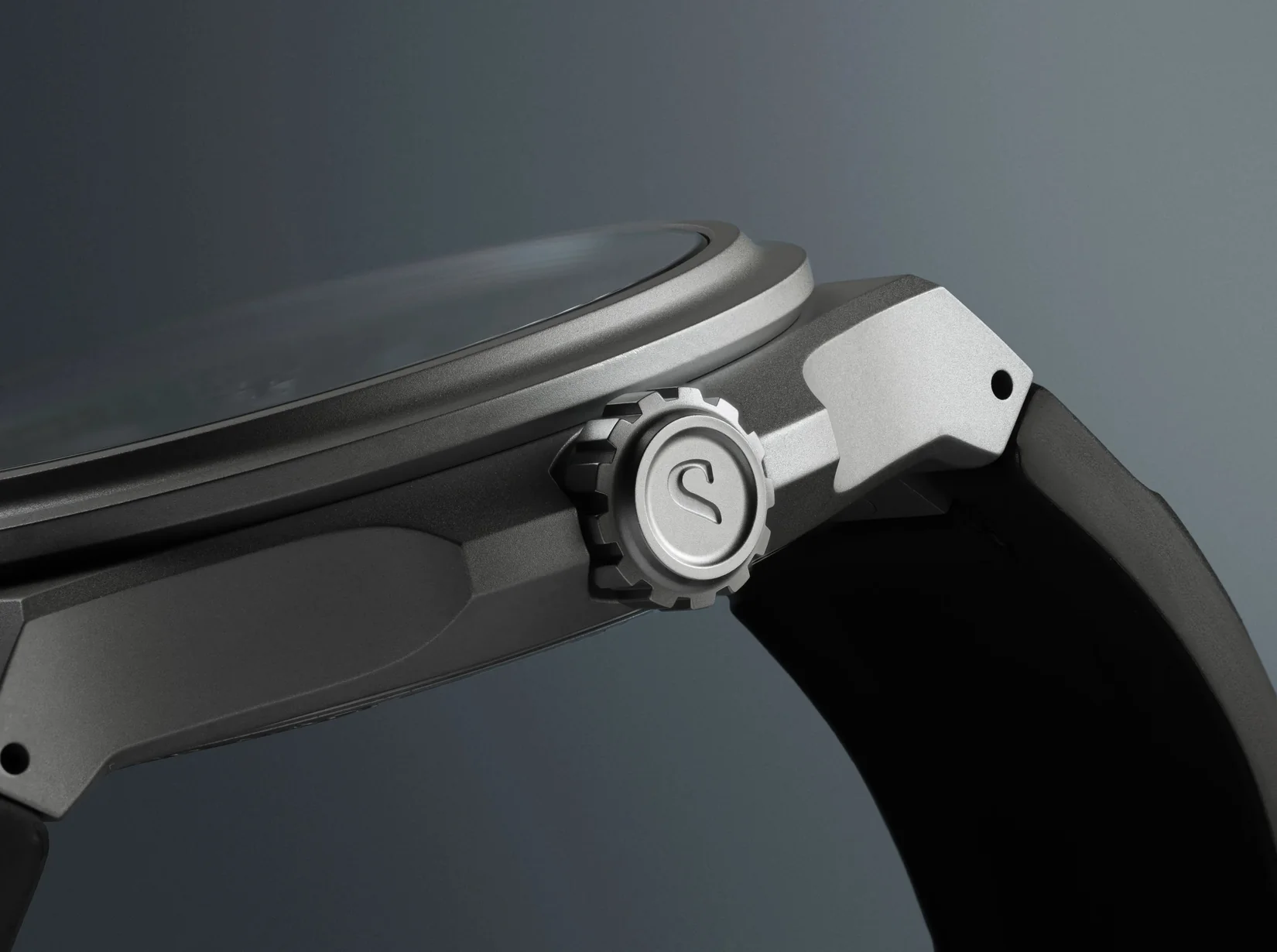
The crown is the tell that somebody on the design team has actually been outside in a Norwegian winter. It is an enlarged screw-down Grade 5 titanium crown, sized for cold or gloved hands, with a Fluor Orange security indicator so a glance tells you whether it is properly seated. Up top sits a double-domed sapphire with internal anti-reflective coating, which keeps the glass looking like an open window rather than a mirror. Built for real use, not babied.
Three Dials, One Idea
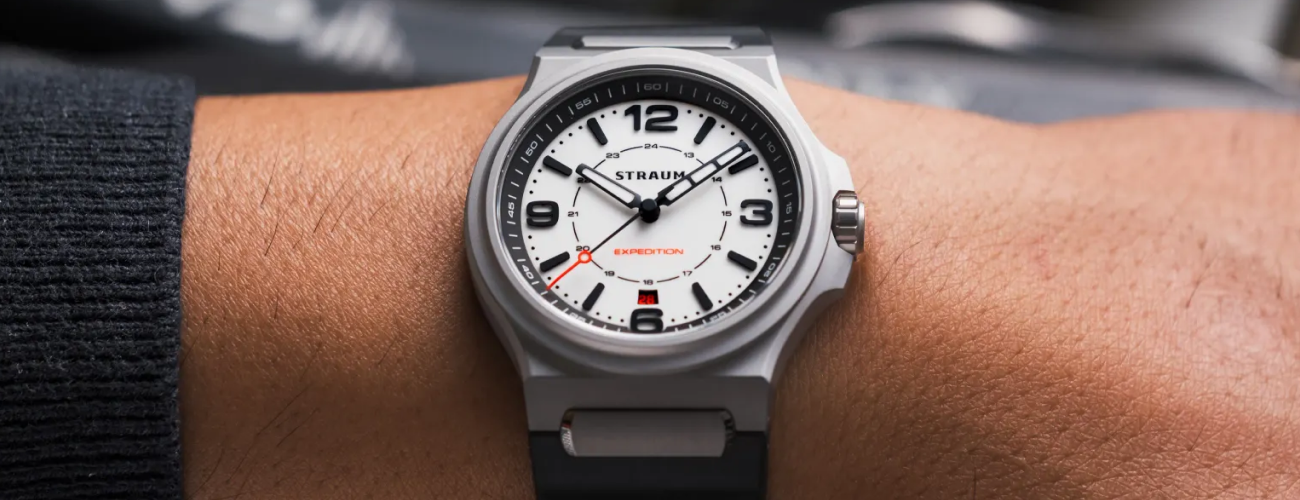
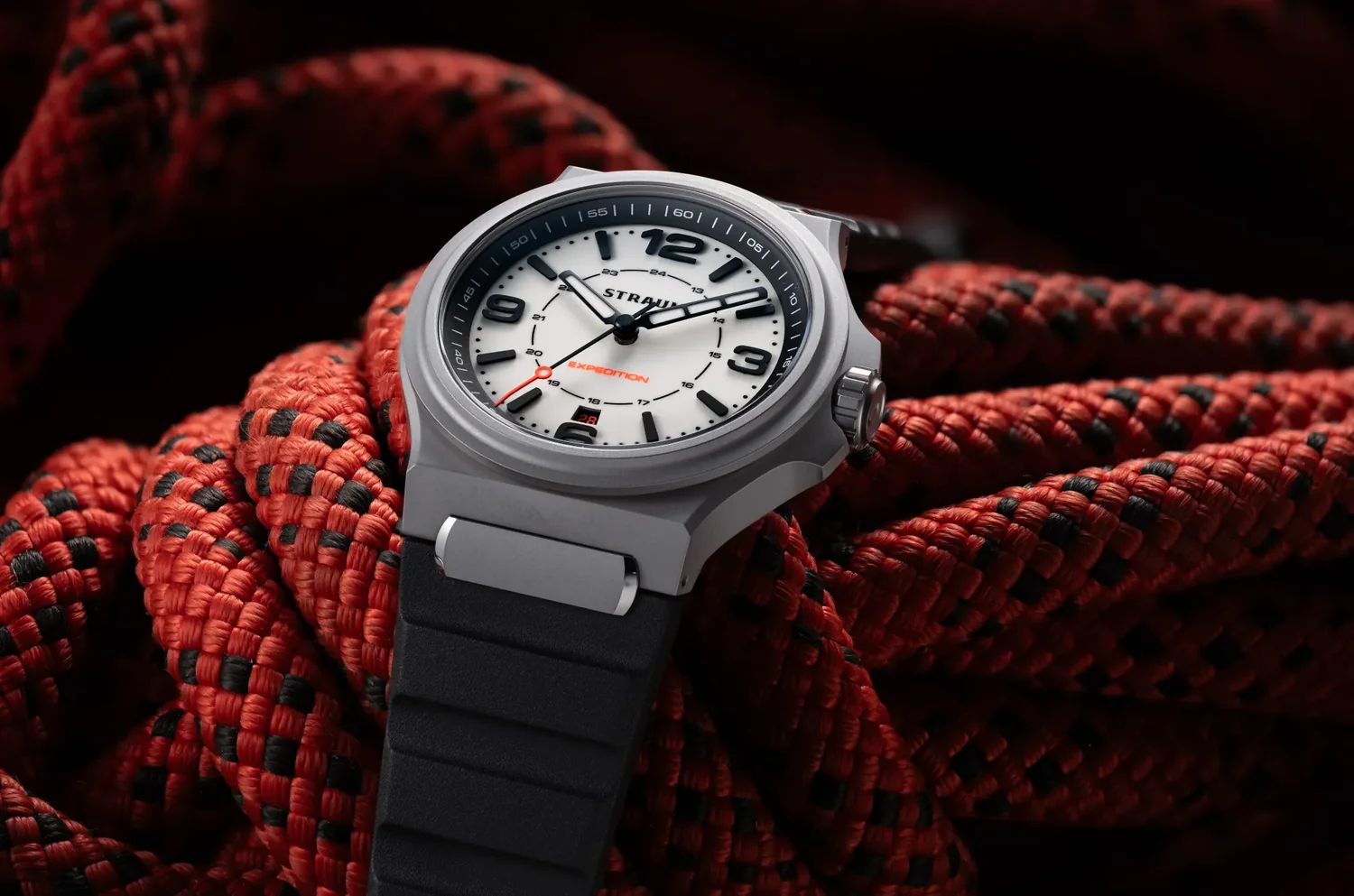
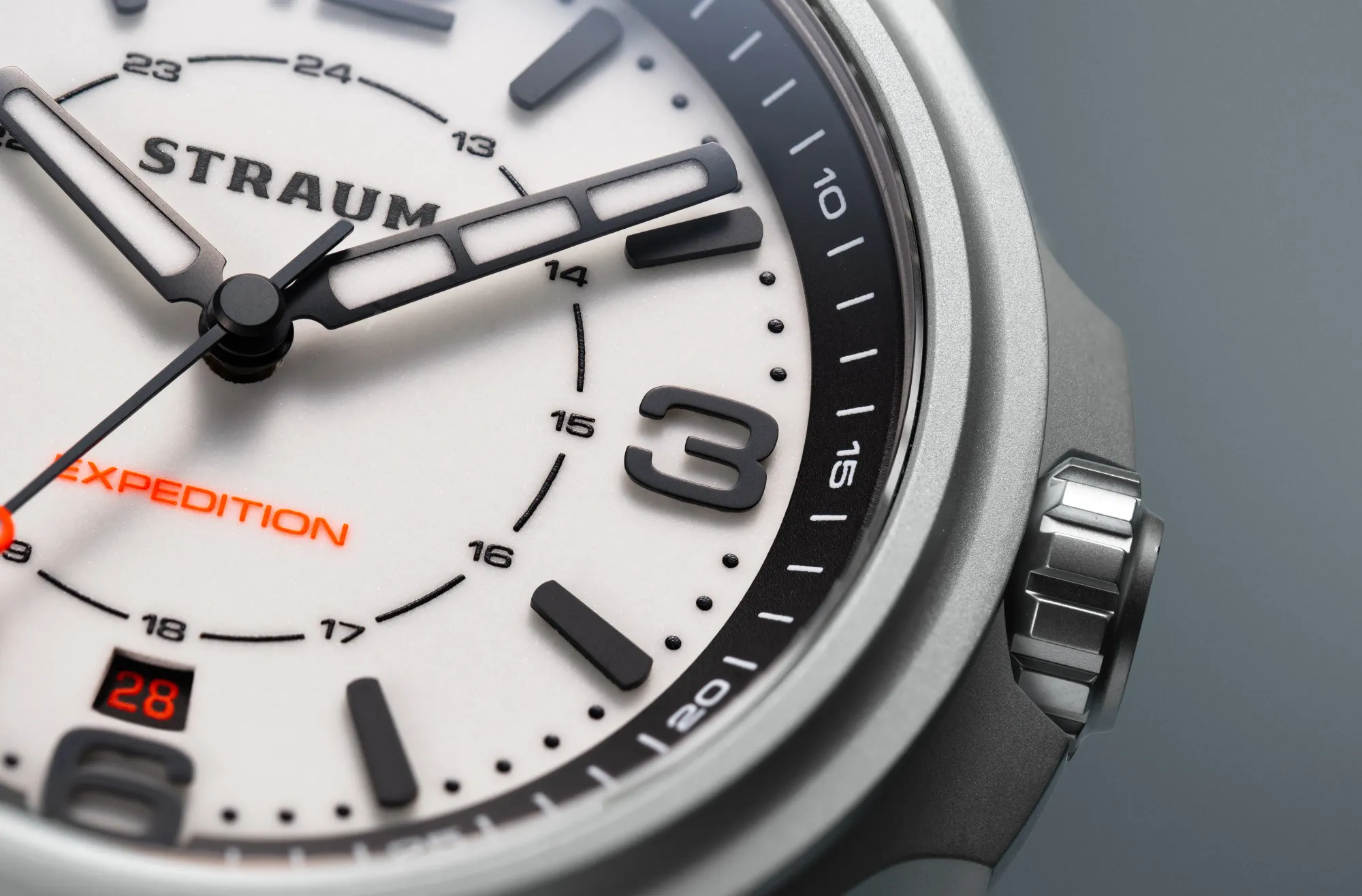
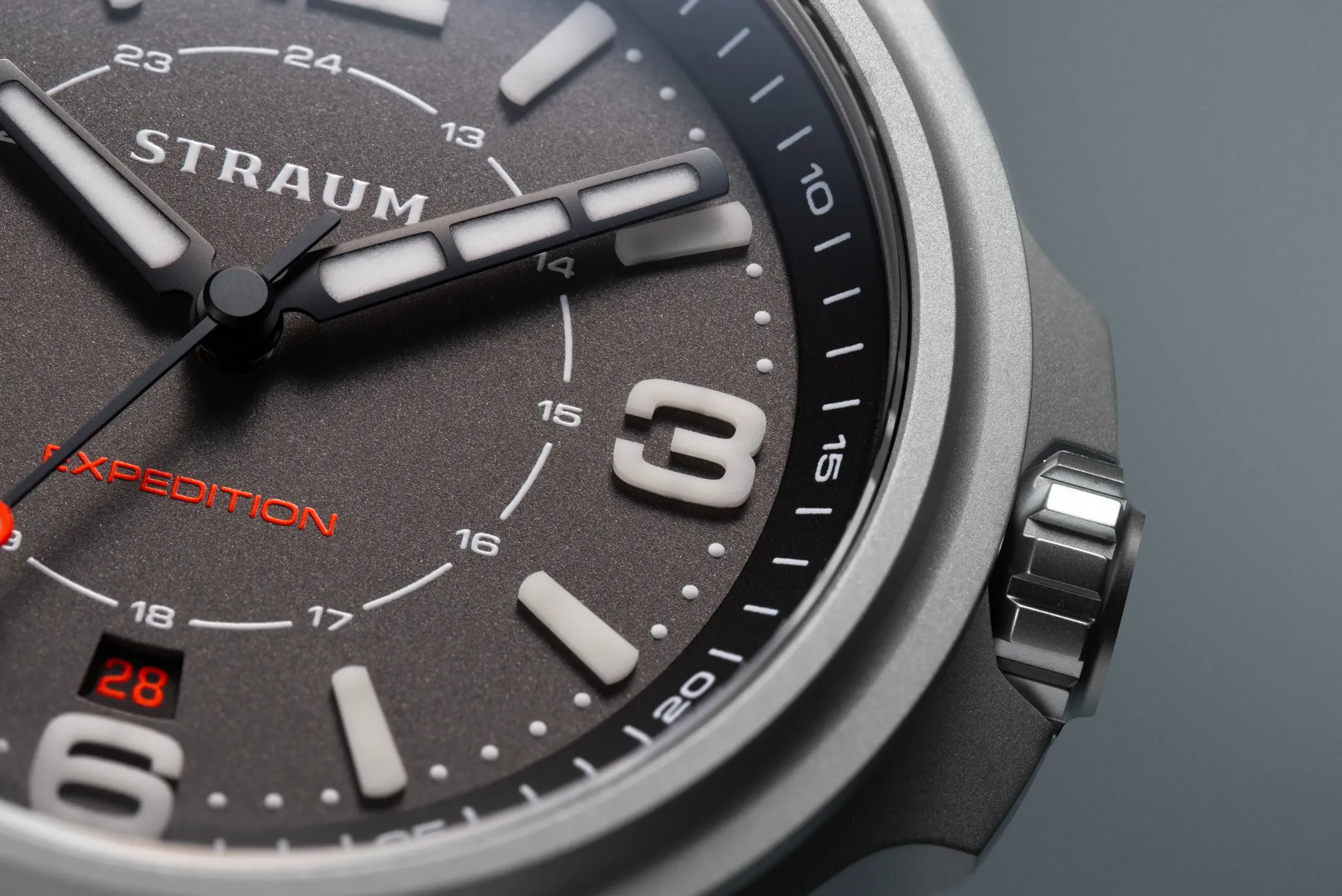
Straum's design team has an unusually good record with colour, and the Expedition launch trio continues that streak by mostly refusing to use any. Bright colour has been traded for high contrast here, which is the honest choice on a legibility-first watch. All three dials share the same architecture, applied indexes and large Arabic numerals at 12, 3, 6, and 9, a segmented minute hand for quick orientation, an hour hand shaped to line up with the intermediary markers, a date at 6 o'clock, and a single dab of Fluor Orange that lifts the whole thing without turning it into a highlighter.
The Titanium Gray is the purist's choice, a bare bead-blasted titanium dial whose numerals and indices are cast in solid white Super-LumiNova beneath black PVD hands. It is the version that looks most like the case swallowed the dial, and it takes ambient light without ever asking for attention. The Midnight Blue Launch Edition is the emotional one, lacquered in a blue that reads near-black until light finds it, with cast BGW9 markers and matte nickel-plated hour and minute hands set against a black PVD seconds hand. It is also the only limited version of the three, capped at 200 pieces.
Then there is the White Lume, which is where the concept goes all the way to its logical end. The dial is a fully luminous BGW9 Grade A foil surface, charging in daylight and glowing across its entire face at night, with black PVD-coated applied indexes and diamond-cut matte black PVD hands drawn on top of it. In daylight it reads as a clean white field watch, and in the dark it becomes a lamp with hands. On every dial the seconds hand carries a Fluor Orange tip and a luminous circle, so at 3am in a tent you can confirm the watch is still running without moving your arm (a small detail that tells you somebody has actually needed to check).
Movement: The La Joux-Perret G100 Under a Hiker’s Sky
Inside sits the Swiss made La Joux-Perret G100, which has become one of the more sensible choices at this level of the market. It carries 24 jewels, runs a 68 hour power reserve, and Straum regulates each one in house rather than shipping them out as they arrive. The functional spec is deliberately narrow, hours, minutes, seconds, and a date, because a watch built around legibility has no business hiding the time behind a complication.
The 68 hours matter more on this watch than on most. A field watch that comes off your wrist on Friday night and still runs on Monday morning is a watch you do not have to reset every time it leaves the rotation, and that is the difference between an object you use and an object you maintain.
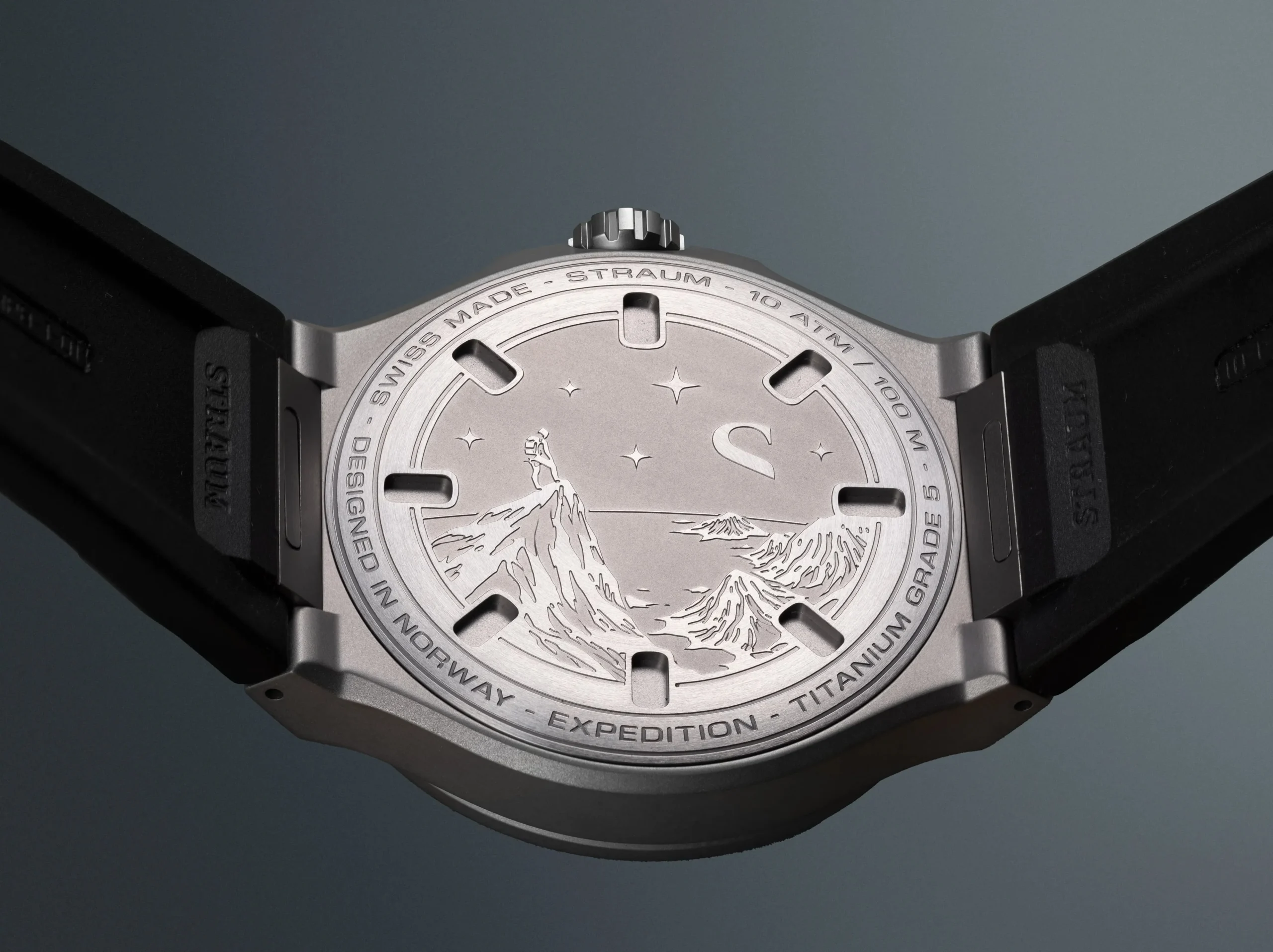
The caseback is where Straum lets the romance back in. It is screw-down hardened Grade 5 titanium with circular brushing, etched with an illustration of a lone hiker beneath a star-filled sky, lit by the Straum "S". There is no exhibition window, which is the correct call on a case whose whole job is to protect what is inside, and the etching is beautifully done in a way that rewards the person taking it off at the end of a long day.
Strap, Bracelet and Everyday Wearability – the Straum Special
The Expedition launches on a choice of FKM rubber or a CNC-machined Grade 5 titanium bracelet, both attached with a quick-release button so switching takes seconds. The rubber tapers hard, from 24.8mm at the lugs down to 18mm at the buckle, and Straum offers it in black, white, beige, grey, yellow, dark blue, dark green, and purple, which is more colour choice than most brands give you across an entire catalogue.
The bracelet is bead-blasted with polished accents, tapered to match, and closes on a machined butterfly deployant with an integrated micro-adjust system giving 4mm of adjustment across three positions. It also ships with two 130% links for anyone whose wrist swells on a long day out (trust me, don't underestimate this feature, you will need it). On rubber the complete watch weighs about 80 grams, on the bracelet around 101 grams, and the head alone is roughly 50 grams. Those are numbers that disappear under a jacket sleeve.
One detail that will matter to existing owners more than to newcomers: the Expedition takes Jan Mayen collection straps. If you already have a drawer of Straum rubber from a previous purchase, none of it becomes obsolete, which is a small courtesy plenty of brands cannot be bothered with.
Why It’s Special
The Expedition is not a reinvention of Straum, it is a hardening of it. The things that make it worth attention are mostly things other brands leave on the table.
- Purpose-Shaped Geometry: The broadened case flank and stepped bezel are not styling flourishes, they are two separate structural answers to the same question of how to keep a rock away from the sapphire
- A Fully Luminous Dial Done Properly: Plenty of brands do a lume dial. Doing one in BGW9 Grade A foil with black PVD applied indexes on top, and still keeping the daytime look clean and legible, is the harder version of the trick
- A Collection With an Actual Thesis: Splitting the catalogue into Inspired By and Built For is not a marketing reshuffle, it is Straum telling you in advance which of its watches are meant to be looked at and which are meant to be REALLY used
- Titanium All the Way Through: Hardened Grade 5 case, Grade 5 crown, Grade 5 caseback, Grade 5 bracelet. At this price point most competitors would have quietly switched to steel somewhere in that list
- A Genuine Tribute: Norway does not need help being beautiful, but it does deserve objects made with this much care in its name. If you have ever spent a summer up there, and I try to spend mine in Scandinavia for exactly this reason, the Expedition will read as accurate rather than decorative
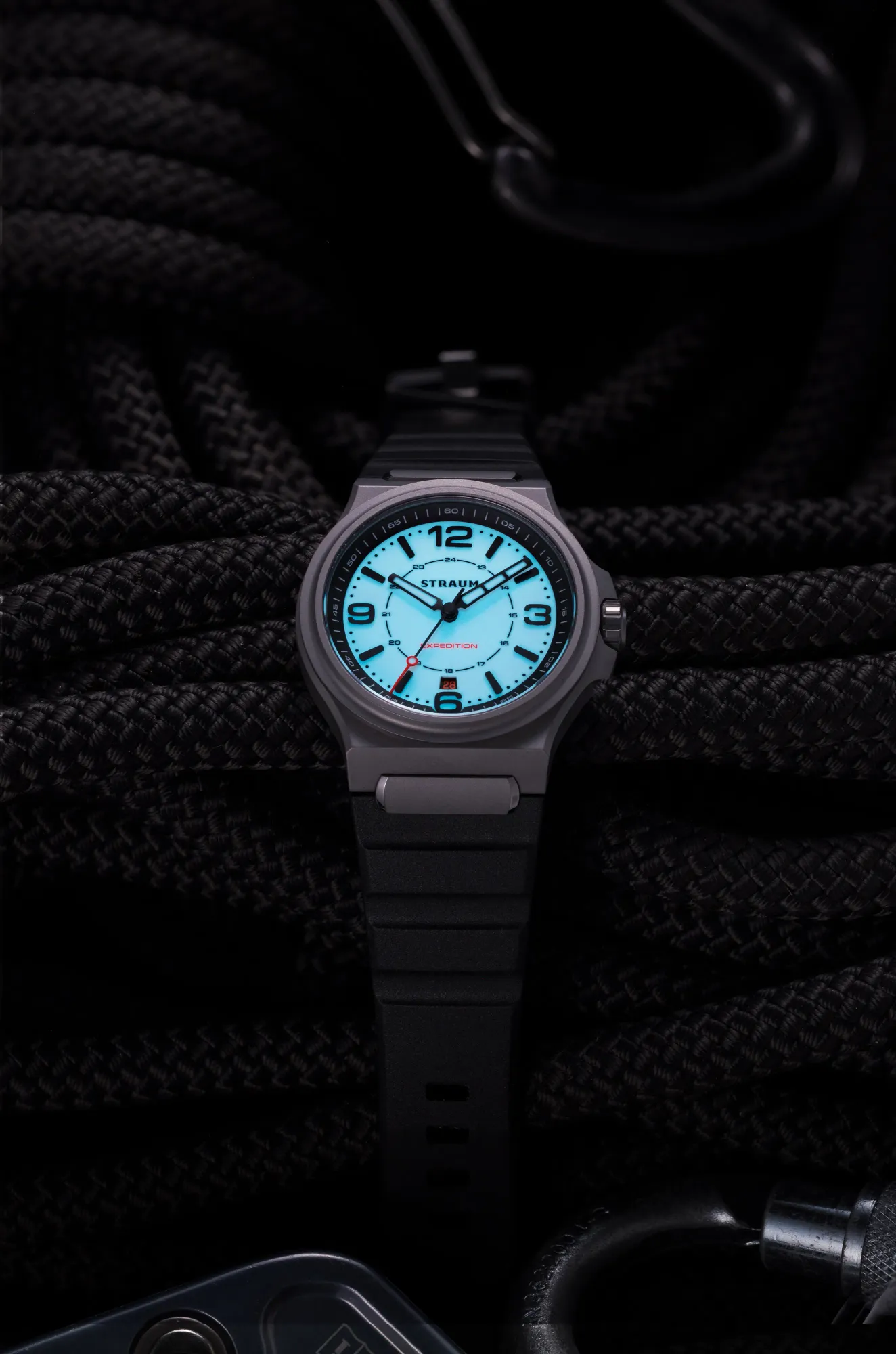
Norwegian Nature, Rendered in Titanium
The Expedition is the most single-minded watch Straum has made, and it is the one that most clearly explains what the brand actually is. The case protects, the dial informs, the movement runs for three days, the caseback tells you why any of it exists. Nothing is there to be admired in isolation, and the whole thing is better for it.
At $2,750 / €2,100 (31,000 NOK) on FKM rubber, and $3,100 / €2,360 (35,000 NOK) on the titanium bracelet, it is not an impulse purchase, and Straum has not priced it like one. What you are paying for is a fully hardened Grade 5 titanium platform, a Swiss automatic regulated in house, and a design team that has yet to release something half-considered. The Midnight Blue is limited to 200 pieces, the other two are standard production, and all three ship in March 2027.
Norwegian nature has been used as a marketing line by a hundred brands. This is the first one in a while that reads like it was written by somebody who had actually been out in it.
Specifications
- Brand: Straum
- Model: Expedition (White Lume, Titanium Gray, Midnight Blue Launch Edition)
- Case Material: Bead-blasted hardened Grade 5 titanium, stepped bezel, broadened flank
- Case Dimensions: 38.2mm bezel diameter, 11mm thick (10.3mm excluding crystal), 45.7mm lug to lug, 24.8mm lug width
- Water Resistance: 10 ATM
- Strap: FKM rubber tapering 24.8mm to 18mm with quick-release, in eight colours, or CNC-machined Grade 5 titanium bracelet with butterfly deployant and 4mm micro-adjust across three positions
- Crystal: Double-domed sapphire with internal anti-reflective coating
- Movement: La Joux-Perret G100, Swiss made automatic, 24 jewels, hours, minutes, seconds and date, regulated in house
- Power Reserve: 68 hours
- Lume: Yes, Super LumiNova BGW9 Grade A (fully luminous foil dial on the White Lume, cast lume markers on Titanium Gray and Midnight Blue)
- Limited Edition: Midnight Blue Launch Edition limited to 200 pieces; Titanium Gray and White Lume are standard production
- Price: $2,750 / €2,100 / 31,000 NOK on FKM rubber. $3,100 / €2,360 / 35,000 NOK on the Grade 5 titanium bracelet
- Availability: Pre-order opened August 24 2026, ships March 2027
Image Gallery
About Straum Expedition: Key Questions Answered
How big is the Straum Expedition on the wrist?
The bezel measures 38.2mm across, the case is 11mm thick (10.3mm without the crystal) and the lug to lug is 45.7mm. On a rubber strap the whole watch weighs around 80 grams, so it wears far smaller and lighter than the numbers suggest for a hardened titanium tool watch.
Which Straum Expedition dial is limited?
Only the Midnight Blue Launch Edition is limited, capped at 200 pieces. The Titanium Gray and the White Lume are standard production models, so if the blue is the one you want, it is the one with a clock on it.
What movement does the Straum Expedition use?
It runs the Swiss made La Joux-Perret G100, an automatic calibre with 24 jewels and a 68 hour power reserve, regulated in house by Straum. It drives central hours, minutes, seconds and a date at 6 o’clock.
Top Lists
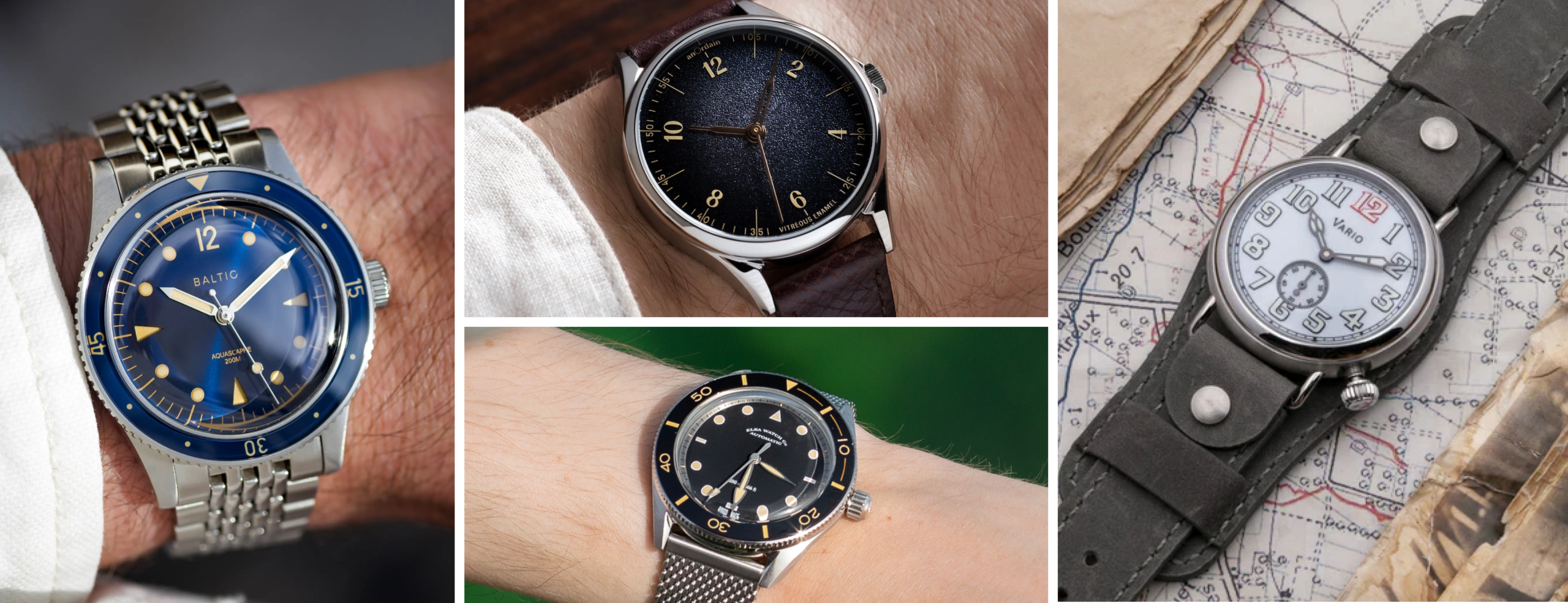
- anOrdain, Baltic, Elka, Furlan Marri, Havaan Tuvali, HEINRICH Watches, Laco, Ophion, Vario
- By Dan H.
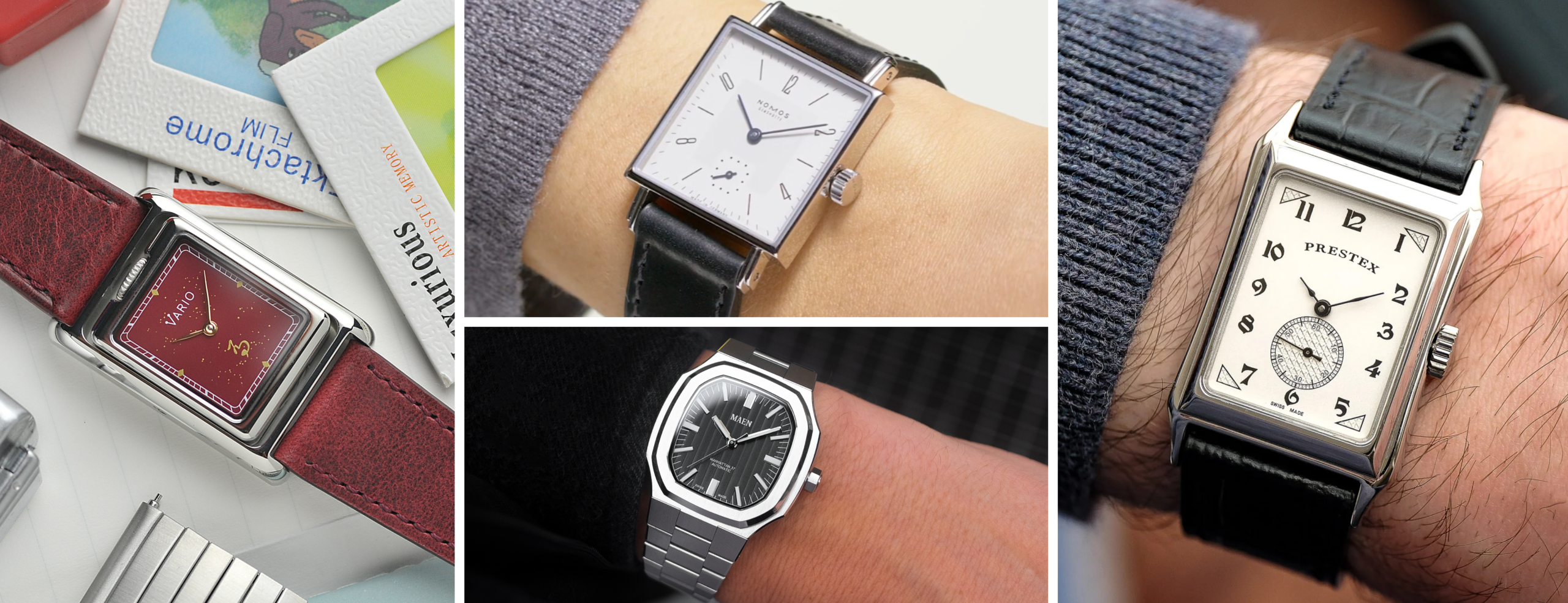
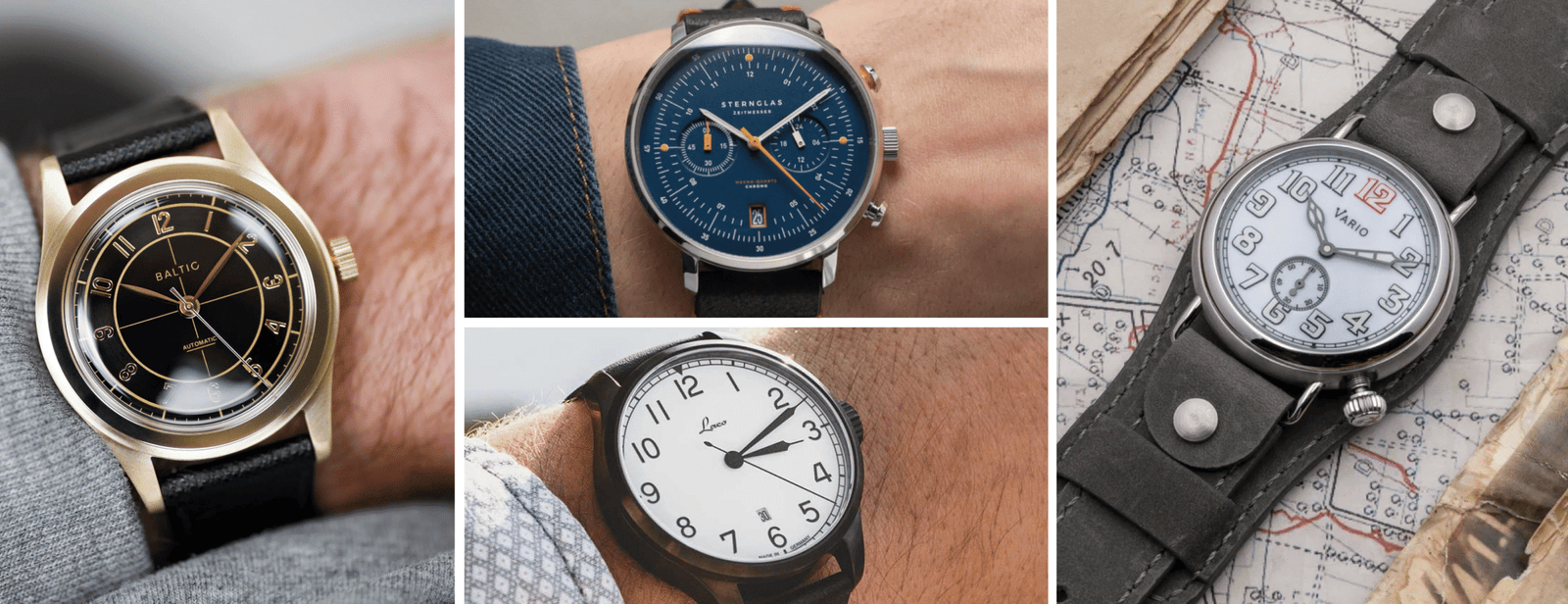
- Astor & Banks, Baltic, Havaan Tuvali, Laco, MD Watches, STERNGLAS, Vario
- By Dan H.