
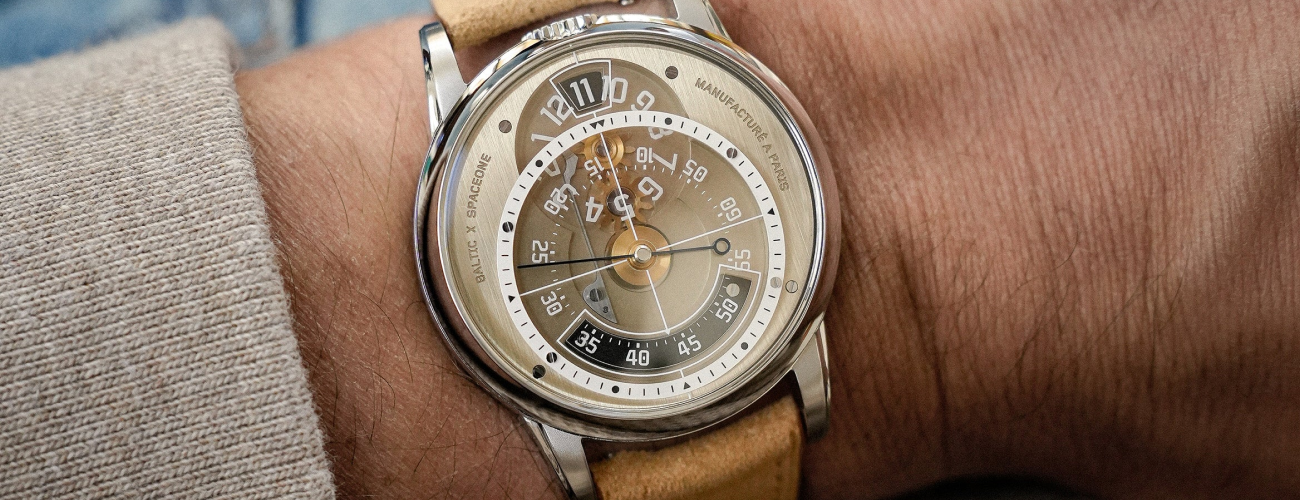
Baltic x SpaceOne Seconde Majeure Review – A Parisian Collaboration to Fall in Love With
- Dan H.
- May 19, 2026
A Parisian incident worth Every Second
Some collaborations make sense on paper. Two brands with overlapping aesthetics, a shared market, complementary audiences. You see the business logic immediately and nod politely. And then there are collaborations like the Baltic x SpaceOne Seconde Majeure, which make absolutely no logical sense whatsoever, and yet, the moment you lay eyes on it, you completely understand why it exists.
Baltic, founded in 2017 by Etienne Malec in Paris, has built one of the most beloved microbrand identities in the world. Their vintage-inspired watches, careful attention to craft, and deeply French sensibility have earned them a devoted following (and rightfully so, as anyone who has spent time with the MR Classic Salmon will tell you). SpaceOne, on the other hand, is a very different creature. Founded by Guillaume Laidet and watchmaker Théo Auffret, SpaceOne makes watches that look like they were designed inside a spacecraft, deconstructing the very concept of reading time and rebuilding it from the ground up. Vintage subtlety versus futurist audacity. Heritage versus disruption.
The story of how these two worlds collided is genuinely charming. In 2021, Baltic invited French watchmakers to visit their new Paris headquarters. Théo Auffret and Guillaume Laidet showed up, a friendship was born, and five years later, that friendship became the Seconde Majeure. Honestly, in an industry where so many “collaborations” are just co-branded marketing exercises, this one feels like the real thing, two independent visions that refused to compromise and somehow, beautifully, met in the middle.
A Dial that stops you Cold
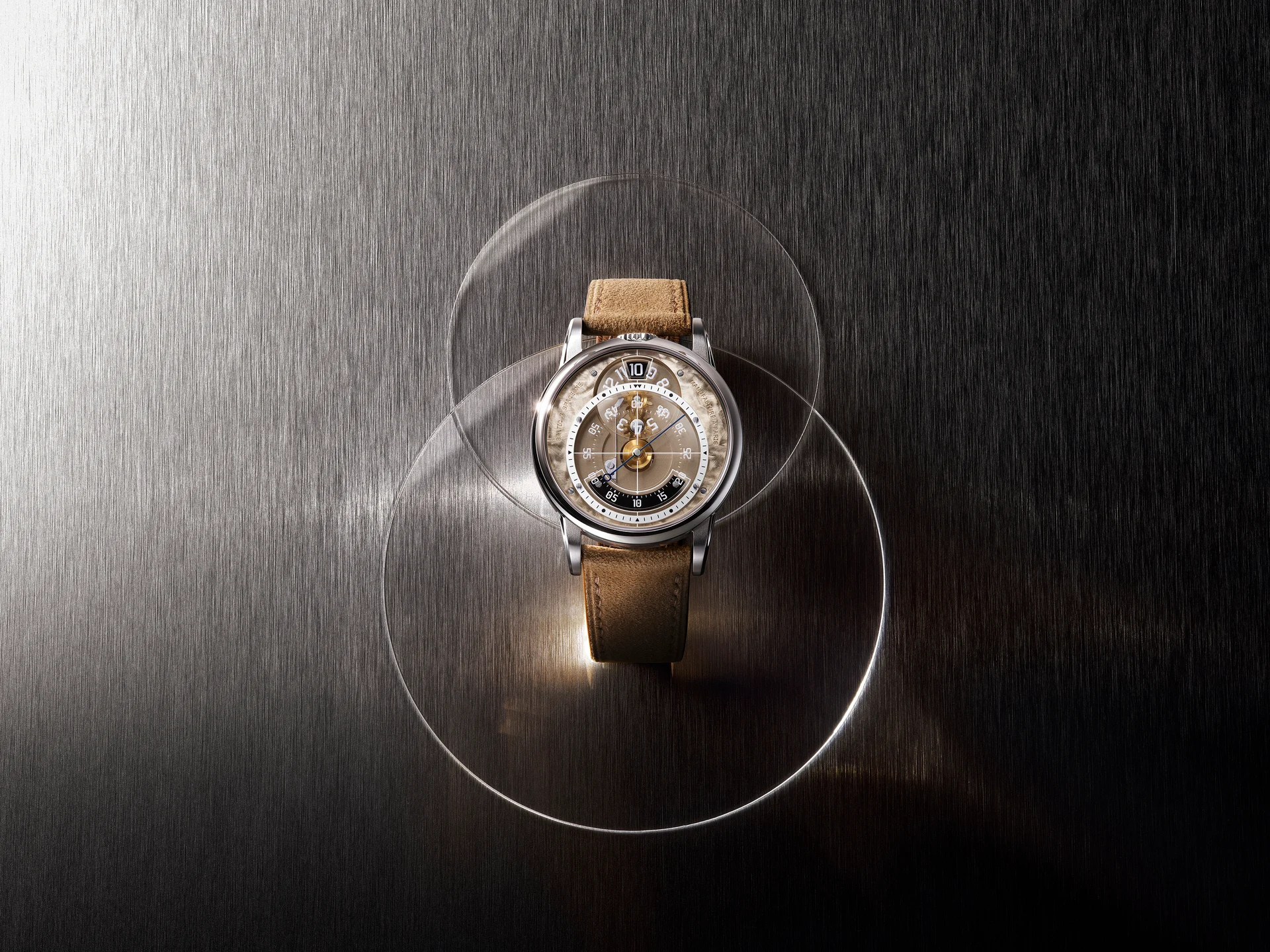
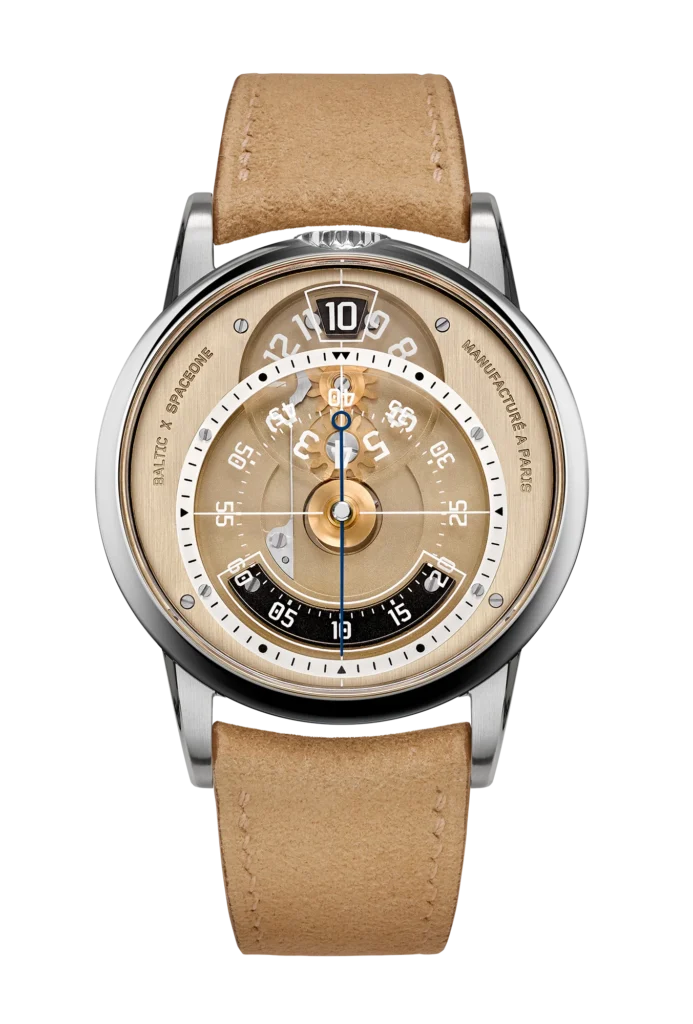
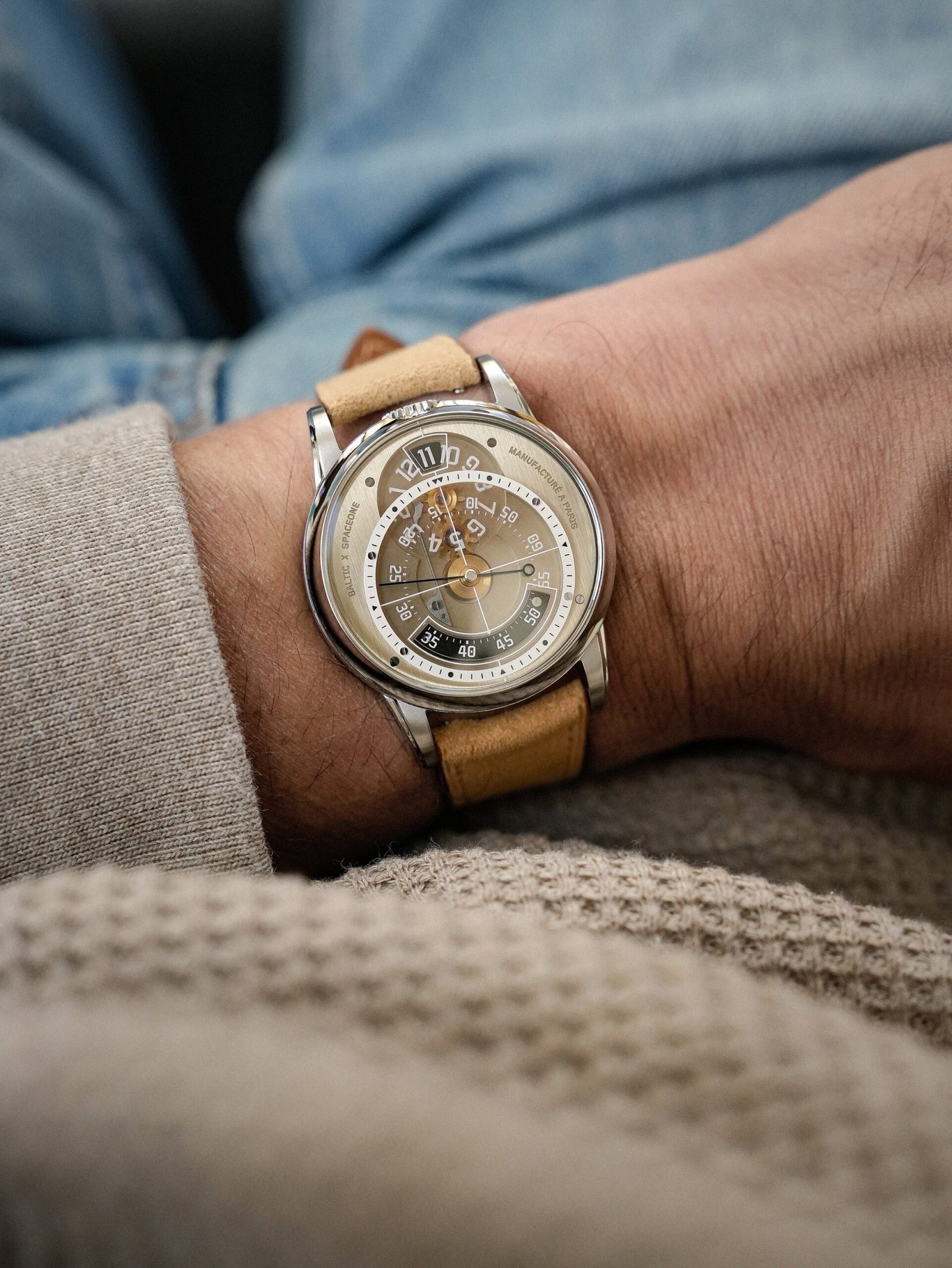
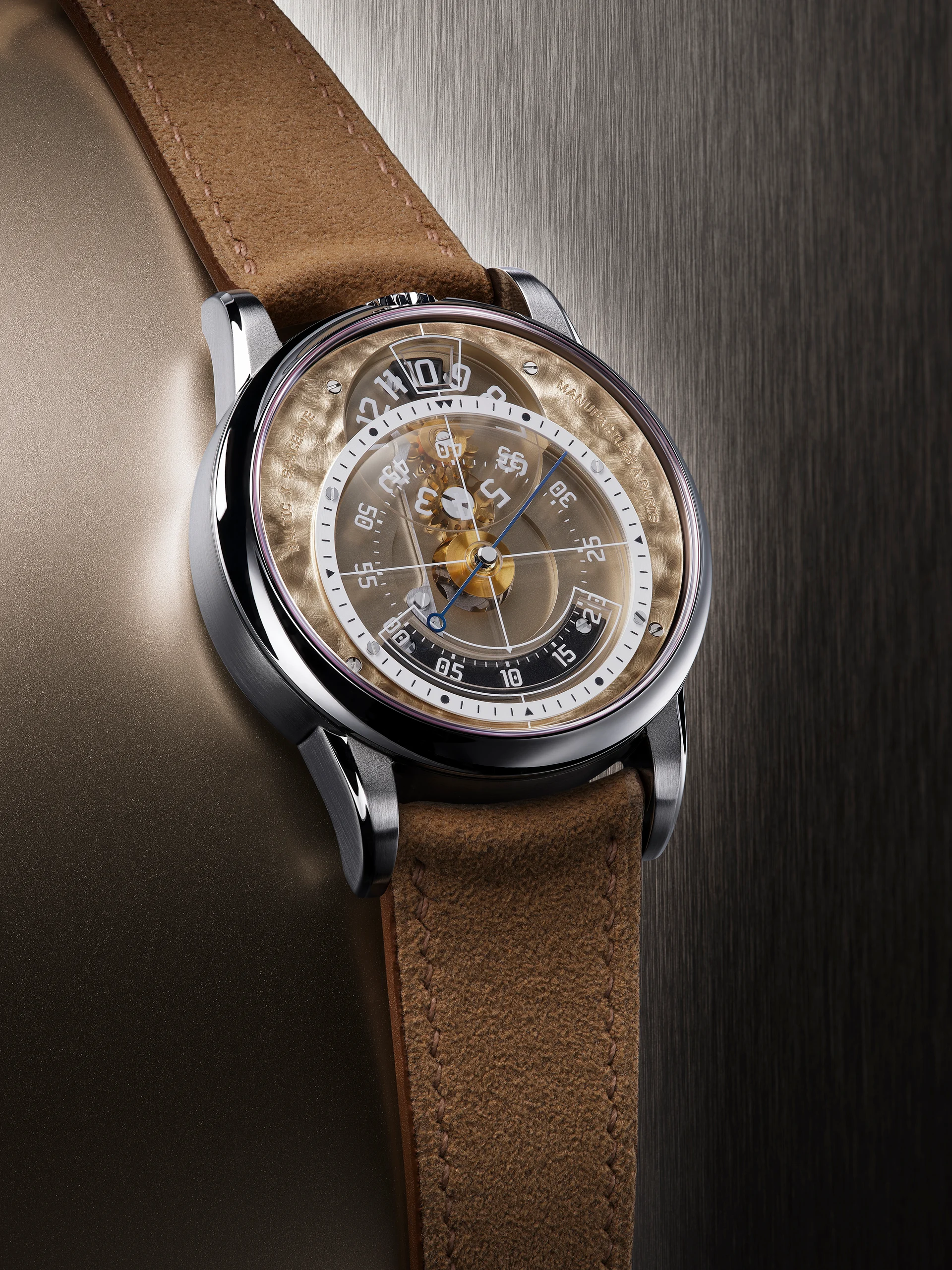
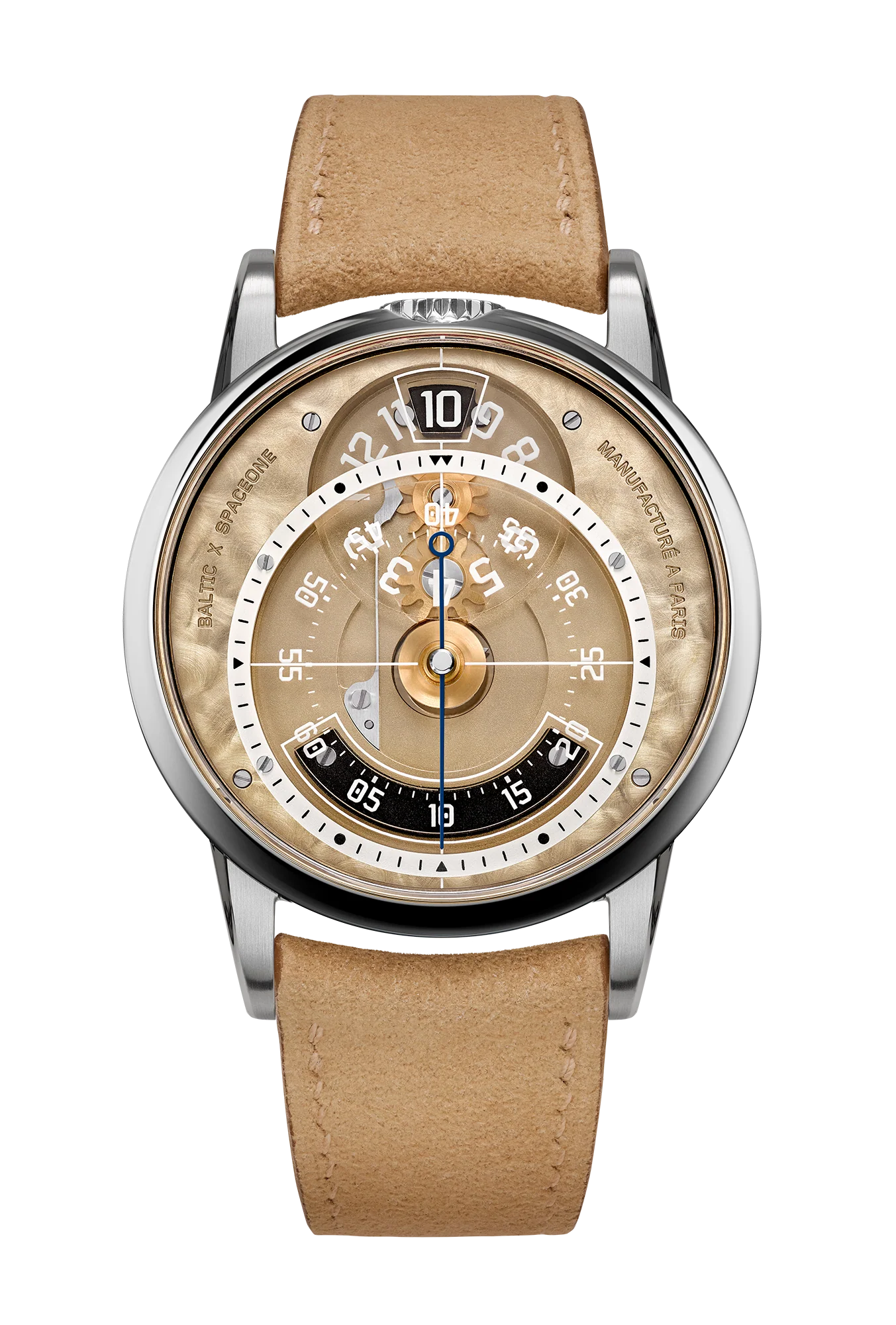
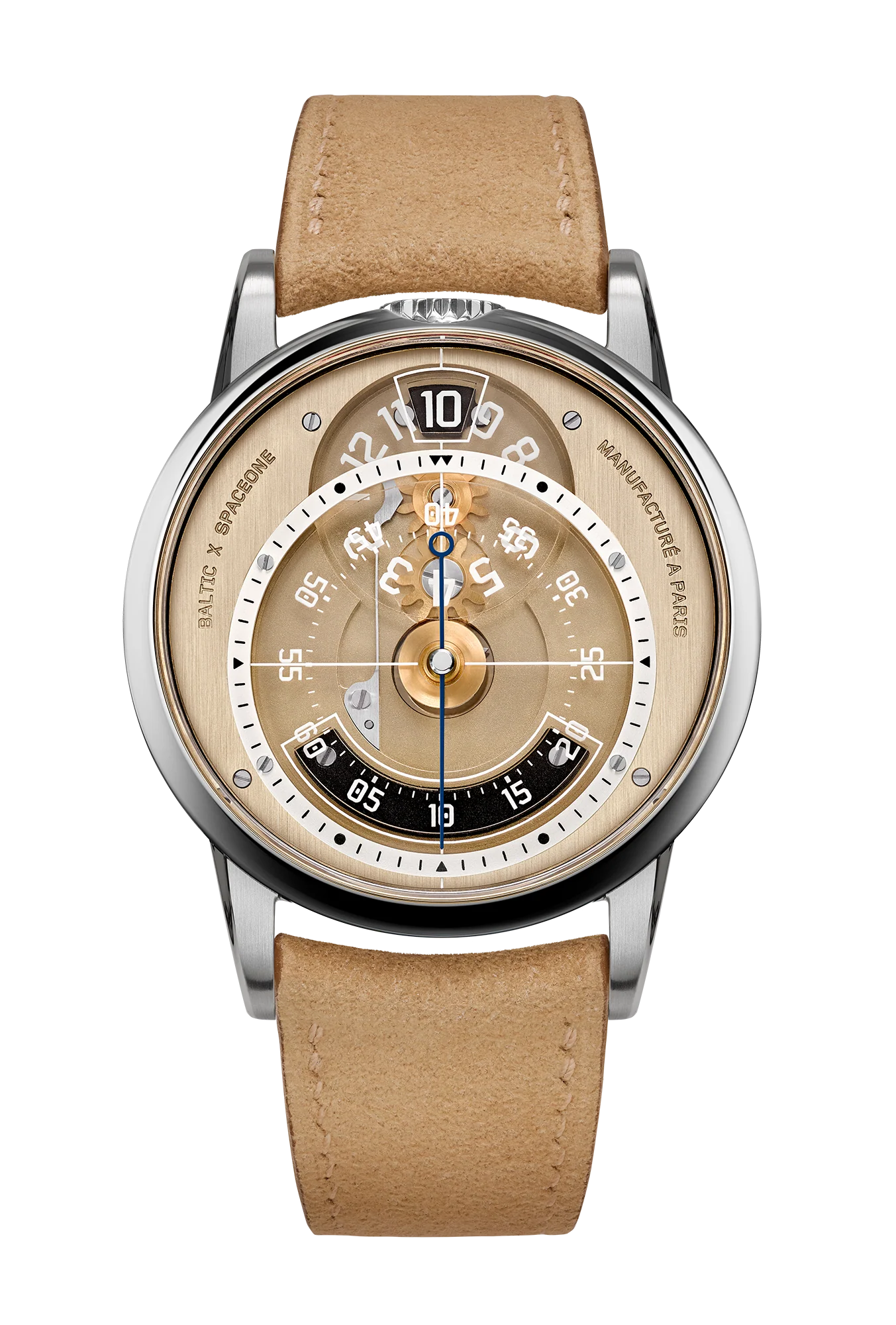
Let’s get straight to the point: the dial of the Seconde Majeure is something else entirely. The watch takes what the brand calls a kinematic approach to time reading. Instead of traditional hands sweeping across a dial, the Seconde Majeure uses sapphire discs, with hours displayed at 12 o’clock and minutes at 6 o’clock, each guided by a forward-pointing arrow crosshair. Above all of this, a large central seconds hand glides across the entire composition. It’s the sweep of that hand that gives the watch its name (and what a name to give it).
The dial itself is cut from a single piece of maillechort, a copper-zinc-nickel alloy with a long tradition in fine clockmaking. It serves double duty here: decorative surface and structural plate, supporting Théo Auffret’s custom jumping-hour module from below. The typography stamped on the sapphire discs is bold and forward-looking, bringing a graphic tension to what would otherwise be a very refined, classical assembly. It is, quite simply, one of the most visually striking dials I have seen from the French independent scene in years.
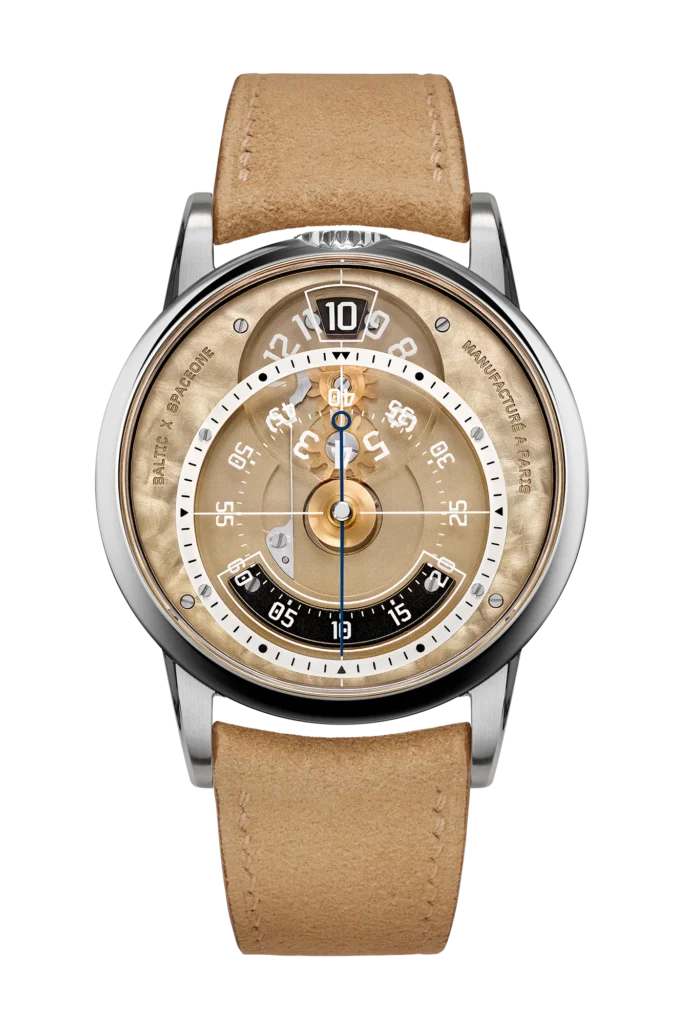
The watch comes in two dial finishes. The Brushed version, at €3,000 / $3500, offers a clean, industrial elegance that feels completely at home in SpaceOne’s futurist vocabulary. Then there is the Charbonné. At €4,200 / $4890, it is the version I completely fell in love with, and I am not sure I have fully recovered. The Charbonné technique is a 19th century decorative method, originally found on precision clocks of that era, achieved using a piece of charcoal worked across the metal surface. The result is a finish that oscillates between matte and glossy depending on how light catches it, sometimes appearing almost chalky, other times reflecting with a depth that genuinely surprises you. In Théo Auffret’s hands, this process takes up to three hours per dial. Three hours. For one dial. That kind of commitment to craft is exactly what the independent watchmaking world is built on.
Case and Dimensions: Refined to the Millimeter
The case is 38.5mm in diameter, 47.5mm lug to lug, and 12.3mm thick, all in 904L stainless steel (the same grade used by Rolex, for those keeping track). These are dimensions that feel considered rather than compromised. The 38.5mm diameter is generous enough to carry the complex dial without overwhelming the wrist, and the 47.5mm lug to lug should sit comfortably on a wide range of wrist sizes. The lug width is 20mm, which opens up a good range of aftermarket strap options if the included Alcantara strap by Delugs is not your first choice (though it is a lovely one).
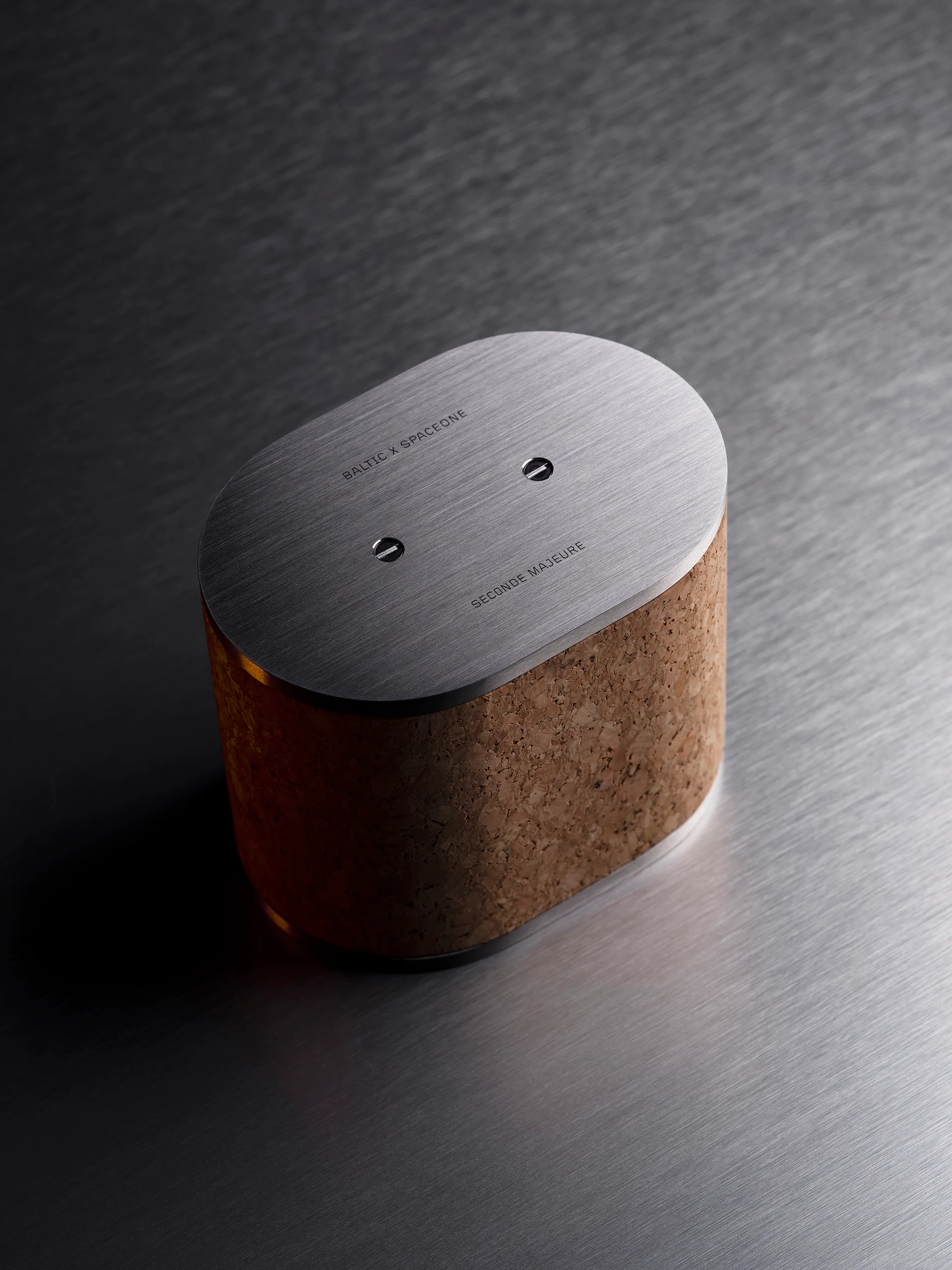
One detail I keep coming back to is the crown. Positioned at 12 o’clock and flushed directly into the case, it disappears into the architecture of the watch in a way that feels completely deliberate and genuinely satisfying. There is no awkward protrusion digging into your wrist, no visual interruption to the case profile. It is smooth, integrated, and almost invisible until you need it. This is exactly the kind of considered design decision that separates watches built with genuine intent from those built to a brief.
The crystal is a single dome sapphire with an internal anti-reflective coating, offering clarity across the complex dial layout without unwanted glare. Water resistance sits at 50 metres (5 ATM), which is appropriate for a dress-adjacent piece of this nature.
Movement: A Complication built from Friendship
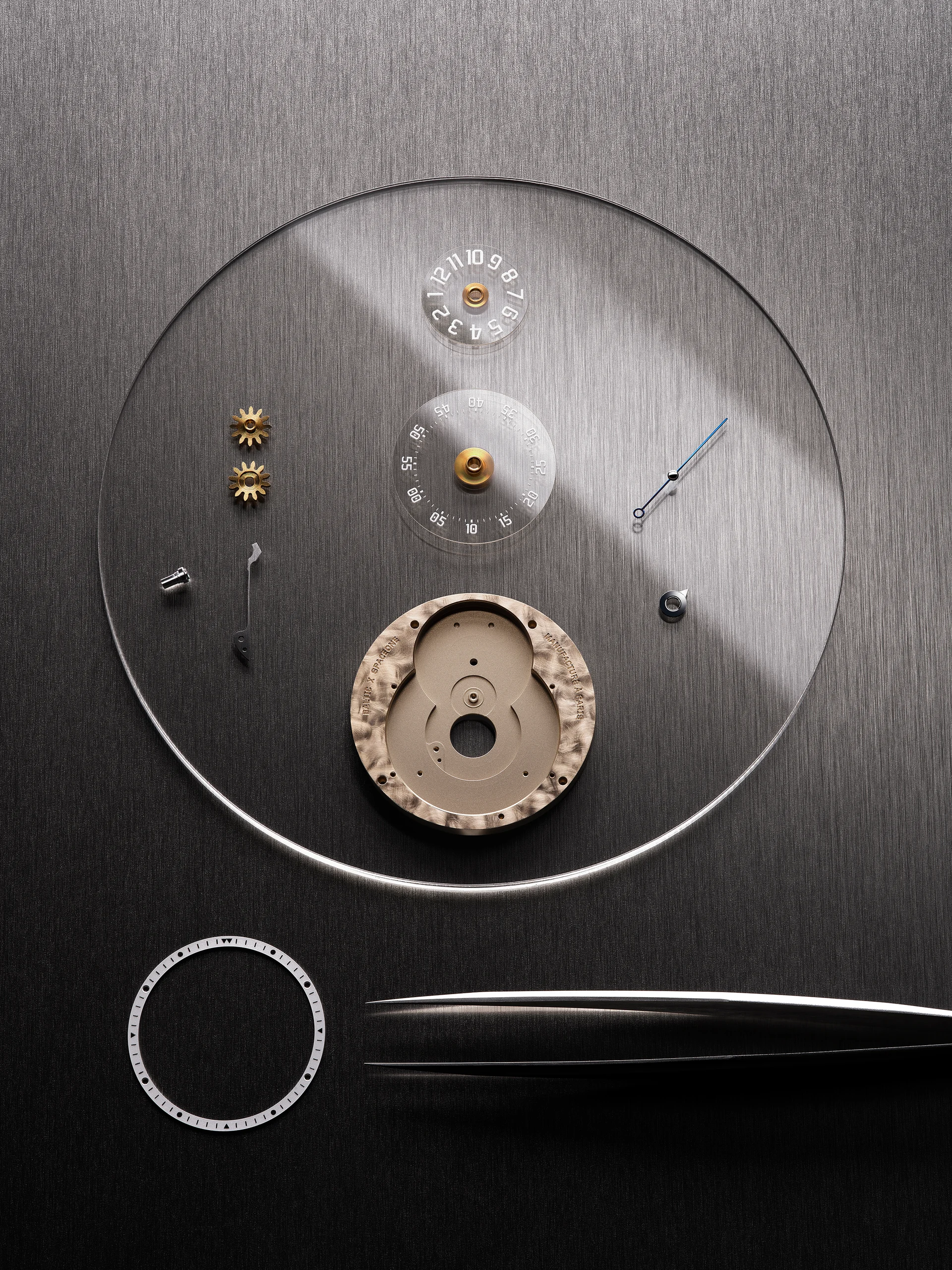
Under the dial, the Seconde Majeure runs on a Soprod P024 automatic movement with a 42-hour power reserve. The Soprod P024 is a reliable Swiss-made base, but the real story here is the jumping-hour complication module developed entirely by Théo Auffret and layered on top of it.
The module relies on three visible components: a Central Control Wheel beneath the minute disc, which completes one full rotation per hour; a Star Wheel with 12 teeth corresponding to the 12 displayed hours; and a Jumper Spring, visible to the left of the dial, which maintains tension against the Star Wheel. When the Control Wheel completes its rotation, it engages the Star Wheel, pressure builds in the Jumper Spring, and then the hour disc jumps cleanly and crisply to the next position. It is a mechanism you can partially observe through the sapphire discs, giving the watch a kind of mechanical theatre that rewards close attention (time well spent, one might say).
What makes this particularly impressive is that this is not an off-the-shelf jumping hour module. Théo Auffret designed it specifically for this watch. In the world of independent watchmaking, that matters enormously.
The Baltic and SpaceOne DNA, both very present
What I find most remarkable about the Seconde Majeure is how thoroughly it manages to feel like both brands at once. The refined proportions, the Parisian elegance, the commitment to craft and material quality: that is Baltic. The deconstructed time display, the bold typography on the sapphire discs, the futurist architecture of the dial: that is SpaceOne.
There is no sense that one brand swallowed the other. This is not a Baltic watch with a SpaceOne logo slapped on the dial, nor is it a SpaceOne concept that Baltic merely manufactured. The color scheme across both variants is calibrated to walk this same line. The Brushed version leans into SpaceOne’s industrial confidence. The Charbonné tilts toward Baltic’s love of surface craft and historical technique. And yet both feel unmistakably like a single, unified object.
What Makes It Special
A few things stand out most clearly:
- Jumping-Hour Complication: Designed specifically by Théo Auffret for this watch, not an adapted off-the-shelf module
- Charbonné Finishing: A 19th century clockmaking technique requiring up to three hours of hand labour per dial
- Flushed Crown at 12 o’clock: Fully integrated into the case architecture, clean, ergonomic, and visually seamless
- Sapphire Disc Display: Sapphire discs for both hour and minute reading, an unusually refined material choice for this complication type
- Maillechort Dial Plate: A single piece of the alloy serves as both dial surface and structural plate for the complication module
Conclusion
The Seconde Majeure arrives at a moment when the independent watchmaking world is producing some of its most compelling work. Baltic and SpaceOne have not just made a beautiful object. They have made an argument for what happens when two genuinely different visions stop competing and start listening to each other. At €3,000 ($3500) for the Brushed and €4,200 ($4890) for the Charbonné, this is a watch for collectors who understand that the best complications are the ones that change how you think about reading the time. If you can stretch to the Charbonné, I would not think twice. Some dials you just know immediately, and this is one of them.
Specifications:
Brand – Baltic x SpaceOne
Model – Seconde Majeure
Case Material – Stainless steel 904L, brushed and polished
Case Dimensions – 38.5mm diameter, 12.3mm thickness, 47.5mm lug-to-lug, 20mm lug width
Water Resistance – 50m (5 ATM)
Strap – Alcantara by Delugs
Crystal – Single dome sapphire with internal anti-reflective coating
Movement – Soprod P024, automatic winding, with custom jumping-hour module by Théo Auffret
Power Reserve – 42 hours
Limited Edition – Not specified but most probably yes
Lume – No
Price – €3,000 or $3500 (Brushed) / €4,200 or $4890 (Charbonné)
Official store link here.
Image Gallery
About Baltic x SpaceOne Seconde Majeure: Key Questions Answered
How do you read the time on the Baltic x SpaceOne Seconde Majeure?
The Seconde Majeure uses a regulator-style display rather than traditional hands. Hours are shown on a rotating sapphire disc at 12 o’clock, minutes on a second sapphire disc at 6 o’clock, and a central seconds hand sweeps across the entire dial. A forward-pointing crosshair arrow ties the two disc displays together visually, making time reading intuitive once you spend a minute (pun very much intended) getting acquainted with the layout. The jumping-hour complication means the hour disc does not move continuously but snaps crisply to the next numeral at the top of each hour, which is one of the small pleasures of wearing this watch daily.
What exactly is the Charbonné finishing, and why is it more expensive?
The Charbonné is a 19th century decorative technique historically used on precision clocks, achieved by working a piece of charcoal across the maillechort dial surface by hand. The result is a finish that shifts between matte and glossy as light moves across it, creating a visual depth that photographs cannot fully capture. Each Charbonné dial requires up to three hours of skilled hand labour, which directly explains the €700 price difference over the Brushed variant. If you are on the fence between the two, the Charbonné is the one that tends to settle the argument the moment you see it in person.
Is the Seconde Majeure a limited edition, and can it still be purchased?
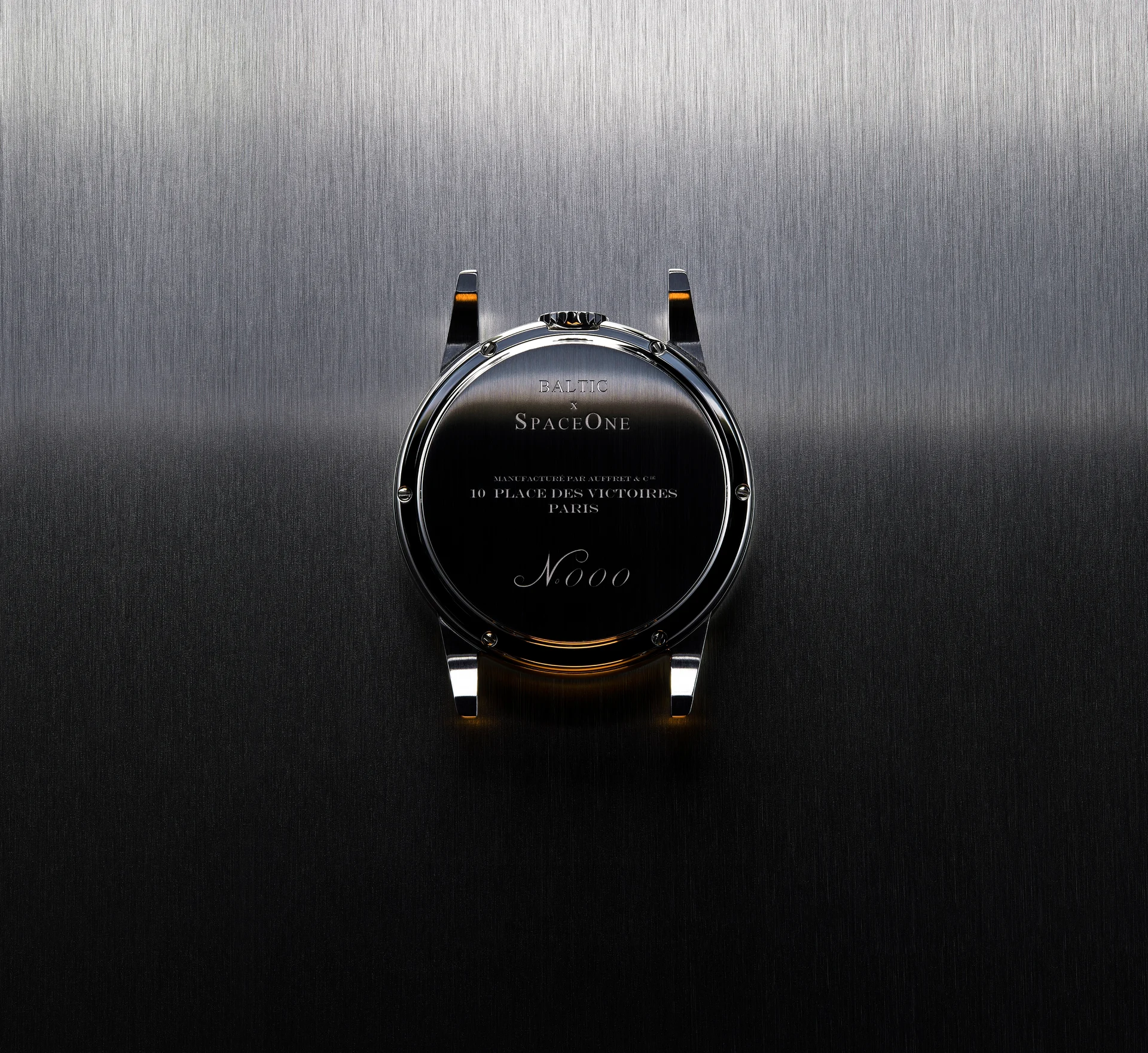
The watch was offered as a pre-order between May 12th and May 17th, 2026, with production limited strictly to the number of orders placed during that six-day window. Each piece is individually numbered on the caseback. Once the pre-order window closed, the watch was no longer available to order, with delivery to customers scheduled for November 2026. If you missed the window, your best bet is to keep an eye on the secondary market or reach out directly to Baltic or SpaceOne.
Top Lists
- anOrdain, Baltic, Elka, Furlan Marri, Havaan Tuvali, HEINRICH Watches, Laco, Ophion, Vario
- By Dan H.
- Astor & Banks, Baltic, Havaan Tuvali, Laco, MD Watches, STERNGLAS, Vario
- By Dan H.